

Average order value only matters when it improves profitable revenue, not just cart size. Ecommerce brands often raise AOV with deep discounts, weak bundles, or free shipping that hurts margins. The goal is to increase cart value through offers customers actually value while protecting margin, repeat purchase, and customer quality.
Make the cart bigger only when every AOV lift is measured against margin and repeat behaviour; otherwise you are training customers to buy only on price.
TL;DR – Increase AOV Without Sacrificing Margin or Repeat Purchases
- A Bigger Cart Is Not Automatically Better: AOV matters only when the additional revenue also improves margin and preserves repeat-purchase behaviour.
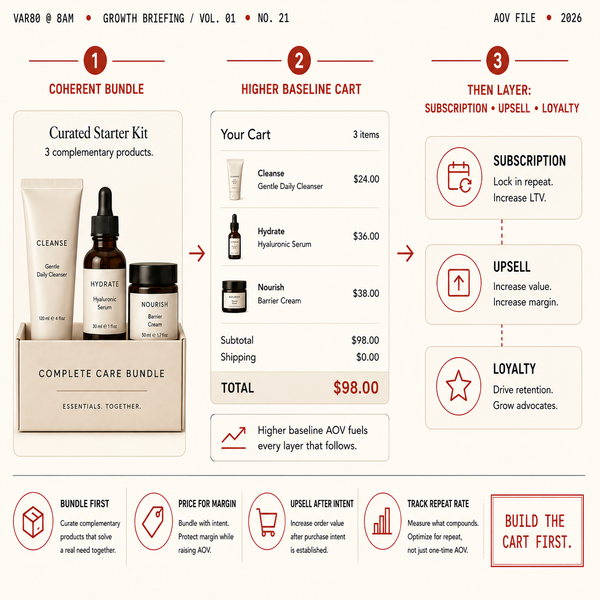
- Bundles Can Raise Cart Value Quickly: Complementary bundles, starter kits, and gift sets can increase spend by solving a customer need without relying on deep discounts.
- Use Thresholds and Discounts Carefully: Free-shipping thresholds, volume pricing, and tiered discounts should encourage natural additions while protecting contribution margin.
- Upsells and Cross-Sells Need Relevance: Premium upgrades and complementary products work when they match buyer intent and appear at the right point in the purchase journey.
- Subscriptions and Loyalty Should Build Long-Term Value: Use subscriptions for genuine replenishment products and loyalty to reward higher-value behaviour rather than creating permanent discount dependence.
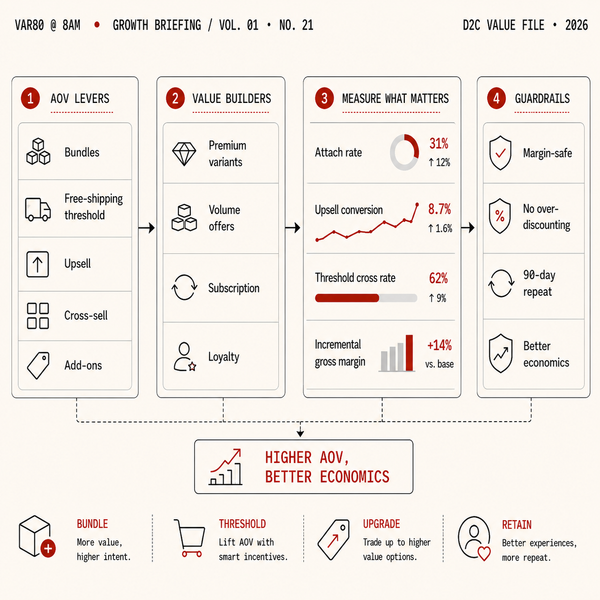
- Measure AOV With Margin and Retention: Track AOV alongside incremental gross margin, attach rate, conversion rate, and repeat purchases to distinguish profitable growth from an inflated cart.
What Is Average Order Value? AOV = Total revenue ÷ Number of orders, and nothing else
Average order value is a bookkeeping metric: take the total revenue over a period and divide it by the number of orders in that same period. It is not a proxy for profitability, margin, or lifetime value by itself. AOV describes the typical sale size, not whether that sale was good business.
Example: if a store sells ₹150,000 in a month across 150 orders, AOV for the month is ₹1,000. If the next month revenue rises to ₹165,000 but the store ran heavier discounts and AOV stays ₹1,100, the simple AOV increase masks whether profit rose or fell. Always compute AOV alongside gross margin per order and incremental margin from any offer you run.
Why Average Order Value Matters: Because it accelerates CAC recovery when the lift is profitable
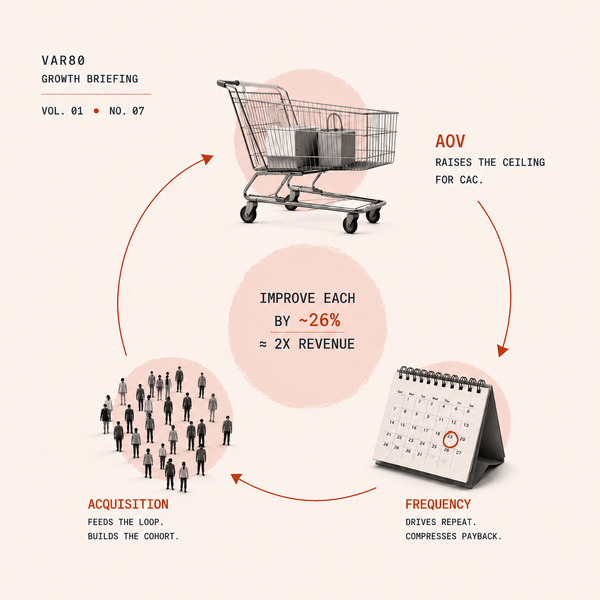
A higher AOV improves the revenue you record from each successful checkout, and when the uplift is driven by higher-margin items or attach-rate offers it shortens the time it takes to recover customer acquisition cost. That matters especially for paid channels where CAC is fixed per acquired buyer. If you raise AOV with margin-positive offers, each new buyer pays for their acquisition faster and becomes less expensive to serve across their life.
Beyond CAC, a healthy AOV enables product packaging that reduces shipment complexity and increases the average carried value per parcel. That can reduce per-unit fulfillment cost when you pivot from single-item shipments to consolidated, higher-value parcels.
Failure case: Any AOV lift that depends on steep percentage discounts will increase short-term revenue but reduce gross margin and weaken repurchase incentives.
12 Effective Strategies to Increase AOV

1. Implement Product Bundling. Bundles should raise per-order margin while solving a customer problem
Bundling works when the combination improves usefulness for the buyer and leaves margin intact for the seller. There are three practical bundle formats that work reliably: complementary bundles that solve a single job (for example shampoo + conditioner), starter kits that remove trial friction (a small kit that includes a travel size plus an accessory), and gift bundles that package best-sellers for gifting. Packs of two or three work better for most consumers than larger multipacks because they are easier to justify emotionally at checkout.
How to test in a week: pick two complementary SKUs with healthy margin, price the bundle slightly below the sum of individual prices (fixed-amount savings instead of deep percent discount), and run the bundle on product pages and in-cart recommendations. Track bundle attach rate and incremental margin per bundle sold.
Example experiment: if SKU A sells for ₹700 and SKU B sells for ₹500, offer a starter kit at ₹1,099 rather than a 20% bundle discount; the fixed-dollar incentive keeps messaging simple and protects margin math.
What can go wrong: poor pairing that confuses buyers (putting a premium non-related accessory with a budget consumable), or bundling low-margin SKUs that turn every bundle into a loss leader. Watch attach rates and gross margin per order, not just bundle sales.
2. Set Free Shipping Thresholds. Use thresholds to nudge AOV above margin-safe steps
Free shipping is a powerful nudge because shipping is a salient checkout cost. The trick is to set thresholds that are slightly above your current AOV and aligned with SKU steps so the uplift is sensible for customers and margin-safe for you. If your current AOV is ₹1,000, test thresholds at ₹1,199 and ₹1,299 rather than leaping to ₹1,499. The smaller step increases the likelihood a buyer adds a low-cost, high-margin item to cross the line.
Implementation note: show a progress bar in the cart that clearly states how much more the buyer needs to get free shipping. Progress bars create immediate, contextual urgency and boost the probability of an add-on. Track the conversion rate of carts that cross the threshold and the gross margin delta for those orders.
Failure case: setting the threshold too high relative to median basket size drives abandonment or forces heavy discounting around the shipping threshold. The correct threshold is the smallest step that meaningfully increases attach-rate without compressing margin.
3. Use Upselling and Cross-Selling Upsells lift margin; cross-sells lift relevance and attach-rate
Upselling and cross-selling are distinct levers and should be measured separately. Upselling asks a buyer to trade up to a premium version or larger size. It usually increases per-unit margin because premium variants carry higher gross margin or price without proportional cost increases. Cross-selling suggests complementary products that increase the usefulness of the purchase; cross-sells raise attach-rate and the basket's average number of SKUs.
Where to place each: upsells belong on product pages and in the cart as an upgrade option. Cross-sells work best as 'frequently bought together' modules and in post-purchase flows. Measure upsell conversion rate (percentage of product detail views that accept the upgrade) and cross-sell attach-rate separately.
Example: a customer buying a razor blade has a high propensity to add a travel case as a cross-sell and to move to a subscription or larger cartridge pack as an upsell. Failure appears when generic upgrades are shown to all buyers. If you push premium upgrades to bargain shoppers, conversion will drop and returns may increase.
4. Create Tiered Discounts. Offer spend-based savings that preserve margin tiers
Tiered discounts "spend more, save more" work because they convert marginal buyers into committed buyers at a predictable price. Use fixed-dollar or capped percentage offers that step up with spend. For example, test 10% off above ₹2,000 and 15% off above ₹3,500. The step design should reflect SKU price points so the customer only needs one or two natural additions to qualify.
Design rule: avoid an across-the-board percent that applies to everything. Instead, make the tiers conditional on categories or exclude low-margin SKUs. Track the incremental purchase value against the discounted margin: the real question is whether the incremental revenue contributes positive margin after the discount.
Failure case: over-discounting to chase AOV where each extra rupee sold is margin-negative. That produces inflated AOV but lower contribution margin and weaker repurchase signals.
5. Offer Volume Discounts . Use bulk pricing for consumables and repeat-use products
Volume discounts are a durable AOV lever for consumables (skincare refills, supplements, household staples). Customers who value convenience will trade capital for convenience when the per-unit economics look better. Offer simple quantity breaks (buy 2, save 10%; buy 3, save 15%) and present per-unit pricing so the math is transparent.
Volume discounts sit best on category pages and subscription onboarding flows. They reduce shipping frequency and increase LTV for replenishment categories when coupled with subscription incentives. Failure occurs when volume discounts cannibalize higher-margin single-item purchases; measure repurchase timing and per-customer gross margin to ensure the volume offer improves lifetime economics.
6. Offer Subscriptions for Repeat-Purchase Products. Turn AOV into recurring revenue
Subscriptions are a different AOV lever because they convert a one-time larger cart into predictable recurring revenue. 'Subscribe and save' offers work when your product is refillable or replenishable. Use trial-size subscriptions, refill reminders, and a simple cancellation policy to reduce friction. When subscriptions are priced slightly lower than one-off orders, the immediate AOV may not spike, but the monthly recurring revenue and LTV improve substantially.
How to present it: offer a first-order discount for a subscription that includes an option to add a one-off accessory or gift so the initial checkout AOV increases. Track ARPU for subscribers vs one-off buyers, and measure churn within the first three cycles closely, early churn negates subscription economics.
Failure case: applying subscription pricing to products with low repurchase intent. That creates churn and refunds. Only push subscriptions where product refill cadence is clear and predictable.
7. Implement a Loyalty Program. Reward higher spend without turning everything into a discount
Loyalty programs let you incentivize higher spend while keeping the economics off the price tag. Points that unlock VIP tiers, rewards above cart thresholds, early access to bundles, or occasional gift-with-purchase generate a sense of status and compound repeat behavior. Structure rewards so that meaningful benefits require commitment: for example, a VIP tier that requires three orders in 12 months or ₹10,000 in lifetime spend.
Where it succeeds: loyalty increases repeat purchase probability and average spend per visit because members perceive access to exclusive bundles and pre-release premium variants. Where it fails: if the rewards are thin or purely percentage discounts, the program becomes a discount engine rather than a retention tool. Measure incremental AOV among loyalty members and track repeat rate lift separately from discount-driven lift.
8. Showcase Premium Products. Make the premium choice the rational upgrade
Promoting premium variants or larger packs is an AOV strategy that relies on clear comparative messaging. Use comparison blocks on product pages that highlight ingredient quality, larger format economics, and long-term value. The premium SKU must have defensible differences: better ingredients, longer warranty, or additional accessories. If the premium option feels like a cosmetic label, buyers will not convert at scale.
Example execution: on the product page present a comparison of entry, standard, and premium—show per-unit cost, expected usage period, and a short justification for the premium price. Track the upgrade rate and returns for premium SKUs separately; warranty claims or dissatisfaction will erase profit quickly.
9. Create Limited-Time Offers. Use urgency selectively to push larger, profitable carts
Limited-time bundles, seasonal packs, and gift-with-purchase promotions can drive higher AOV when they add genuine value and are time-boxed. The urgency must be credible and inventory-backed where possible. Seasonal bundles for gifting are powerful because they reframe the purchase decision: buyers are buying for convenience and curation rather than price alone.
Design tip: tie limited-time offers to inventory or seasonal intent so the incentive feels relevant. Measure whether the uplift is one-time revenue or brings new buyers who return. Failure case: constant 'limited-time' messaging trains buyers to wait for deals. Use urgency sparingly and measure cohort retention for buyers who converted on those offers.
10. Provide Gift Wrapping and Add-Ons. Small add-ons increase cart value without much friction
Checkout add-ons gift wrap, personalization, faster delivery, samples, extended warranty, installation are high-margin ways to increase AOV. The key is to present them as optional, contextual choices at checkout with a clear incremental price. One-click add-ons on the checkout page reduce friction and lift attach rates, especially for buyers who are already committed.
Execute: present a compact set of 1–3 add-ons, with clear benefits and a simple price. Track add-on attach rate, average add-on revenue per order, and any changes to returns or support contacts that arise from offering warranties or installation. Failure case: too many choices slow checkout and reduce conversion. Keep the add-on set short and relevant.
11. Personalize Product Recommendations. Use history and behavior to raise attach-rate
Personalized recommendations, when done with relevant signals, increase attach-rate more reliably than generic modules. Use three signals in combination: product-level affinity (frequently bought together), customer behavior (browsing and past purchases), and quiz or preference data. A quiz-driven recommendation can place the perfect accessory in front of the buyer when intent is still forming.
Implementation steps: start with a simple "frequently bought together" widget on product pages, then A/B test a personalized widget that uses customer history. Measure attach-rate lift and downstream repeat behaviour for customers who accepted recommendations. Failure: poor personalization that recommends irrelevant or out-of-stock SKUs lowers trust and click-throughs; always ensure inventory-backed suggestions.
12. Optimize Your Checkout Process. Reduce friction and make smart one-click offers
A faster, clearer checkout improves conversion and creates space for revenue-positive offers. One-click post-purchase offers and progress bars nudging toward free shipping should be implemented only after checkout flow is streamlined. Reduce field count, make costs transparent, and use progress indicators so buyers understand how close they are to a reward or free shipping.
One-click offers after payment are convenient because they do not interfere with authorization. Test a small, high-margin add-on immediately after payment; measure attach-rate and the incidence of post-purchase support contacts. Failure case: intrusive cross-sells before payment increase cart abandonment. Post-payment and in-cart placements perform better for lift without sacrificing conversion.
13. Improve Product Pages So Buyers Trust Bigger Purchase. Trust is the multiplier for large carts
Bigger carts are riskier purchases for customers. Trust features reduce perceived risk and make buyers comfortable spending more. Use clear reviews, FAQs about usage and returns, high-quality images, short product videos showing scale or combined usage, guarantees, and explicit return terms. For bundles and premium SKUs, include a short comparison that shows why the larger spend is safer or smarter.
Checklist for a page promoting larger purchases: product proof points, a short FAQ addressing common objections, clear usage instructions, and a satisfaction guarantee or simple returns policy. When buyers can see why a bigger pack saves time or money per use, they are more likely to accept higher AOV offers. Failure case: poor or missing proof increases returns and support costs on expensive carts.
Measuring Success. Track AOV with margin, attach-rate, and repeat behaviour, not in isolation

Measure AOV alongside a compact dashboard of related metrics. Key metrics to track are AOV, conversion rate, incremental gross margin per order, bundle attach rate, upsell conversion rate, free-shipping threshold performance, and repeat purchase rate over 30–90–365 day windows. This set shows whether AOV moves are profitable and whether they change customer behaviour.
|
Metric |
What it shows |
How to use it |
|
AOV |
Average revenue per order |
Use as the high-level signal; always view with margin |
|
Incremental gross margin / order |
Profitability of add-ons, bundles, and discounts |
Stop offers that reduce incremental margin below target |
|
Bundle attach rate |
Share of orders that include the bundle |
Inform bundle rework and merchandising |
|
Upsell conversion rate |
Effectiveness of upgrade messaging |
Refine page copy and placement |
|
Repeat purchase rate (30/90/365) |
Whether AOV lift harms or helps retention |
Prioritise tactics that preserve or lift repeat behaviour |
The takeaway is that any AOV increase must clear a margin and retention bar. If AOV rises while incremental gross margin falls or repeat rate drops, the tactic is harming long-term economics.
Common AOV Mistakes to Avoid. Mistakes that look like growth but aren't
- Irrelevant upsells shown to all visitors, which reduce conversion and increase returns.
- Too many pop-ups and forced modals that interrupt purchase flow and damage conversion.
- Over-discounting to hit arbitrary spend thresholds, which destroys margin and trains customers to wait for price drops.
- Poorly designed bundles that mix low-margin items with high-margin items and shift profit to loss.
- Ignoring post-purchase behavior if buyers who accepted the AOV offer don’t return, the lift is short-lived.
Avoid these by running short experiments, measuring incremental margin and repeat rate, and keeping offers relevant to buyer intent.
Final Thoughts. Treat AOV as a controlled experiment, not a vanity metric
Making bigger carts profitable and repeatable requires a playbook rather than a single tactic. Start by mapping which tactics are margin-raising (upsell to premium, premium variants), which raise attach-rate (cross-sell, recommendations), and which convert one-time AOV into recurring value (subscriptions, loyalty). Run small experiments, measure incremental margin and repeat behaviour, and only scale winners that clear both short-term and lifetime economics.
Quarterly operational directive: this quarter, run a single prioritized experiment that aims to increase AOV while protecting per-order gross margin by at least X% (set X using your margin data). The single action is: pick one product family with healthy margin, create a 2–3 SKU complementary bundle with a fixed-dollar incentive, run it on the PDP and cart, and measure bundle attach rate, incremental margin per order, and 90-day repeat for buyers who purchased the bundle.
Make the cart bigger only when the business benefits from it. Bigger without better is not growth. Bigger with margin and repeat behaviour is how commerce becomes sustainable.
Your AOV Is Not Fixed. Your Offer System Is.
Var80 helps ecommerce brands build bundles, upsells, subscriptions, free-shipping thresholds, and post-purchase workflows that increase cart value without relying only on more traffic.
Leave a comment