


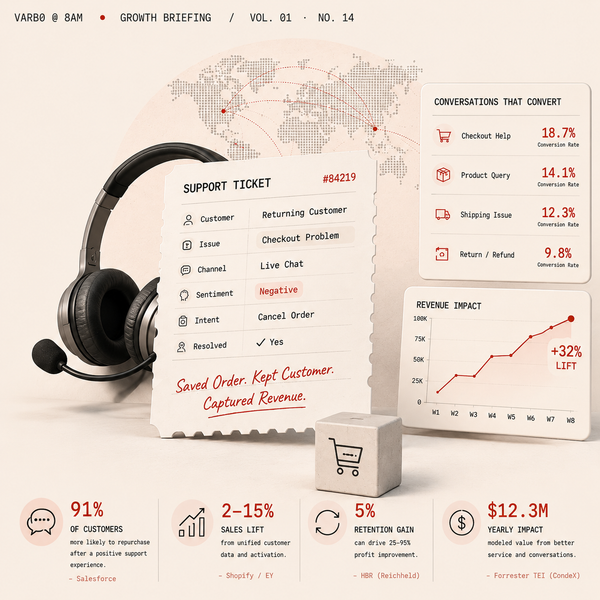
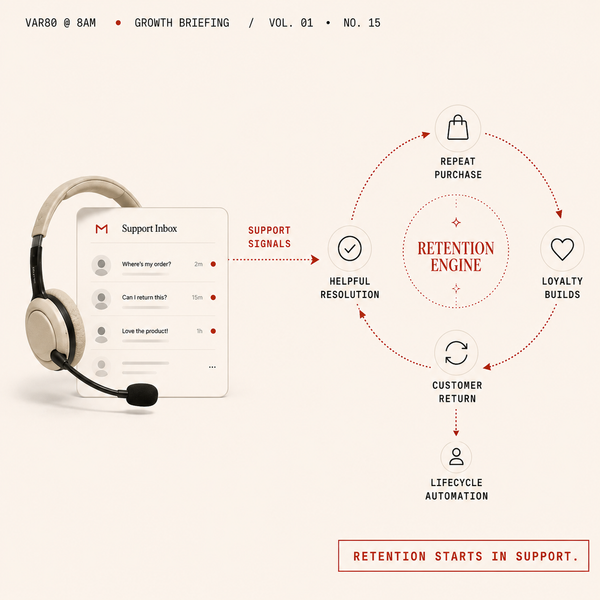
Support conversations contain some of the strongest marketing signals in ecommerce. Tickets and call transcripts reveal purchase intent, churn risk, product-fit questions, refund concerns, and copy ideas before they appear in dashboards. When these signals are connected to customer profiles, marketing can target better, retain faster, and stop wasting spend on broad audiences.
76% of customers expect consistent interactions across departments, yet 54% report that sales, service, and marketing do not share information.
TL;DR – Your Best Marketing Signals May Be Sitting in Support Tickets
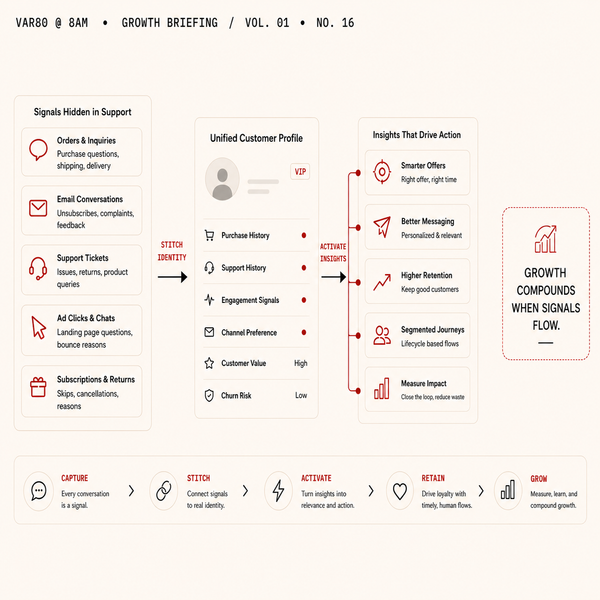
- Support Is a Customer Intelligence Layer: Tickets and transcripts reveal purchase intent, objections, product friction, churn risk, and customer language that traditional marketing dashboards often miss.
- Support Signals Can Predict Churn Earlier: Ticket type, escalation frequency, and language such as “cancel” or “refund” can identify at-risk customers before churn appears in retention reports.
- Activation Beats Perfect Data: Start by mapping a few high-confidence support events to specific revenue actions instead of waiting for a perfect CDP or customer data model.
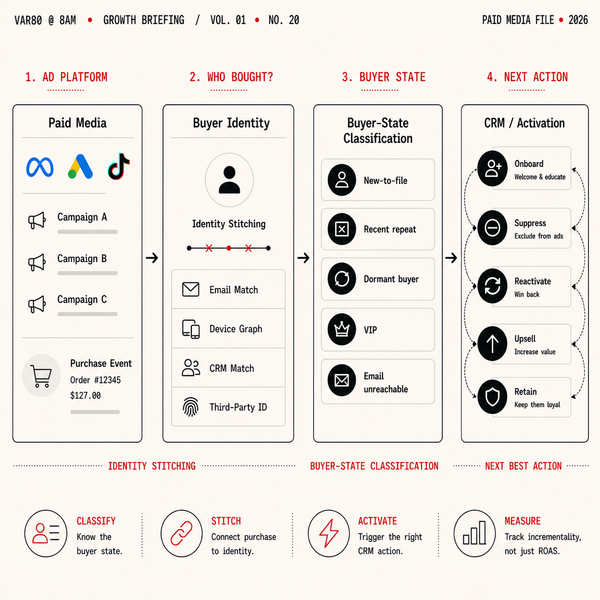
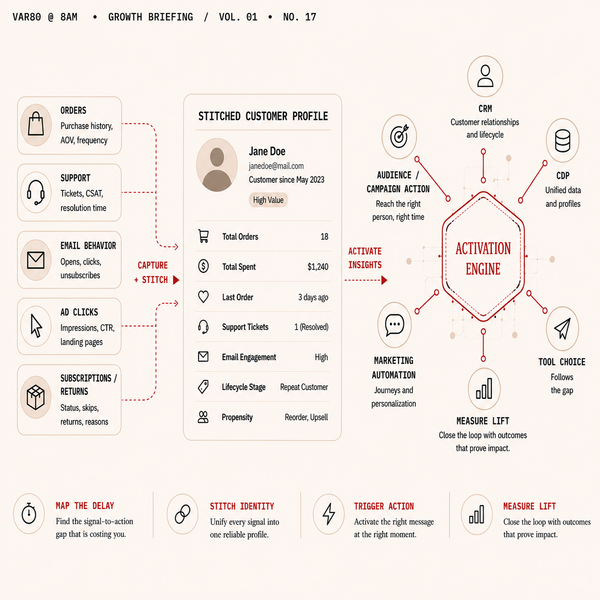
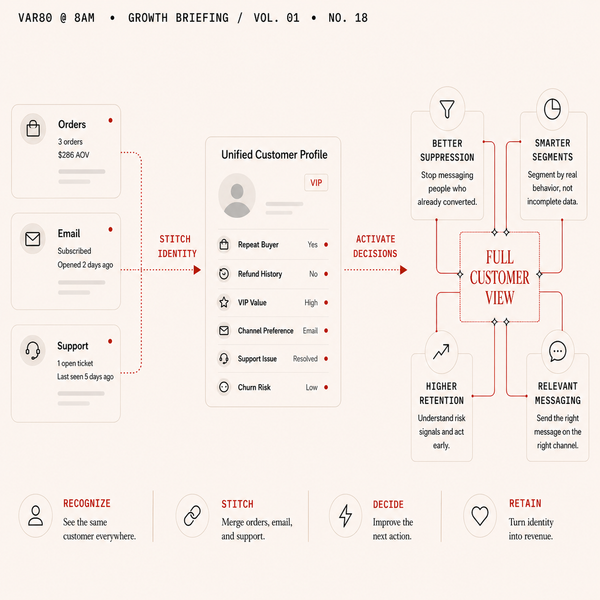
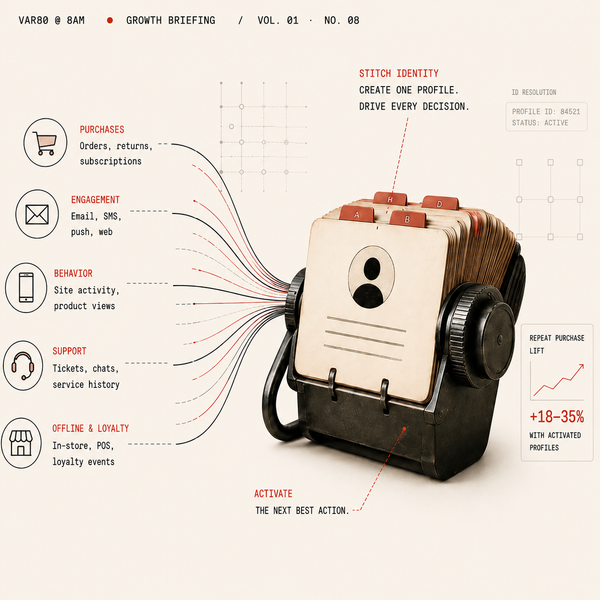
- Identity Stitching Makes Support Data Actionable: Connecting support events to known customer profiles allows marketing to turn conversations into CRM segments, retention flows, and paid-media audiences.
- Customer Language Should Feed Marketing: Repeated questions, objections, and product-fit concerns can become FAQ content, email subject lines, ad messaging, and new creative angles.
- Turn Support Tags Into Revenue Actions: Use signals such as refund intent, product-fit questions, and lapsed VIP status to trigger winbacks, content pushes, reactivation campaigns, and targeted audiences.
Support Conversations Are the Customer Intelligence Layer Marketing Ignores
Support transcripts are not an operational log; they are a continuous field study of friction, objection, and intent. Every support ticket carries three types of information at once: a symptom (the explicit complaint), a latent motive (why the customer searched or bought), and an outcome intent (the action they plan, from "refund" to "upgrade"). Because support sees the moment when expectation and reality collide, its conversations surface product gaps and content opportunities that directly influence conversion and retention.
Enterprises often treat support as a cost center, and the outcomes follow that decision. The average company runs a very large set of applications and integrates only a minority, which creates the technical plumbing that hides support signals from marketing. The vendor literature and the research pack assembled for this brief make this explicit. The Salesforce analysis reproduced in the research pack documents that customers expect consistent cross-department experiences and that more than half perceive the opposite when it comes to information sharing. That mismatch is the organizational explanation for why support knowledge does not reach marketing.
When support is left isolated, every high-fidelity observation it makes becomes a closed-loop insight that never changes upstream behavior. For example, repeated product-fit questions that appear in chat transcripts prove a content gap: customers ask on chat, they call to confirm a sizing or compatibility detail, and they abandon cart when the doubt is unresolved. Zendesk clients have used support reporting to surface those repeat questions, and the resulting FAQ pages drove organic traffic and reduced repeated tickets. That simple cycle is a direct revenue lever: fix the content gap, reduce friction, lift conversion without increasing CAC.
There are operational objections to putting support in the same room as marketing. Identity is messy. Events are noisy. Yet the practical path is not perfection first; it is activation-first. Pull events from support systems, reconcile identity by email or phone, tag the profile with the issue, and push a small segment to an automation destination. That single loop converts a qualitative complaint into a content hit, a campaign, or a cross-sell opportunity.
The Signals That Predict Who Stays and Who Leaves Live in Tickets, Not Dashboards
Traditional retention metrics are lagging and aggregate. Net Promoter Score and monthly cohort retention tell you that you lost customers; they do not show who will leave tomorrow. Support-derived indicators, by contrast, act as early-warning signals that identify cohorts at elevated churn risk.
Ticket-to-churn is an operational KPI
You can define *ticket-to-churn* as the share of customers who file a support ticket and subsequently churn within a predefined window. This is not a fancy statistical construct. It is an operational KPI that belongs in monthly marketing and retention reporting because it connects a concrete operational event to a revenue outcome. Different ticket categories carry different multipliers. Billing and refund tickets tend to predict imminent churn more reliably than basic UX questions, while product-fit complaints often predict longer-term dissatisfaction that shows up as lower lifetime value. In practice, teams should track ticket-to-churn as a cohort metric, stratified by ticket type and customer value band, then use those multipliers to prioritize retention spend.
A retail client used support tags to identify a product-fit complaint that disproportionately affected a VIP cohort; when the product was re-described and targeted content was pushed to affected VIPs, the cohort's churn fell measurably. Twilio/Segment customers included in the research pack found that escalation events correlated with roughly a twofold increase in churn risk within six weeks in specific use cases; that finding is an operational pattern rather than a universal constant, but it is the exact kind of multiplier that should change how marketing budgets are allocated across cohorts.
Language patterns are early-warning signals
Escalation words are higher-fidelity predictors than a single satisfaction score. The presence of terms such as "cancel", "refund", or "charged twice" in a transcript signals a concrete action intent and therefore deserves heavier weight in a retention model than a passive negative sentiment tag. Natural language processing can assign weights to these intent tokens and surface a short list of customers requiring immediate intervention. In simple operational models the weight is a multiplier on the base churn probability conditioned on recency, frequency of tickets, and customer value. Because these tokens are explicit calls to action, they require one immediate response: route the customer into a retention flow, then escalate to human outreach if the automated flow fails.
There are failure modes to acknowledge. Not every heated message is predictive; some customers use aggressive language as a negotiation tactic and then repurchase. The correct operational response is not to treat every escalatory message identically but to combine intent tokens with behavioral context: recent spend, historical return rate, and segment value. That is the pragmatic work of converting transcript signals into a high-precision retention trigger.
Activation Beats Perfection: Turn Support Signals Into Campaigns This Quarter

Most organizations buy analytics first and activation second. The research consensus favors the opposite approach. McKinsey's work on personalization shows clear revenue upside when personalization is activated. Choose a small set of triggers, map each to a single revenue action, and measure. Speed produces learning; waiting for perfect identity and data hygiene usually produces nothing.
Activation over perfection wins early ROI
A simple activation loop produces fast ROI. Take a 'refund-intent' tag on a 30-day lapsed VIP; push that small, identity-stitched segment to an automated winback flow in your email platform and run a human follow-up for those who do not re-engage. Exporting stitched VIP segments to Brevo and Meta produced noticeable reactivation in early deployments. Those tactical moves require only a minimal identity guarantee and a healthy feedback loop, not a full CDP implementation.
One event should map to one revenue action
Complexity kills throughput. The right early discipline is to map one event to one revenue action. If a customer files an escalation ticket with explicit refund language, trigger a winback and escalation sequence. If a customer asks repeatedly about sizing or fit, trigger a fit-content push and a cross-sell for accessories. That one-to-one mapping creates an operational runway: each automation is small, measurable, and iteratable. It also forces the org to prioritize the highest-fidelity signals rather than drowning in a long backlog of low-confidence use cases.
Three quick-win triggers to implement first
First, re-engage recent high-value customers who have a support ticket tagged 'refund intent' by sending a conciliatory email flow and opening a human retention ticket if the automation fails. Second, turn repeat product-fit questions into targeted content pushes; teams that surfaced fit-related tickets in support and published FAQ assets saw search traffic and a reduction in repeat tickets, as Zendesk reporting illustrates. Third, export support-segmented VIPs into Meta as custom audiences to tighten retargeting efficiency; the segments exported from a stitched profile reduced wasted ad spend versus naive behavior-only audiences.
All three of these triggers are operationally cheap: they need a tag, a minimal identity match, and a push connector to your marketing tool. The aim is not to perfect the data model; the aim is to move signals into action so the business learns what works.
If Your Profiles Aren't Stitched, Personalization Will Always Be Guesswork
A unified profile is not a vanity project. It is the gatekeeper for personalization. Identity resolution is the decision that determines whether a support event turns into an attachment on a known customer or becomes an orphaned row in a support CSV. Connector breadth and identity guarantees matter far more for activation than the prettiness of dashboards.
Identity resolution is a product decision
Resolving identity across support, web, and CRM is not merely an engineering task. It is a product decision about what marketing can do in real time. The email and phone are the pragmatic anchors for identity matching. Where those fields exist, many events become immediately actionable. Where they are missing, marketing must accept a delayed batch approach or invest in a capture flow to collect identifiers. This trade-off is the essential product decision: invest engineering time to guarantee identity now, or accept a higher-latency activation loop and smaller initial ROI.
Integration patterns matter. Choose the right trade-offs
Teams face a choice between API/webhook real-time patterns and ETL batch patterns. Real-time ingestion and identity stitching enable immediate automations and faster learning. Batch ETL solves many scale problems with less engineering overhead, but it adds days to the reaction window and reduces the value of time-sensitive signals like refund intent. Small teams should prefer a minimal real-time pipeline for high-fidelity events and batch for low-value historical aggregation. That hybrid approach yields activation without full platform rollouts.
Conversation Analytics Is Not a Nice-to-Have — It’s the Measurement Layer for VoC
VoC must be more than anecdote. Conversation analytics converts qualitative transcripts into quantifiable signals: topic extraction, sentiment, and intent labels become audience builders. NLP is the only practical way to scale the work of reading thousands of call transcripts, chat logs, and emails. Properly validated topics then become the inventory marketers use to prioritize content, product fixes, and campaigns.
Topic extraction scales what humans cannot
NLP topic extraction automates the classification of emergent complaints and questions. The right implementation validates topics against revenue signals rather than against human intuition alone. For example, a sudden spike in 'fit' topics should be tested against conversion and return rates. If the topic correlates with lower conversion or higher returns, it moves from being a curiosity to a prioritization metric for product and content teams. Qualtrics clients have used VoC topic trends to sequence product fixes and content creation.
Track signal drift, not just sentiment
Sentiment scores are fragile and often noisy. A more useful operational metric is topic velocity: the rate of change in topic volume over time. A sharp rise in a new complaint topic is a prioritization signal. Topic drift matters because it shows what has recently changed for customers, and it often matters more than the average sentiment over a quarter. Set alerts for unusual velocity and route those alerts into a lightweight prioritization process that includes marketing, product, and support ownership.
Ecommerce Teams Should Use Support Tags as Targeting Signals, Not Vanity Data
For e-commerce teams the difference between a tag and a signal is whether someone runs a campaign from it. Support tags are not just metrics to decorate dashboards. When connected to identity, they become the targeting signals that outperform brute-force behavioral audiences because they come from explicit customer language.
A VIP Who Lapsed 30 Days Ago Deserves Different Treatment
Support-derived segmentation must change channel choice and offer economics. A VIP who lapsed 30 days ago after an escalation deserves an expensive, high-touch outreach because their expected lifetime value justifies it. The pre-built VIP segments exported to Brevo and Meta allowed teams to deploy differentiated flows for high-value users and produce measurable reactivation. Treating every lapsed user the same is the precise error support signals cure.
Use support tags to seed lookalike audiences
Support-driven segments translate directly into higher-quality acquisition when used as seeds for advertising. Export the stitched segment to Meta, build a lookalike model, and use it to target users who resemble customers who asked specific product-fit or accessory questions. Lookalikes seeded from support tags reduce wasted ad spend compared with naive behavior-only audiences because they encode explicit product interest expressed in natural language.
The Stack Matters Only When It Moves Signals Into Action
Vendor pages promise features. Operators need connectors, identity guarantees, and predictable push paths. The right purchase decision is intensely practical: buy the thing that guarantees connectors and identity, or build a small activation pipeline that does it. Teams that prioritized real-time ingestion and identity stitching achieved faster activation than teams that waited for a full CDP rollout.
Pick for connectors and identity guarantees
When evaluating platforms, prioritize connector breadth to critical marketing destinations and explicit identity guarantees. The difference between a platform that can export an auto-updating VIP segment to Brevo and one that cannot is not a UI nuance. It is the difference between running a revenue-driving flow tomorrow and waiting months to retrofit connectors. Twilio Segment clients highlighted the same point in vendor materials: connectors and identity are the gating problems for activation-first teams.
Small teams should stitch first and automate second
The minimum viable pipeline beats a perfect CDP. Start with a webhook or API that pushes ticket events into an identity layer that performs best-effort matching on email and phone. Then wire simple outbound connectors to your email and ad platforms. Once flows are running and the business is measuring impact, iterate on additional hygiene, enrichment, and analytics. That order of operations preserves momentum and delivers measurable revenue uplift while larger platform choices are still being evaluated.
Customer Language Should Drive Message Strategy — Not Gut Feelings

Customer language is headline-grade creative. The phrasing customers use in support transcripts makes higher-performing subject lines and ad copy than most brainstorms. When marketing recycles the exact question or objection a customer used in support, the message lands with higher relevance because it mirrors the customer's frame of mind.
Question → Content → Subject line
The fastest content loop is extract the customer question, publish a short FAQ asset, then reuse that phrasing in email subject lines and ad copy. SEO teams in the research pack turned top support questions into blog posts that ranked for long-tail queries. The same phrasing lifted open rates when used verbatim in subject lines. That pattern is low-cost and high-impact. It requires only a topic extraction pipeline and a content cadence that prioritizes rapid publishing over perfection.
A/B test before you personalize aggressively
Personalization driven by support language should be tested in controlled experiments. When you shift from generic copy to support-language-driven personalization, run A/B tests to confirm uplift and monitor for over-personalization errors. Use a staged rollout that begins with top-performing, high-confidence segments and expands as evidence accumulates. The research pack underscores that personalization lifts are real, but they are safest when activated through measured experiments rather than large, untested programs.
Stop Treating Support as a Sink; Make It Marketing's Most Reliable Signal
The uncomfortable truth is organizational, not technological. Marketing's measurement problem is that valuable signals are trapped in a different department's workflow. Fixing that is less a data-science problem and more an operational one: route support events into identity-resolved profiles, prioritize three support tags, and build automations that produce revenue this quarter.
Route support events into identity-resolved profiles and activate three simple automations (winback for escalation intent, FAQ content push for repeat product-fit questions, VIP reactivation for lapsed high-value customers). That one directive captures the operational lift available without a multi-quarter platform rollout. Data CX deployments pulled events from Shopify, booking tools, quizzes, and chat; stitched identities; and pushed segments to Brevo and Meta to run targeted flows that produced immediate reactivation and reduced wasted ad spend.
There are governance and failure cases to name. Not all transcripts predict churn. Some escalatory language is bargaining behavior and should be conditioned on historical value and recent activity. Connectors will fail. Payloads will be missing email or phone. The right governance model is a staged activation: implement simple, auditable automations for high-fidelity events; instrument the outcomes; iterate on scope and identity guarantees.
Do this quarter what you can do this quarter. Map three support tags to three automated campaigns. Measure revenue impact. If the experiment shows lift, expand. If not, adjust the weights and try again. Waiting for perfect data guarantees no outcome. Activation-first teams win.
By leaning on support as a discovery engine, marketing gets a continuous source of high-fidelity signals for creative, content, and spend decisions. The vendors in the research pack, from Salesforce to Twilio Segment, frame the technical knobs you need. The playbook you should run: pull, stitch, push, measure. Do not treat the support inbox as an archive; treat it as a primary signal stream.
Stop Letting Support Signals Die in Tickets
Var80 helps ecommerce brands turn support conversations into CRM segments, retention triggers, product insights, and workflow experiments that marketing can actually use.
Leave a comment