

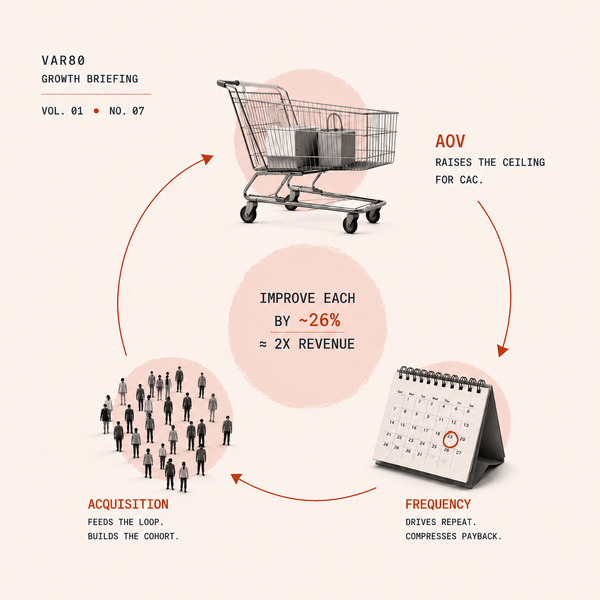
Bundles are often the fastest AOV lever because they increase cart value at the point of decision. Instead of relying first on loyalty, subscriptions, or upsells, ecommerce brands can use margin-aware bundles to help customers buy more in one checkout while reducing choice overload and protecting profitability.
Bundles increase AOV by encouraging customers to purchase multiple items in one transaction and simplify decision-making, reducing choice overload and the "pain of paying."
TL;DR – Build the Cart First. Everything Else Fits on Top.
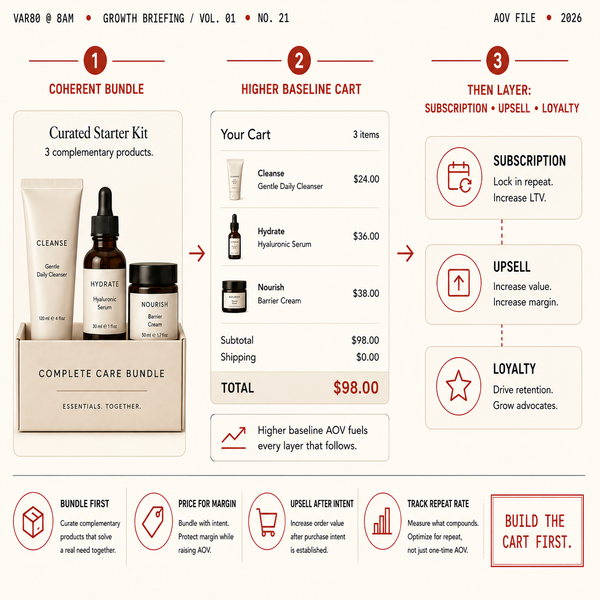
- Bundles Should Be Your First AOV Lever: Increase the value of the initial cart before investing heavily in loyalty, subscriptions, or sophisticated personalization.
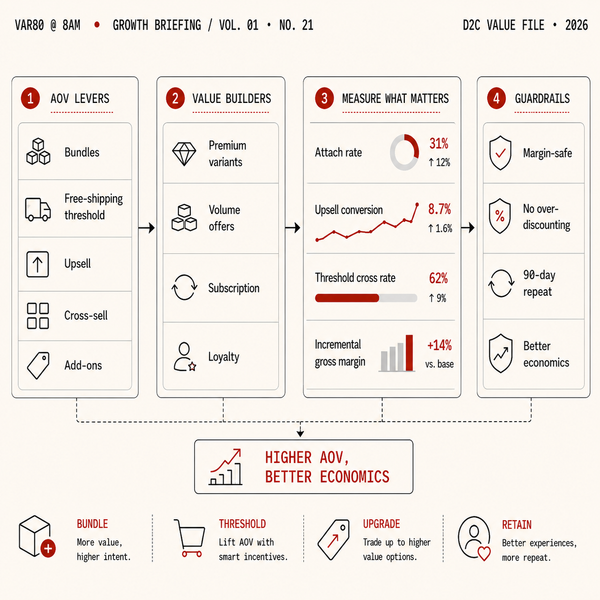
- The AOV Stack Has an Order: The stronger sequence is bundle → subscription → upsell/cross-sell → threshold → loyalty, with each layer building on stronger baseline cart economics.
- Good Bundles Solve a Problem: Starter kits, routines, complementary products, and refill combinations simplify buying decisions and outperform random SKU pairings.
- Higher AOV Is Meaningless If Margin Falls: Measure incremental AOV alongside blended gross margin because discounts, fulfillment costs, returns, and cannibalization can turn a bigger cart into a false win.
- Subscriptions, Upsells & Loyalty Come Next: Establish the larger cart first, then use subscriptions for recurrence, upsells for incremental revenue, and loyalty to reinforce higher-value behavior.
- Measure Whether the Lift Actually Compounds: Track incremental AOV, blended gross margin, repeat purchase rates, and buyer type to determine whether a larger cart is creating durable customer economics.
The Normal Playbook Gets the Order Wrong
The startup script most teams follow is familiar: build a loyalty program, buy an upsell app, then layer subscriptions and personalized flows. The result is a menu of tactics applied in parallel. That menu rarely changes the baseline economics because each tactic assumes the cart is already large enough to make recurrence and VIP status profitable.
The stronger proposition is a sequence: bundle → subscription → upsell → cross‑sell → threshold → loyalty. Sequencing matters because each layer plays a different structural role. Bundles lift the baseline cart value. Subscriptions convert a larger baseline into recurring revenue. Upsells and cross‑sells work after intent is established. Free‑shipping thresholds nudge cart composition. Loyalty then compounds higher spend into repeat behavior. Presenting these as independent tools is the failure mode; sequencing them correctly is the operating fix.
Amazon’s recommendation engine is the simplest proof that pairing products increases basket size when the pairing is framed as a package rather than a separate suggestion. The algorithmic module Amazon calls "Frequently Bought Together" is an explicit example of bundling at scale driven by co‑purchase signals and converted into a merchandising primitive.
BigCommerce’s practical guidance on pricing, bundle types, and when to use which format shows that merchants who treat bundling as primary gain a stable lever for AOV before they invest in heavier lifecycle systems.
The practical implication is immediate: stop treating bundles, subscriptions, upsells, and loyalty as separate projects. Treat offers as layered infrastructure where bundles are the foundational layer that funds and stabilizes everything that follows.
Bundles Raise Baseline Cart Value Faster Than Any Other Lever
Bundles are the easiest first move because they do not require perfect identity, deep personalization, or a sophisticated lifecycle engine. They can be merchandised on product pages, in the cart, and at checkout where intent is highest. That placement converts existing purchase intent into larger paid orders on first purchase, which is a crucial operational advantage.
Two forces explain why bundles lift AOV immediately. The first is psychology. When a bundle is framed as one coherent solution, the customer treats the price as a single decision instead of multiple choices. The second is math. A bundle that swaps a percentage discount for a sensible pack size converts intent that already exists into more revenue in one transaction.
Why reducing choice increases conversion
Simplifying decision paths lowers cognitive friction and reduces the pain of paying. Behavioral writeups of bundling explain this plainly: well‑constructed bundles feel like a single product with a higher value anchor, not three separate items. Omnia Retail’s survey of bundling psychology lays out the mechanism and notes that coherent bundles can deliver meaningful uplifts in basket size, with vendor examples pointing toward up to a 30% uplift in AOV when pairings are chosen correctly and presented as a solution rather than a discount.
That principle is the reason Amazon’s "Frequently Bought Together" module works: it reduces the decision surface by surfacing a ready‑made solution constructed from co‑purchase behavior rather than asking the buyer to assemble their own combination from scratch.
Why first‑order revenue matters more than deferred loyalty
Loyalty programs and subscription investments compound over time, but they cost money to design, acquire members for, and measure. The practical constraint for most teams is capital and statistical power. Lifting revenue on first orders creates budget and sample sizes to test the downstream mechanics. Klaviyo’s benchmark materials demonstrate how lifecycle flows amplify revenue once there is more to monetize. But the fiscal reality is that flows perform better when the baseline per‑order value they work on is already higher. In short: you cannot compound what you have not first raised.
Rebuy and other vendors show merchant case work where bundles deliver immediate AOV lifts on PDP and cart. Those results are not hypothetical. They are the financial oxygen that makes subscription and loyalty experiments viable.
Not All Bundles Are Equal.Formats and Pricing Decide If You Win or Lose
Design is not optional. A poorly constructed bundle simply inflates AOV while destroying margin and training customers to expect discounts. The operating decision is to design bundles that raise incremental AOV while protecting gross margin. That decision has three parts: format, discount math, and fulfillment trade‑offs.
Packaged solution bundles outperform random pairings
The bundle that wins is purposeful. A curated solution bundle, a starter kit, a complete routine, or a refill plus accessory maps to a use case and justifies a higher anchor price. Random SKU pairings framed as "you may also like" are weak. Market‑basket analysis helps find pairings that actually co‑purchase, but the merchant must then wrap those pairs in a product narrative that makes the combined purchase feel inevitable.
Peel Insights explains how association metrics like support, confidence, and lift identify high‑probability pairings. Those metrics tell you what customers already buy together. The job of product and merchandisers is to convert the statistical pair into a narrative bundle: the narrative is what shifts perception from multiple purchases to one higher‑value purchase.
Discount math that preserves margin
The correct pricing model for a bundle is contribution‑margin thinking, not headline percentage discounts. BigCommerce and Quikly both describe practical frameworks: compute the blended margin you need, set the bundle price to meet that blended margin, and choose fixed‑dollar discounts for low‑priced SKUs where percentages look too steep. Fixed‑dollar offers protect the economics of replenishment SKUs and make margin predictable.
Quikly’s guide walks merchants through the formulas and examples that turn a marketing discount into a margin‑consistent offer. The key rule is to price bundles so that incremental revenue is positive after product and fulfillment cost, not just to increase AOV at all costs.
Inventory, fulfillment, and packaging trade‑offs
Dispatching three small items in one shipment can look simpler on paper but can add dimensional weight and packaging cost that eats the margin lift. Bundle design must account for SKU velocity and the true landed cost of the bundle. Shopware and BigCommerce product docs show that modern platforms treat bundles as first‑class product objects, which makes inventory accounting cleaner and reduces fulfillment surprises.
The failure case to name is obvious. A bundle that sells well but generates returns, costly packaging, and low repeat rates is a false win. Operational owners must model fulfillment cost and return behavior into the blended margin target before the bundle launches.
Offer Architecture: Bundles Are the Foundation of the AOV Growth Stack

Think of offers as infrastructure, not campaigns. Bundles raise baseline cart value. Subscriptions convert that baseline into recurring revenue. Upsells and cross‑sells extract additional value after a purchase decision is made. Thresholds nudge cart composition. Loyalty compounds higher spend into repeat behavior. The correct sequence reduces friction and preserves incrementality.
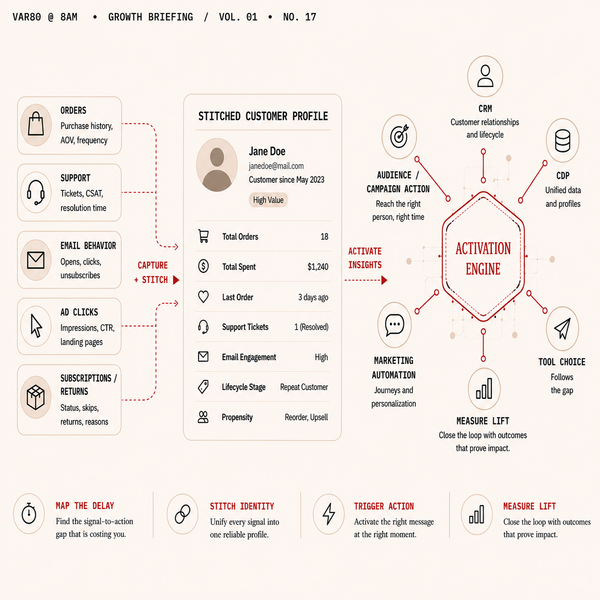
Shopify’s enterprise guidance on unified customer profiles and Twilio Segment’s identity resolution documentation are relevant here because they show why subscription and personalization succeed only when the customer and product signals are reliably stitched before activation.
Below is an operational taxonomy that forces decisions rather than slogans. Place this table adjacent to your offer planning documents and use it to assign owners and metrics to each layer.
|
AOV Layer |
What It Changes |
What Can Go Wrong |
How to Measure |
|
Bundles |
Raises baseline cart value by converting intent into multi‑item purchases |
Discounting destroys margin; poor pairings cannibalize full‑price sales |
Incremental AOV, blended gross margin, attach rate by SKU |
|
Subscription |
Turns one larger cart into recurring revenue and lifetime value |
Starting price too high increases churn; launched too early prevents acceptance |
Subscription ARPU, churn at 30/90 days, cohort LTV |
|
Upsell / Cross‑sell |
Extracts incremental revenue after commitment |
Offered before intent reduces attach rate; timing cannibalizes bundle economics |
Attach rate post‑selection, incremental margin, repeat rate |
|
Free‑shipping threshold |
Nudges cart size without direct price cuts |
Generates filler low‑margin items if threshold misaligned |
Threshold attach rate, margin on added SKUs |
|
Loyalty |
Rewards higher spend and compounds retention |
Discount‑led loyalty erodes margins and trains spend thresholds |
Repeat rate, retention cohorts, revenue per member |
Operator takeaway. Build the stack in order. Launch a bundle experiment that meets blended margin targets. If it succeeds, sequence a subscription test that enrolls the bundle buyer at a pragmatic price point before you invest in a points‑based loyalty program.
How to Integrate Bundles With Upsells and Loyalty Without Cannibalizing Margin
Integration is a timing and messaging problem. The wrong timing turns incremental behavior into cannibalization. The right timing preserves incrementality and increases lifetime value.
Offer timing that preserves incrementality
Upsells work after commitment. Presenting an upgrade before the customer has accepted the bundle is the common error. Instead, the higher‑probability sequence is selection → confirmation → post‑selection upsell or post‑purchase one‑click upgrade. Rebuy’s merchant work shows higher attach rates when contextual upsells are offered after the bundle selection, not as the initial point of friction. That sequencing raises attach rates without displacing the bundle.
Similarly, subscriptions should usually follow a bundle acceptance when the product is replenishment oriented. Recharge’s subscription benchmarks show that subscription ARPU and retention improve when the starting cart is meaningful; starting subscriptions on a low baseline raises churn risk and reduces cohort LTV.
Designing loyalty for status, not discounts
Loyalty should be positioned as access and recognition for higher spend rather than an additional discount. Loyalty that merely replicates the bundle discount creates a race to the bottom. Use loyalty to reward the behavior bundles create. Examples include early access to new bundles, expedited service for bundle buyers, or tiered replenishment benefits that compound without a constant coupon flow. Quikly and merchant playbooks demonstrate how non‑discount perks preserve margin while reinforcing AOV behavior.
The failure mode is simple. If your loyalty program becomes the place customers expect to get the discount, then you have funded retention through margin collapse instead of structured value.
Measure the Stack : Dashboards and Guardrails That Prevent False Wins

AOV alone is a weak signal. AOV can rise while blended margin falls. AOV can rise while repeat rate drops. The dashboard must connect incremental AOV to margin, buyer type, and repeat behaviour so the team can act without being misled by raw uplift.
The recommended minimum dashboard for any bundle experiment is four signals that together answer the business question of incrementality and durability.
|
Metric |
What It Shows |
Why It Matters |
|
Incremental AOV |
Net lift attributable to the bundle |
Captures whether the offer added revenue beyond baseline |
|
Blended gross margin |
Profit after product and fulfillment costs |
Prevents AOV from masking margin erosion |
|
Repeat purchase rate (30/90/180) |
Whether buyers return after the larger order |
Shows whether the bundle created durable value |
|
Buyer type breakdown |
New vs recent vs lapsed vs VIP |
Prevents one‑size‑fits‑all decisions and reveals cannibalization |
Each metric must have an explicit guardrail and an owner. Example operating rules: if AOV rises but blended margin falls below target, pause or reprice the bundle; if attach rates rise but repeat rate falls for new buyers, delay upsell timing and reexamine product fit; if free‑shipping thresholds generate filler behavior, tie thresholds to higher‑margin SKU steps. These are not suggestions. They are decision rules that keep growth durable.
Peel Insights and merchant analytics platforms show how market‑basket analysis quantifies incrementality and helps identify which pairings produce both attach rate and repeat behavior. Use those association rules to choose bundle candidates, but validate them with A/B tests that report the dashboard metrics above.
Reframe Offers as Infrastructure: Build Baseline Cart Value Before You Build Retention
The strategic reframe is this. Offers are infrastructure. Too many teams think of offers as temporary hacks or launch‑week stunts. The right posture treats bundles as an infrastructural fix: a short, measurable investment that raises baseline economics and makes subsequent investments in subscriptions, upsells, and loyalty testable.
Here is the quarter‑one directive you can operationalize this week. Launch a single coherent bundle experiment designed to lift blended margin, with three explicit guardrails: incremental AOV is positive, blended gross margin meets the target, and the 90‑day repeat rate for new buyers does not decline by more than a pre‑specified tolerance. Assign one owner for the bundle P&L, one owner for fulfillment impact, and one owner for measurement. Run the experiment to statistically significant sample, then sequence subscription and upsell tests only if the guardrails pass.
That cadence one experiment, one dashboard, one owner is how a team turns a tactical uplift into durable economics. The alternative is to pour budget into loyalty, personalization, and media before the baseline cart economics support it.
One sentence to close. Build the cart first. Everything else fits on top of it.
Var80 helps ecommerce brands design high-converting bundles, kits, upsells, and offer ladders that increase AOV without needing more traffic or deeper discounts.
Leave a comment