


TL;DR – Stop Counting Tickets Closed. Start Counting Revenue Recovered.
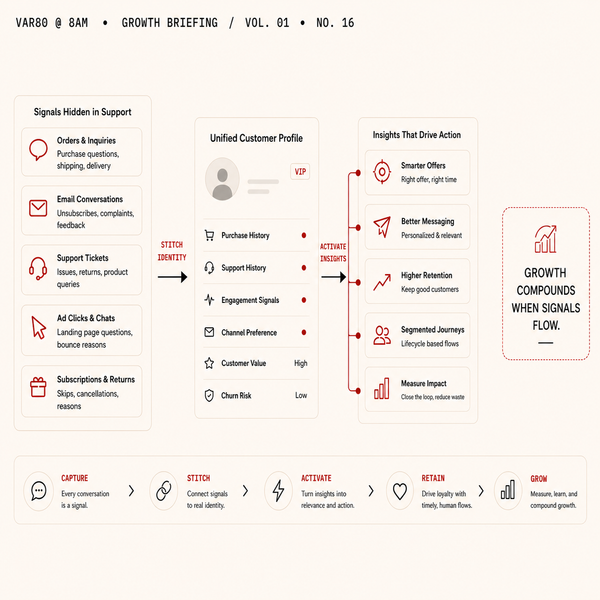
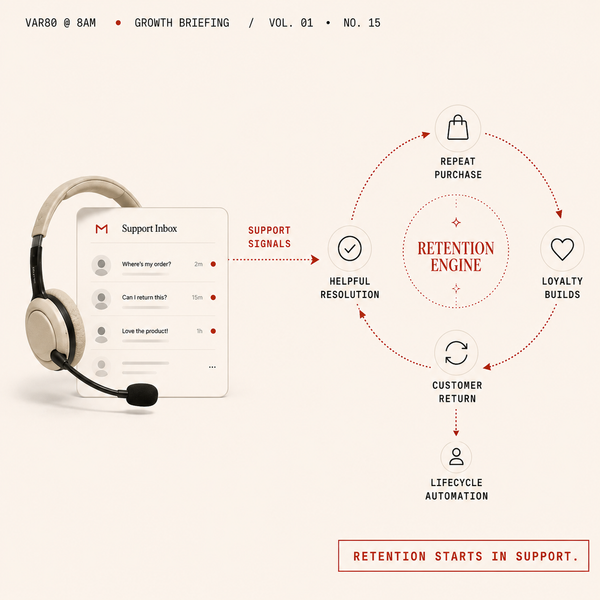
- Support Interactions Are Revenue Signals: Refund requests, checkout questions, product comparisons, sentiment, and repeat contacts reveal purchase intent, friction, churn risk, and opportunities to recover revenue.
- Stitch Support Events to Orders: Connect support conversations with product views, carts, purchases, and customer identity so support activity can be tied to validated revenue instead of ticket metrics alone.
- Ticket Signals Can Predict Customer Behaviour: Resolution speed, repeat contacts, sentiment, and ticket topics can become leading indicators for repurchase, churn, and customer lifetime value.
- Prove Support Revenue With Holdout Tests: Use short conversion windows and randomized controls to measure incremental purchases and AOV instead of giving support misleading last-touch credit.
- High-Intent Support Triggers Can Recover Revenue Fast: Combining abandoned checkout, support intent, VIP status, and high-AOV signals creates priority segments where timely assistance can rescue otherwise lost purchases.
- Measure Revenue Recovered, Not Just Tickets Resolved: Track revenue per resolved ticket, retention lift, recovered carts, incremental AOV, and LTV impact to turn support from a cost-center metric into a measurable growth function.
1. Support interactions are revenue signals, not just tickets
The claim: when a customer opens a support conversation they are sending commercial signals. They reveal intent, obstacles and the moment at which purchase behavior can still be changed. Operators who treat every ticket as purely operational miss the commercial lever embedded in conversation intelligence.
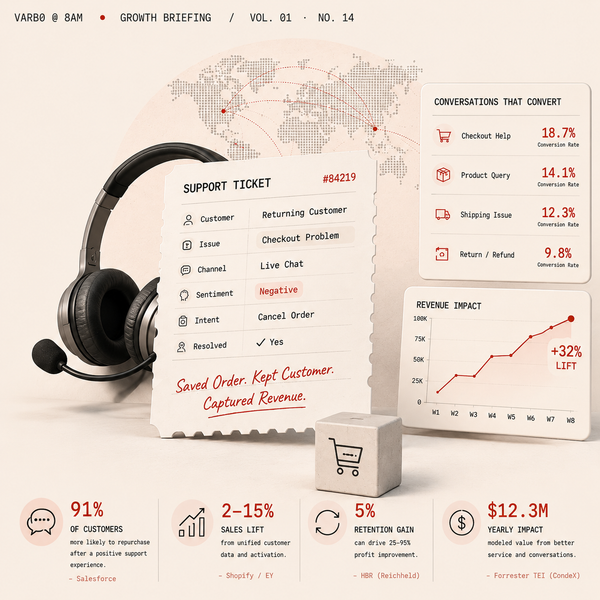
Two linked observations make this concrete. First, support contacts contain intent tags: refund request, checkout help, product comparison, upsell interest. Forrester's TEI notes that conversation intelligence surfaces what is bothering customers and therefore their intent (Forrester TEI for Zendesk). Second, customer behaviour surveys show the commercial weight of service: 91% of customers say a positive service experience makes them more likely to repurchase (Salesforce).
Those two facts combine into one operational rule: a resolved ticket can be re-labeled as a potential conversion or retention event if it maps to purchase behavior within a defined window. Treat tickets as raw events in an event stream and the support team becomes a signal source for growth.
Failure case: if you only report tickets closed and response SLAs, you will never persuade finance. Metrics that matter commercially must be translated to money — contact windows, conversion windows and validated purchases.
2. If you can’t stitch tickets to orders, finance will ignore everything support says

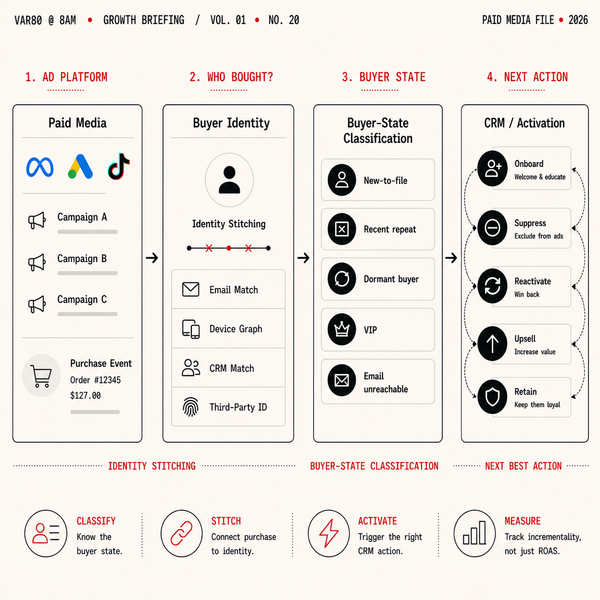
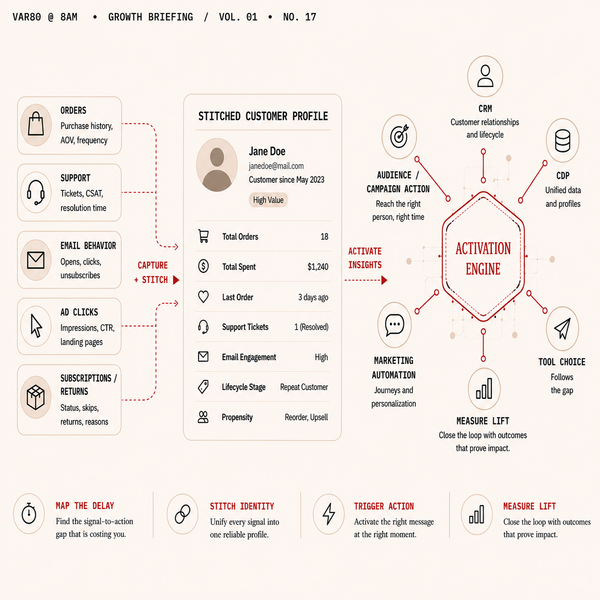
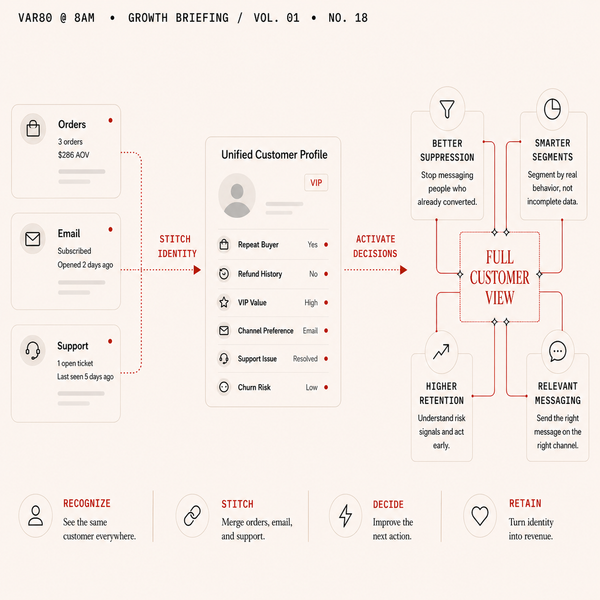
Position: identity-first, event-first stitching into a central profile is non-negotiable. Finance accepts dollars. It will only accept support as causal when you can show a user-level path from support_conversation to purchase.
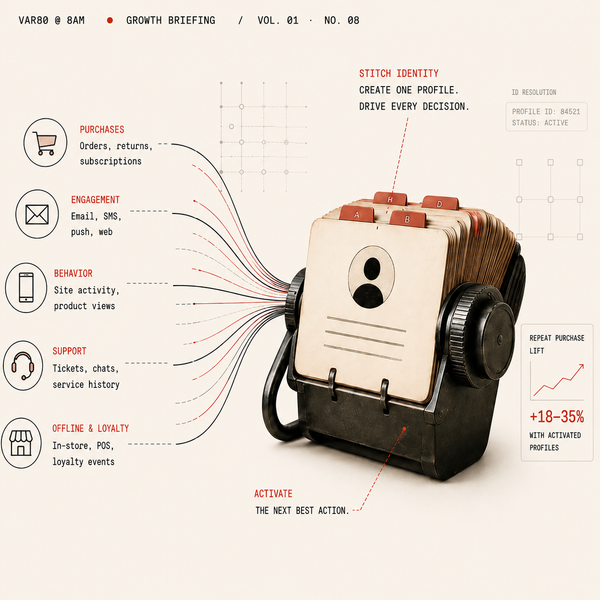
Stitching must be event-first, not ticket-first. Ticket IDs are useful inside the support system. They are useless to ad platforms, warehouses, and order systems. Build customer profiles from events: product_view, add_to_cart, support_conversation, purchase. Those event names become the join keys across systems. That pattern appeared repeatedly in DataCX demos where Shopify orders, booking events and quiz responses were unified into one profile.
Identity stitching must be event-first not ticket-first
Start from the event stream. Record a minimal identity set on each event payload: email when available, hashed phone, anonymous cookie or device id, and a server-side user id when known. Do not depend on ticket ids to bridge to orders. They do not exist in ad platforms or the warehouse. Use email and phone (hashed when needed) plus a server id as the minimal identity surface.
Implement a minimum viable event set for revenue attribution
Operators instrument too many low-value events. Instead capture a tight MVP event set that enables segmentation, attribution and follow-up automation. The table below is the small set that proves work.
|
Event |
Properties (minimal) |
Why it matters |
|
product_view |
product_id, category, timestamp, session_id |
Defines interest and product-level intent |
|
add_to_cart / checkout_started |
cart_value, product_ids, session_id |
Shows purchase intent and recoverable carts |
|
support_conversation |
topic, sentiment, channel, agent_id, customer_identity |
Captures friction and revenue opportunities |
|
purchase |
order_id, order_value, items, customer_identity |
Ground-truth for attribution and LTV |
|
repeat_contact |
count, window, topic |
Early warning for churn/retention plays |
Why this minimal set? It creates direct causal chains from product_view → add_to_cart → support_conversation → purchase. That chain is what finance and ad platforms understand. With a validated order event, you can run holdouts and attribute incremental conversions to support-driven flows.
Complication: identity resolution is sensitive to privacy rules and consent. If your region requires explicit consent for server-side conversion sharing, build consent flags into profiles and respect them in conversion feedback loops.
3. Ticket signals predict customer behavior better than any single marketing metric
Position: ticket KPIs are leading indicators for repurchase and churn in ways pageviews and click-through rates are not. Support metrics belong in commercial dashboards because they forecast valuable customer behaviors.
Multiple analyst sources tie ticket KPIs to retention and conversion. Response speed, repeat contacts and CSAT correlate with retention and conversion in vendor and analyst patterns. Zendesk and Salesforce have repeated the theme: service quality shapes repurchase intent and satisfaction (Zendesk), (Salesforce).
Resolution speed correlates with repurchase probability
Faster first responses and faster resolution materially increase the chance a customer will buy again. Practically, that effect is causal in two ways. First response reduces friction and anchors trust. Rapid resolution lowers perceived risk and makes future purchases more likely. In several modeled scenarios operator teams observed that reducing mean time to resolution improved repurchase rates within the 7–30 day window that matters to LTV calculations. That is why SLA improvements should be reported as commercial experiments with conversion windows, not only as operational KPIs.
Repeat contact flags at‑risk customers before churn
Repeat contacts are an early-warning system. A rising repeat-contact count for a customer in a short window forecasts churn more reliably than a single drop in sessions. Operators should translate repeat-contact thresholds into automated retention flows: auto-upgrade outreach, targeted discounts, or proactive agent callbacks. Use a small randomized holdout to measure the incremental effect of those flows on retention.
Revenue per resolved ticket is a real, measurable KPI
Support leaders need a business language. Revenue per resolved ticket or LTV lift per ticket are measurable primitives. The measurement steps are simple: stitch events to orders, pick a post-ticket window (7–14 days), and measure conversion rate and AOV for customers who had a resolved ticket versus matched controls. That yield becomes the language finance understands: dollars per ticket and ROI on agent time. One nameable observation: when support agents are prompted with product offers at the time of resolution, teams report higher immediate conversion — a pattern Salesforce documents as agents using AI to recommend offers (Salesforce State of Service).
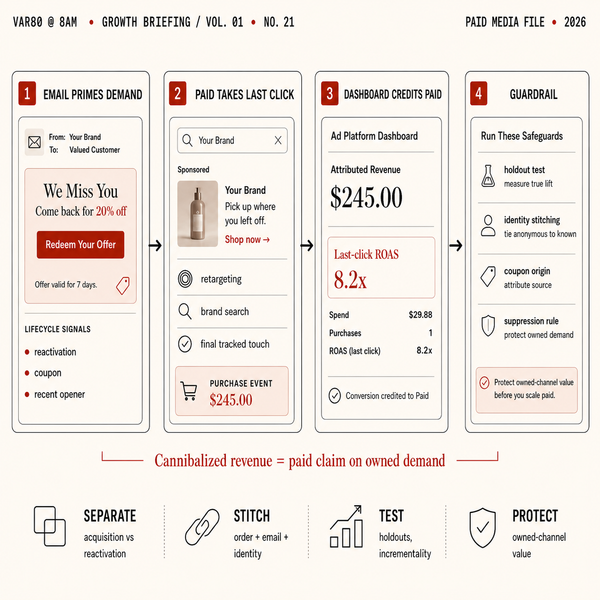
Complication: naive last-touch attribution overstates support effect. Ticket events often co-occur with marketing exposures. Use short windows and holdouts to guard against spurious attribution (next section explains how).
4. Attribution turns helpful support into measurable LTV lift
Position: attribution for support must be pragmatic and experimental. Short windows plus randomized holdouts beat naive last-touch models for proving lift and influencing finance.
Analysts have modeled the potential lift from CX improvements. McKinsey finds that a one-point increase in journey satisfaction corresponds to roughly a three-percentage-point uplift in revenue-growth rate (McKinsey). Vendor TEI work frames this into modeled profit and contact-rate savings; Forrester's model for Zendesk provides an example of a finance-facing TEI calculation (Forrester TEI).
Short windows plus holdout tests beat naive last-touch
Design a small, rapid experiment. Randomize a portion of customers who interact with support into a treatment that receives an activation play (e.g., personalized follow-up, a one-time offer, or targeted email/WhatsApp flow) and compare them to a holdout that receives the standard disposition. Use a short post-interaction window to capture near-term conversions (7–14 days is typical for ecommerce). Measure validated purchases using stitched order events. This approach reduces bias from concurrent marketing and provides a finance-ready incremental-lift estimate.
Practical notes:
-
Randomize at the customer level to avoid contamination.
-
Validate purchases server-side. Do not rely solely on client pixels.
-
Report both conversion lift and incremental AOV. Finance wants dollars and margin, not only percentages.
Complication: holdouts reduce short-term revenue in the control arm. Keep tests small and time-boxed to manage commercial risk while producing evidence that changes budget allocation.
5. Support-driven retention is the scalable way small teams move CLV
Position: retention is where support moves the needle for small teams. Acquiring a new customer costs multiples of retaining an existing one. Support has unique access to at-risk customers via ticket signals and disposition tags; those signals scale into retention experiments that increase CLV.
Forrester and Zendesk evidence shows that customer-obsessed organizations report materially better retention: a 51% improvement in retention for customer-obsessed organizations is cited in practitioner research (Zendesk / Forrester). That capability is actionable when you translate ticket attributes into cohorts and flows.
Segment signals that forecast churn
Combine ticket attributes (topic, sentiment, repeat_contacts) with behavioral signals (recent spend, session depth, time-since-last-purchase) to create at‑risk cohorts. A typical segmentation rule set might look like: customers with a high recency of support contact, negative sentiment, and a purchase gap of 30–90 days become a reactivation cohort. Export that cohort to your automation platform and run a reactivation flow: tailored troubleshooting, product education, or a small reactivation offer.
Experiment blueprint: export the top 10% highest-risk cohort to an automated WhatsApp or email flow via Brevo or a messaging provider. Compare 30- and 90-day retention against a matched control cohort. Practical demo teams have exported stitched VIP segments to Brevo and Meta for automated follow-ups in live activations.
Complication: support-driven retention requires ownership. If support owns signal collection but marketing owns outreach, handoffs fail. Define responsibilities up front: support owns disposition tagging and triggers, marketing owns creative and promotion rules, data owns the segment exports.
6. In ecommerce the right support trigger recovers revenue faster than any creative
Position: timing and intent beat creative. An agent reaching a user with checkout friction will convert more reliably than a new creative cycle. Support triggers can rescue abandoned carts and recover revenue more quickly than waiting for marketing cadence.
Customer expectations reinforce this: 83% of customers expect immediate interaction when contacting a company (Salesforce). That immediacy is the conversion advantage for support-driven recovery.
Abandoned checkout + support intent = a high-conversion segment
Operational play: create a segment that intersects cart abandonment events with inbound support intent. That segment is high-propensity and economically justify prioritized outreach or a one-time discount. Implement a rescue flow: agent outreach within 30–60 minutes, a targeted email, or an SMS/WhatsApp with a friction-focused message or assistance. Measure the conversion window at 48–72 hours for immediate recovery and 7–14 days for late conversions.
Case evidence: ecommerce demos have shown correlated abandoned checkout sessions with inbound support queries converting when agents intervene or when automated flows send targeted messages through Brevo or WhatsApp gateways. The measurement is straightforward: track purchases attributable to those outreach messages and feed validated purchases back to ad platforms to improve future targeting.
Complication: rescue economics vary by AOV and margin. Prioritize segments where recovered revenue exceeds outreach cost. High-AOV carts, VIP customers and time-limited offers usually come first.
7. Integrations, automations and the operator playbook: who does what, when

Position: operationalize support-to-revenue with a simple checklist: stitch, segment, export, automate, feedback. Integration and automation are the plumbing. The organization and ownership are the levers.
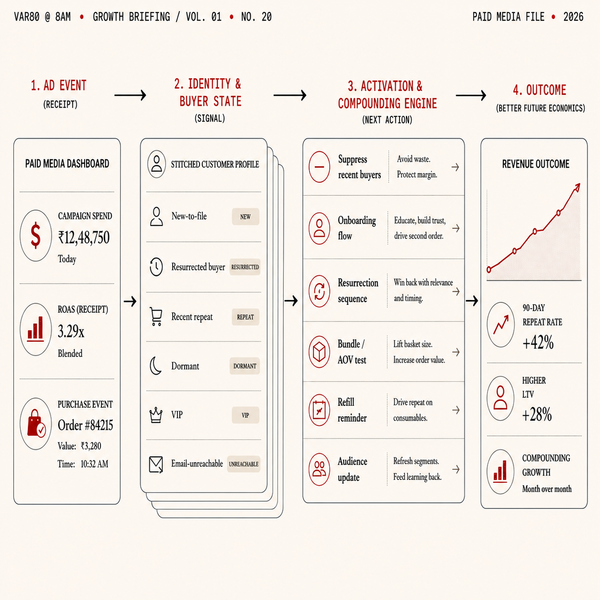
Most service decision-makers expect support teams to contribute more to revenue via upsell, cross-sell and retention (Salesforce 2024). The path is integration and automation: export stitched VIPs to Brevo, push audiences to Meta and Google, and send validated conversion feedback back via server-side Conversion APIs.
Small teams should stitch first, automate second
Start by prioritizing identity resolution and segment correctness before building complex automations. Automated flows are only as good as their inputs. Demos show the labor cost and waste when automation pushes poor segments; cleaning identity first avoids that wasted spend.
Send validated conversion feedback back into ad platforms
Ad learning improves when you return outcome events. Use server-side conversions to send validated purchase events and LTV flags back to Meta or Google. Do this only for validated, de‑duplicated purchases and honor user consent flags. Conversion feedback accelerates ad learning and reduces attribution leakage, but you must avoid double-counting by reconciling client-side signals with server receipts.
Disposition-driven call scripts beat generic outreach
Make agent dispositions structured. A disposition is structured data. Use it as a dimension: if disposition = "support_resolved_but_interested", run an agent script that asks for upsell permission and offers a tailored add-on. Track disposition outcomes as signals back into the CDP so that future automations learn which disposition→script combinations drive lift.
Operational ownership checklist:
-
Data team: event ingestion, identity stitching, segment definitions.
-
Support ops: disposition taxonomy, agent scripts, conversational prompts.
-
Growth/Marketing: creative offers, export destinations, ad feedback.
-
Finance: acceptance criteria for experiments, margin guardrails for offers.
Complication: sending outcomes back to ad platforms requires privacy and consent engineering. Work with legal and data privacy to create a consent flag on profiles and gate the CAPI events accordingly.
Stop counting tickets closed — start counting the revenue you recovered
The uncomfortable truth: if you do one thing this quarter, run a six-week experiment that stitches support events to orders, builds a VIP/reactivation flow, and sends validated conversions back to your ad platforms so finance and growth teams can measure real LTV lift. Structure the experiment as: (1) instrument the minimum event set and identity stitching; (2) define a high-propensity cohort (abandoned cart + support intent or repeat-contact + high-AOV); (3) randomize a small treatment that receives a support-driven flow; (4) measure validated purchases in a 7–14 day window and report dollars to finance.
This is low-friction, high-leverage work. It reframes support leadership as a commercial function with measurable KPIs. When you deliver an experiment with validated incremental revenue, the conversation with finance changes from "we answered tickets" to "we recovered X dollars of revenue and moved LTV by Y%."
Your support inbox is not just a complaint box. It is customer intelligence.
Var80 connects support, CRM, ecommerce, and campaign data so you can spot churn risks, high-intent buyers, recurring product issues, and retention opportunities before they leak revenue.
Leave a comment