


GEO is becoming critical because AI assistants now shape product discovery before shoppers reach search results. Brands need machine-readable product truth: accurate feeds, identifiers, pricing, stock, reviews, and structured attributes. The winners will be ecommerce teams that optimize for AI recommendations, not only blue-link rankings.
McKinsey reports that 40% to 55% of consumers in major sectors use AI‑based search to influence purchasing decisions, a behaviour pattern that hands discovery power to assistants, not blue links.
TL;DR – Stop Optimizing for Clicks. Start Optimizing for Machine Choices.
- Discovery Is Shifting From Search Results to AI Shortlists: AI assistants increasingly translate shopper intent into a small set of recommended products, making inclusion in the shortlist as important as traditional search rankings.
- AI Relevance Depends on Product Context: Rich attributes such as use case, compatibility, material, budget, availability, and customer constraints help assistants understand when a product should be recommended.
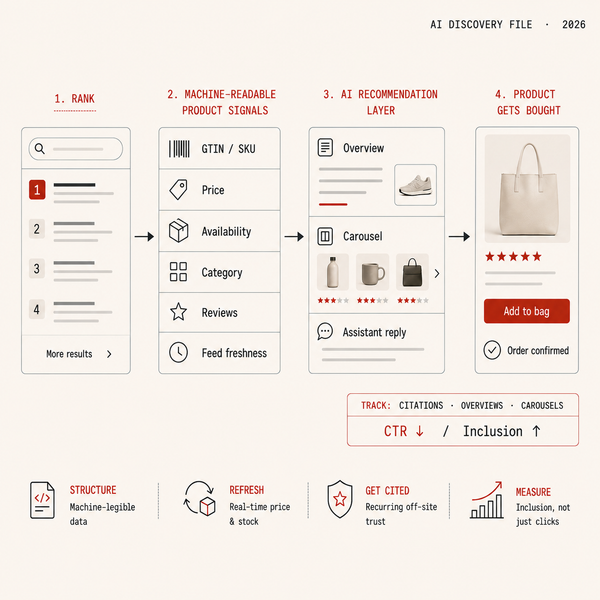
- Machine-Readable Product Truth Drives Visibility: Canonical IDs, structured attributes, schema, accurate prices, inventory, reviews, and fresh product feeds give AI systems the confidence to compare and recommend products.
- Recommendation Quality Is Becoming More Important Than Backlinks: Products need clear, explainable reasons to be chosen for specific customer situations rather than relying primarily on domain authority and link signals.
- AI Visibility Without Attribution Is a Vanity Metric: Brands need to connect assistant consultations and referrals to customer profiles and orders so they can measure whether AI recommendations actually create revenue.
- SEO and GEO Should Work Together: Keep SEO for precise transaction and technical queries while building feeds, structured product data, and attribution infrastructure for assistant-led discovery.
Treating search as a human UI guarantees you will be irrelevant to machine buyers
The default assumption of modern ecommerce teams is that search is a human experience problem: add facets, tune synonyms, and faster autocomplete and customers will find what they need. That assumption is now the failure mode. The practical reality is that most sites do not offer the signal completeness that an assistant needs to resolve conversational intent into a shortlist. Baymard Institute's usability work finds that 56% of ecommerce sites fail to adequately support users' search needs, creating gaps in synonym handling, thematic browsing, and mobile search performance that assistants can exploit; these are not minor UX hiccups. See Baymard Institute's research on search UX.
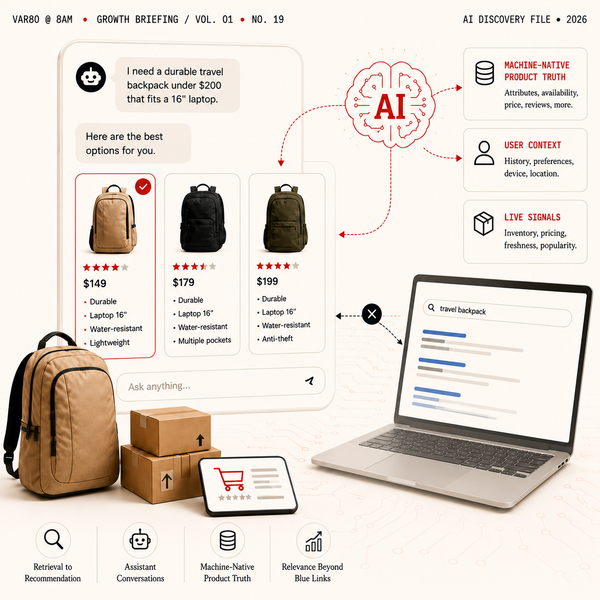
When a person types a query into Google, the search engine can fall back to the content of pages to judge relevance. When a person asks an assistant for "a durable mid‑range travel backpack under $200 that fits a 16 inch laptop," the assistant cannot rely on the human journey of clicking ten links and synthesizing pros and cons. It must translate that natural language goal into explicit attributes and then pick a handful of candidates that satisfy the constraints. That translation favors sellers whose product truth is already structured and machine‑readable.
Google continues to optimize for precise transactional queries and for indexable page content, but those optimizations do not cover conversational intent that assistants surface. Google’s AI overview work demonstrates that links remain essential for transactional precision even as generative overlays appear; Google’s product guidance still anchors transactional discovery in merchant pages and structured product data. See Google's work on AI overviews and search generation at Google's Search blog.
Where site search fails, assistants step in. Assistants take the user's vague goal, add context from the account or prior conversation, and produce a short, narrated shortlist. That pattern bypasses the human UI of your site search entirely. The consequence is simple: the first impression is now the machine's shortlist, not the top blue link. Brands that keep treating discovery as a human UX deliverable will be absent from the new first impression.
Failure case: this pattern breaks when the user has a highly specific, post‑click intent that genuinely requires a page’s technical content, for example, when a buyer searches for a precise SKU, certification, or a complex compatibility matrix. In those narrow cases, page‑level content and classical SEO still win the moment.
AI shopping assistants convert retrieval into a conversation, and conversations change the signal set

Search used to be a verb. With assistants it becomes a dialogue. OpenAI's shopping features turn product discovery into an iterative conversation that returns an in‑chat consideration set with comparisons, pros and cons, and synthesized review evidence. That UX is not an optional interface; it is a new signal emitter. OpenAI describes the shopping experience inside ChatGPT as an interaction that builds and refines shortlists based on query context and available product metadata. See OpenAI's description of shopping research and the mechanics of in‑chat product selection at OpenAI and the corresponding help documentation at OpenAI Help Center.
Multimodal and contextual queries reshape what 'relevance' even means
Relevance for an assistant aggregates multiple inputs: the user's natural language goal, prior chat turns, account history, image uploads, device context, and even the momentary inventory and price landscape. That composite signal is qualitatively different from a keyword hit list. When a user uploads a photo of a jacket and asks for "something similar but breathable for rainy city travel," the assistant uses visual similarity, material attributes, contextual weather assumptions, and the user's prior purchase history all at once. Those signals are not optional; they are the primitives the assistant uses to score candidates. A classic keyword relevance model cannot reproduce that composite without the underlying canonical attributes in feeds.
This is where most brands are underprepared. They still treat relevance as a keyword-matching problem, while AI assistants treat relevance as a context-matching problem. That means product data has to become richer, cleaner, and more use-case aware. A product feed that only says “men’s jacket, blue, polyester” is useless compared to one that says “lightweight, breathable, water-resistant, packable, suitable for humid rainy commutes, available in navy, under ₹3,000, in stock.” That is the level of clarity assistants need to recommend confidently.
The next practical shift is catalogue discipline. Brands need cleaner product feeds, richer metadata, structured comparison content, image-level descriptions, and use-case pages that mirror how people actually ask assistants for help. The old SEO question was: “Which keyword should this page rank for?” The new AEO question is: “What decision context should this product be eligible for?” If the assistant cannot confidently map a product to a situation, body type, weather condition, budget, preference, or constraint, the product will be invisible even if the page technically ranks.
In‑chat consideration sets replace SERP ranking as the buyer’s first taste
Being included in a short, narrated consideration set is worth far more than ranking in the top ten on a search engine results page. An assistant’s shortlist comes with a rationale: why this model, how it fits the budget, and which tradeoffs to expect. That narrated explanation builds trust and shortens time to purchase. OpenAI's product flows show how assistants present side‑by‑side options and synthesize review snippets so the buyer sees not just results but a curated, actionable argument. When assistant exposure includes a price check and a note that one SKU is low in stock, that exposure directly affects conversion probability; price and availability become operational ranking features inside the conversation.
Failure case: in categories where images or technical specs dominate (for example, replacement parts or regulated medical devices), multimodal inputs help but cannot replace the need for authoritative, page‑level documentation. Assistants can suggest candidates, but conversion still depends on page content and technical detail.
Want to Understand How AI Recommendations Decide What Gets Bought?
Read the AI Recommendation Guide—>
In assistant‑led flows, recommendation quality, not backlink authority, decides who gets chosen
Recommendation engines are the gatekeepers of assistant exposure. Assistants do not inherit your backlink profile. They inherit your product signals and your ability to participate in a recommendation game that demands context, explainability, and diversity. Amazon and platform research make this clear: personalization depends on diverse inputs and on systems that avoid overfitting to a single interpretation of intent. Amazon's research on knowledge graphs and retrieval shows how entity signals and graph structure improve candidate selection; see Amazon Science's publications on knowledge-graph representation and retrieval at Amazon Science.
Contextual signals outrank popularity when lists must be explainable
Recommendation engines need structured reasons to choose one product over another. That means budget, size, compatibility, and use case must be visible on the PDP (product page) in plain language and structured fields. If those signals are missing, the assistant cannot confidently match the product to a user’s situation. A product may still rank, but it will fail the recommendation test. A product’s ranking inside a consideration set depends on whether the feed explicitly declares that it has a 16‑inch laptop compartment, that the outer fabric is waterproof, or that it ships within 24 hours. Without those fields, authority signals like backlinks and domain reputation are invisible to the assistant's selection logic.
Recommendation diversity is an anti‑fragility tactic
Diversity in shortlists prevents assistants from collapsing onto the same narrow set of SKUs and gives retailers more slots to capture. Amazon’s engineering literature repeatedly frames diversity as a design choice to avoid overfitting personalization models to head SKUs. A brand that signals complementary attributes alternative price tiers, compatible accessories, regional variants, or bundled offers increases its odds of appearing in at least one failure‑tolerant shortlist. The practical tradeoff is straightforward: broaden attribute coverage in feeds and you broaden the scenarios in which an assistant can truthfully include one of your products.
Failure case: recommendation quality loses value when the downstream activation path is broken. If an assistant includes your SKU but the checkout flow cannot accept the assistant’s referral (mismatched IDs, stale price, or blocked merchant terms), exposure becomes a vanity metric rather than a revenue event.
Visibility in AI commerce is bought with machine‑readable product truth, not backlinks
Generative Engine Optimization, or GEO, describes the work of making product truth consumable by generative assistants. GEO is not a marketing term; it is an engineering and ops discipline. It requires canonical IDs, normalized attributes, complete schema.org metadata, and real‑time price, inventory, and reviews. Platforms are already treating merchant feeds as the canonical contract for assistant visibility. Shopify's documentation positions Shopify Catalog as a real‑time, structured product feed designed to ensure accurate pricing and inventory across AI channels; see Shopify's guidance on agentic commerce and Catalog at Shopify.
Microsoft's messaging about Copilot and merchant feeds makes the same operational point. Copilot and Brand Agents depend on merchant feeds to turn conversational exposure into checkout. Microsoft and Shopify framed those integrations as a means to ensure merchants’ catalog accuracy and to let assistants deliver purchasable recommendations, and Microsoft documented early impressions of visibility gains when feeds are complete and fresh. See Microsoft’s Copilot commerce posts at Microsoft and broader platform guidance at Microsoft Ads blog.
Price, reviews and availability are no longer footnotes. Platform docs from OpenAI, Shopify and Microsoft instruct merchants to keep price and stock fresh because assistants use those attributes as primary filters. OpenAI’s shopping documentation explicitly lists price, availability and reviews as signals that affect which items are shown in shopping responses; see OpenAI Help Center. If your feed shows stale price or a sold‑out flag, an assistant will either downgrade your SKU or remove it from the shortlist entirely. That is discoverability arithmetic: stale signals equal zero impressions.
Failure case: GEO has diminishing returns in categories where catalog parity is low and brand identity drives preference, such as prestige fashion where editorial narrative and owned content still shape desirability. In those categories GEO matters, but it coexists with brand storytelling that lives off‑feed.
Relying on traditional SEO is a strategic risk; visibility in AI commerce requires new investments
Traditional SEO will not disappear overnight. It will remain the correct channel for certain transactional and technical queries that require long, authoritative page content. Google’s product guidance shows that blue links remain the right delivery mechanism for precise, page‑level answers and for queries that require deep documentation. See Google’s work on AI overviews and the continuing role of links at Google.
But the trend is clear: assistant adoption amplifies the value of feeds and reduces the marginal benefit of more backlinks. McKinsey’s work on AI search adoption quantifies the growing share of consumers who use AI tools as part of their shopping process; their finding that roughly 40% to 55% of customers in large sectors use AI‑based search means that a nontrivial share of consideration events will be shaped by assistants, not SERPs. See McKinsey's analysis at McKinsey.
The managerial implication is that teams must reallocate budget from link‑centric SEO to product data engineering, feed ops, and GEO. That means hiring for product data engineering, investing in feed completeness and canonical ID hygiene, and instrumenting consultation events. The protective strategy is hybrid: keep running SEO for transaction‑first queries while steadily building the primitives that buy assistant visibility.
This is where Var80 comes in. Var80 helps D2C brands move from traditional SEO to recommendation-ready commerce. We do not just write blogs or optimise meta titles. We help brands rebuild the product intelligence layer that AI assistants need: cleaner product feeds, richer PDPs, structured attributes, AEO/GEO content, comparison pages, product-use cases, and recommendation journey tracking.
In plain terms, Var80 helps brands answer the question: “Can an AI assistant understand, compare, and confidently recommend this product?” If the answer is no, rankings alone will not protect growth. Var80’s role is to make the catalogue visible not only to search engines, but to the next layer of discovery: AI recommendation systems.
Failure case: small, hyper‑local businesses with negligible catalog depth may find the feed work disproportionate to return. For those operations, tactical SEO and marketplace placements remain the fastest path to revenue in the near term.
The hidden lever: identity and activation pipelines decide whether assistant consultations become purchases

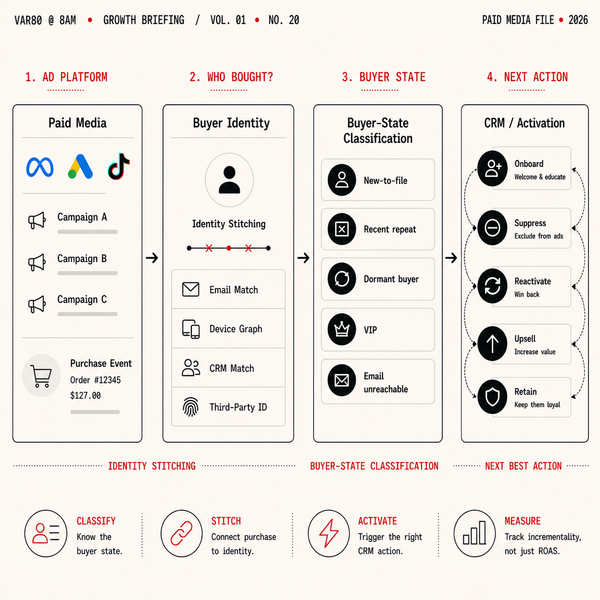
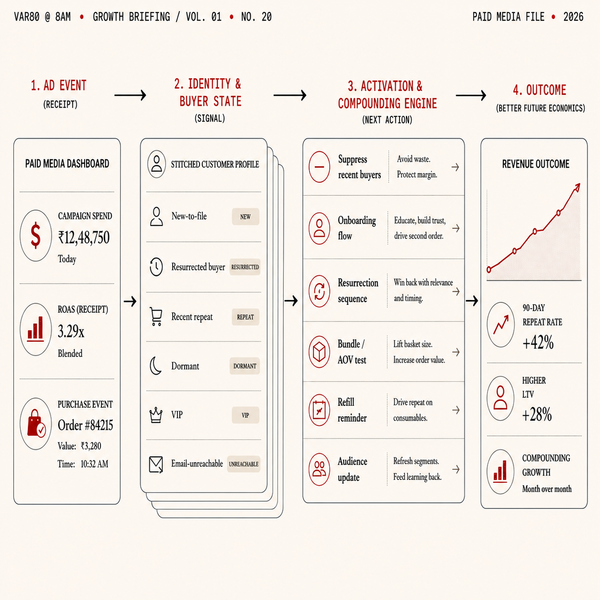
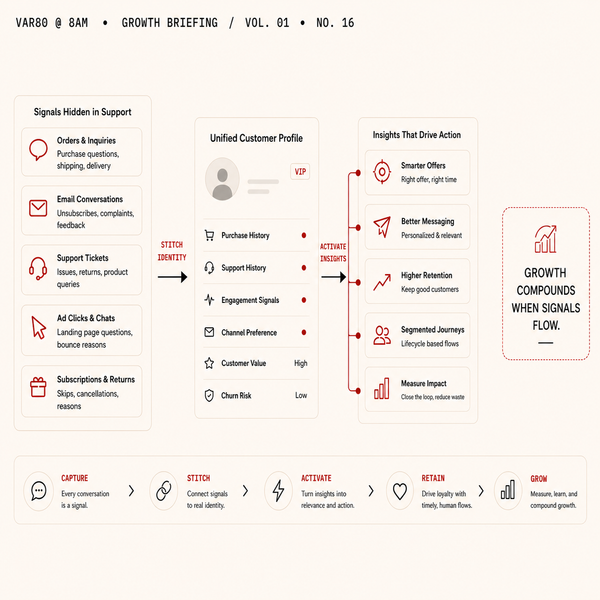
Visibility without activation is vanity. An assistant can recommend your product, but unless you can observe that consultation, tie it to a persistent identity, and connect it to orders, you cannot optimize for lifetime value. Shopify’s merchant feed integrations make this operationally visible: merchants that syndicate Catalog updates and reconcile orders from Copilot get attributable conversions that can feed back into the product feed and pricing strategy. See Shopify and Microsoft descriptions of merchant feed integrations at Shopify and Microsoft.
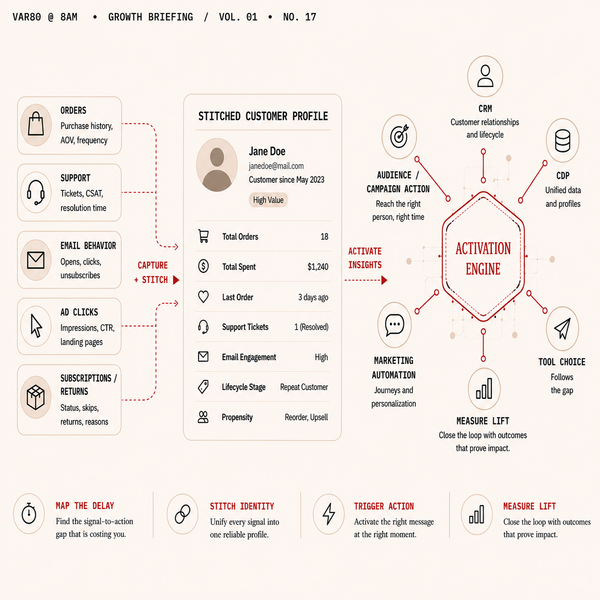
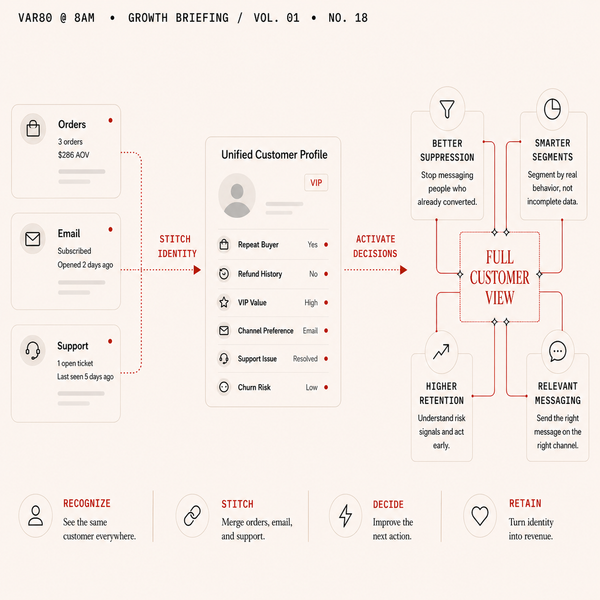
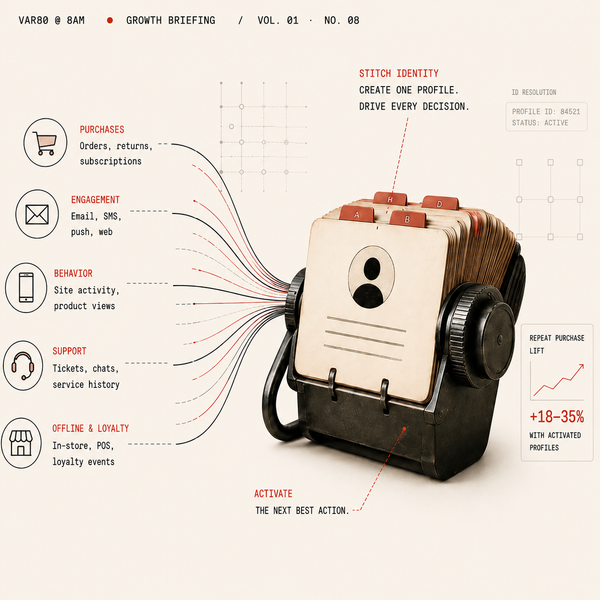
A stitched profile makes shortlists actionable
Only when assistant exposure is tied to a stitched profile and a persistent event stream can a brand close the loop and optimize for long‑term value. A stitched profile enables cohort analysis of assistant referrals, incrementality testing of GEO investments, and improved personalization inside future conversations. Amazon's strength is precisely this: recommendation signals are linked to long‑term purchase behavior, creating a feedback loop and a data moat that increases recommendation precision over time. See Amazon's engineering research on graph and retrieval approaches at Amazon Science.
Small teams should instrument first and automate second
The most practical path for mid‑market teams is to instrument minimal viable events this quarter: record consultation impressions, capture incoming assistant IDs or referral tags, and ensure orders include the originating consultation metadata. Once the event stream exists, automate feed freshness and canonical ID reconciliation. That order is critical: measure before you buy a feed management vendor whose value you cannot demonstrate. This is the operational sequence that turns assistant referrals into repeatable economics rather than one‑off anecdotes.
Failure case: privacy constraints and blocked identifiers can break attribution for some assistant channels. When that occurs, teams must rely on experimental measurement — randomized promotions inside assistant flows — to infer lift instead of deterministic attribution.
Concede where the blue link still matters and set guardrails for a hybrid discovery strategy
The honest concession is that blue links are not uniformly dead. For transaction‑first queries that demand precise specs, long technical content, or regulatory disclosures, page‑level results remain superior. Google’s guidance and the persistence of merchant pages for transactional queries confirm that SEO retains value for high‑intent, precise searches; see Google’s Search blog at Google.
Transaction‑first queries will remain blue‑link dominant
When a customer searches for an exact part number, a safety certification, or a specific warranty clause, the canonical source is still the page. Those moments call for deep, crawlable content and technical SEO. Maintain those pages and keep their markup accurate, they will continue to capture revenue even as assistants grow.
Treat GEO and blue‑link SEO as complementary channels
Run parallel optimizations. Keep investing in page‑level authority for transaction moments while funding feed ops, canonical IDs and instrumentation for assistant moments. The hybrid approach preserves short‑term conversion while funding the primitives needed for long‑term assistant visibility. Over time, the balance should shift toward feed and attribution work as assistant adoption increases.
Failure case: treating GEO and SEO as mutually exclusive creates a revenue cliff. The correct operational posture is complementary investment with measurable milestones for feed completeness and consultation attribution.
Reframe: Stop optimizing for clicks; start optimizing for machine choices this quarter
The uncomfortable truth is that discoverability is shifting from human‑facing pages to machine‑facing feeds and signals. The single most valuable action this quarter is practical and specific: publish a canonical, machine‑readable product feed with complete schema.org metadata, canonical identifiers, real‑time prices, availability and reviews, and instrument consultation → order attribution so assistant referrals can be measured and optimized.
Start by publishing a canonical feed and mapping canonical IDs to your order events this month. Then instrument the minimal event set required to record assistant impressions and referrals. Finally, run a single experiment that ties feed changes to lift in assistant‑sourced orders. Do those three things in sequence and you can measure whether GEO spend produces revenue rather than anecdotes.
Do Not Wait for the Click. Become the Product AI Recommends!
Var80 helps ecommerce brands structure product data, customer signals, content, and conversion paths so AI systems can understand, compare, and recommend their products before shoppers reach the website.
Leave a comment