


CRM, CDP, and marketing automation are not interchangeable tools. For D2C brands, the right choice depends on the activation gap: use CRM automation when you need event-triggered lifecycle campaigns, and consider a CDP when customer identity, real-time signals, and multi-channel activation need to move faster across the business.
"Klaviyo's published benchmark data shows automated lifecycle flows can generate dramatically more revenue per recipient than one-off campaigns the problem is not messaging volume, it's the latency between customer signal and action."
TL;DR – Choose the Smallest Tool That Closes Your Biggest Activation Gap
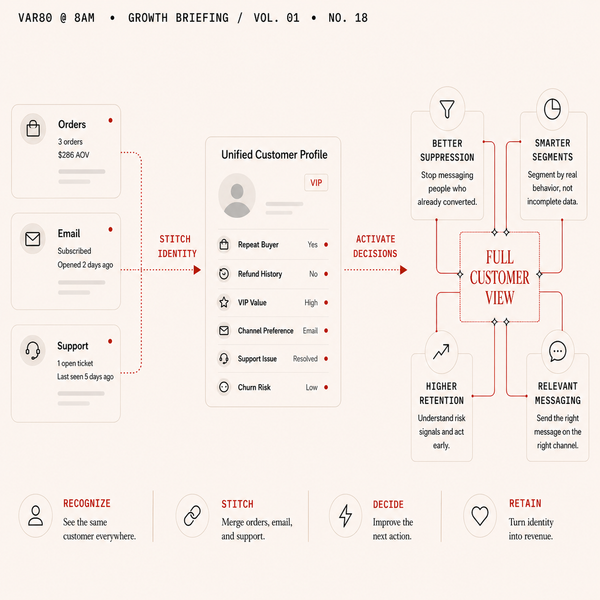
- The Unified Customer Profile Comes First: CRM, CDP, and automation only work when customer identity is reliable enough to connect behavior, purchases, ads, support, and lifecycle activity.
- CRM + Automation Is Enough for Simpler Journeys: Single-platform D2C brands should usually prove value through abandoned-cart, post-purchase, cross-sell, and reactivation flows before adding more infrastructure.
- A CDP Becomes Necessary When Identity and Latency Become Constraints: Multi-platform identity, real-time audience suppression, multiple activation destinations, and always-current customer states are where CRM-only architectures begin to break.
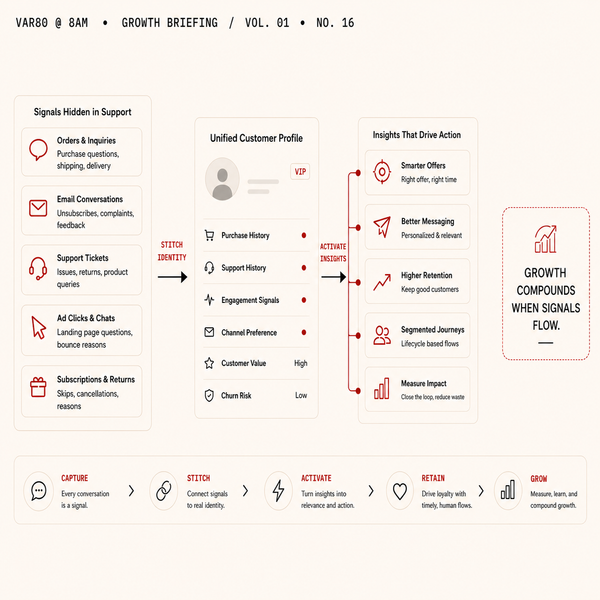
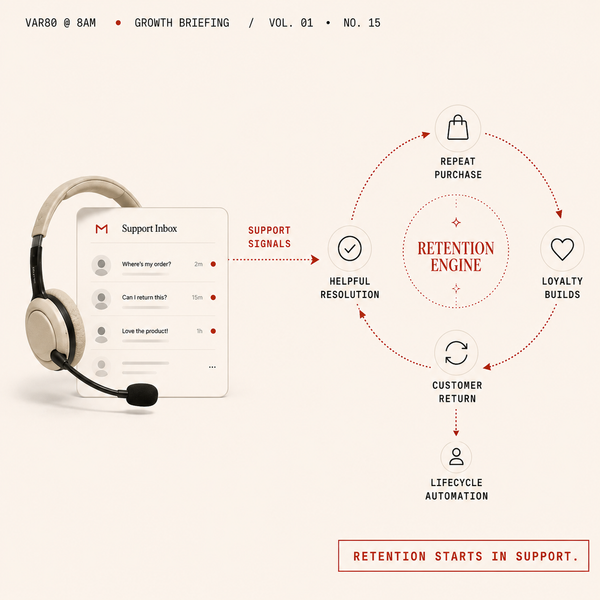
- Support Signals Must Join the Customer Profile: Refunds, sizing issues, churn intent, and other support signals should change marketing segments, suppression rules, recovery flows, and paid audiences.
- Governance Matters More Than Buying More Technology: CDPs become expensive liabilities without canonical IDs, clean event models, audience-refresh SLAs, activation ownership, and clear rules for resolving identity conflicts.
- Buy Technology Against an Activation Gap: Audit where customer signals are delayed, choose the smallest tool that closes the biggest gap, and prove measurable CAC or retention improvement before expanding the stack.
A unified customer profile not the vendor logo decides whether you can personalize at scale
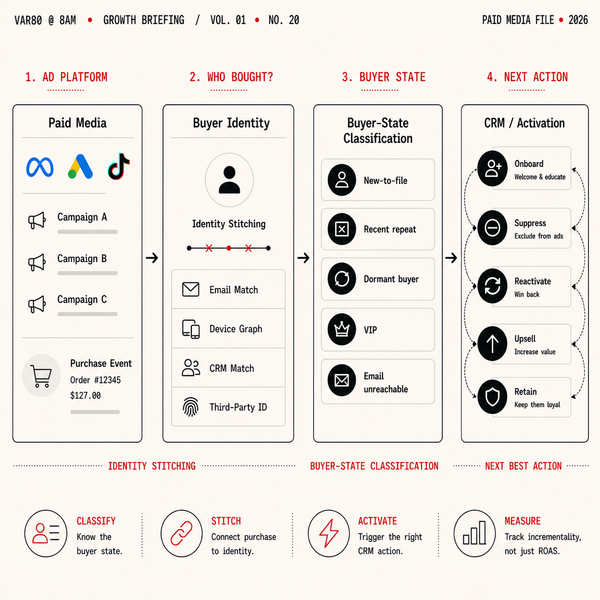
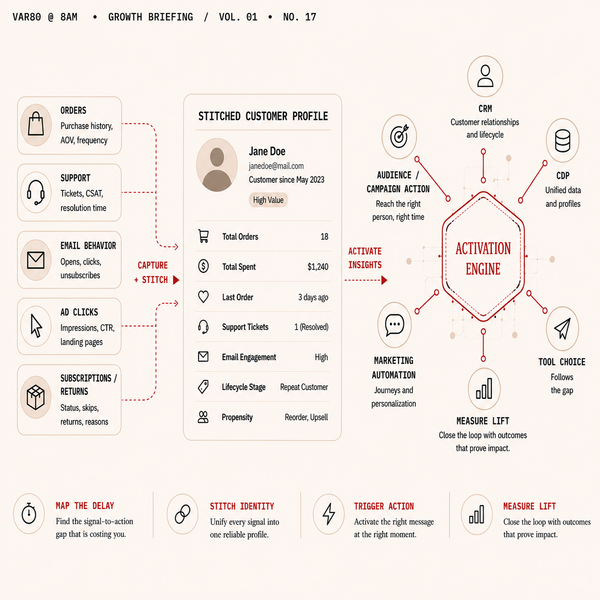
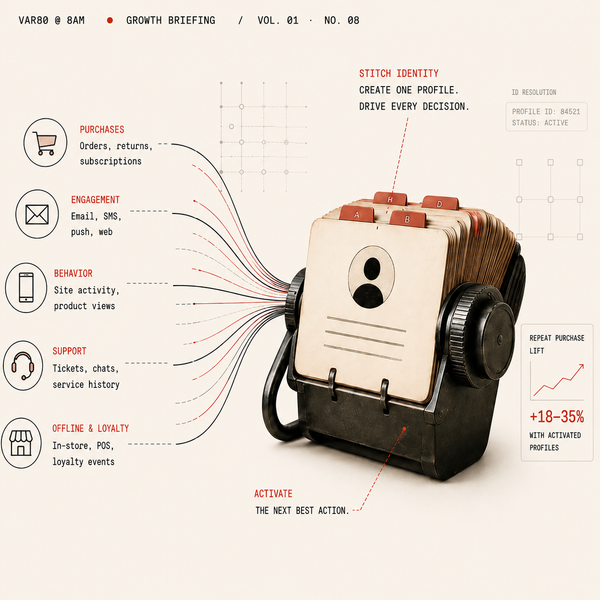
The core problem is identity. If you cannot reliably answer "who is this customer across sessions, devices, ads and support threads" then every personalization decision is guesswork. A CDP exists to stitch identity; the rest of the stack simply acts on the stitched profile. That is not marketing poetry. It is an engineering and product constraint.
Shopify's enterprise guidance frames the customer record as a consolidated view of behavior, transactions, preferences, and channel activity; that consolidated view is only as useful as the identity rules you chose when you built it. Shopify merchants that add a unified profile see store teams begin to act differently because the customer record is no longer siloed; store associates can view bookings, orders and product preferences in one place and change the activation immediately on the shop floor. See Shopify’s David’s Bridal case for an operational example.
Identity stitching is a product decision
Identity stitching choices deterministic versus probabilistic matching, canonical ID model, refresh cadence for merged profiles are product trade-offs, not procurement checkboxes. Twilio Segment describes identity resolution as the connective tissue between customer events and activation. If you adopt probabilistic linkage to avoid asking customers to log in, you accept a higher false-positive rate; if you require persistent canonical IDs you increase friction but improve precision. The choice determines which operations are possible downstream: real-time suppression of ad audiences, immediate lifecycle triggers after support resolution, or sub-minute audience fan-out for live sales.
Deciding which model to deploy is a product conversation. It needs the head of engineering who can estimate error modes, the head of privacy who can set consent patterns, and the head of marketing who will pay the operational cost when an identity conflict forces manual rework. Identity is not a checkbox on a vendor evaluation matrix; it is an architectural contract between how you collect signals and how you act on them.
A single profile stops marketing from buying the same insight twice
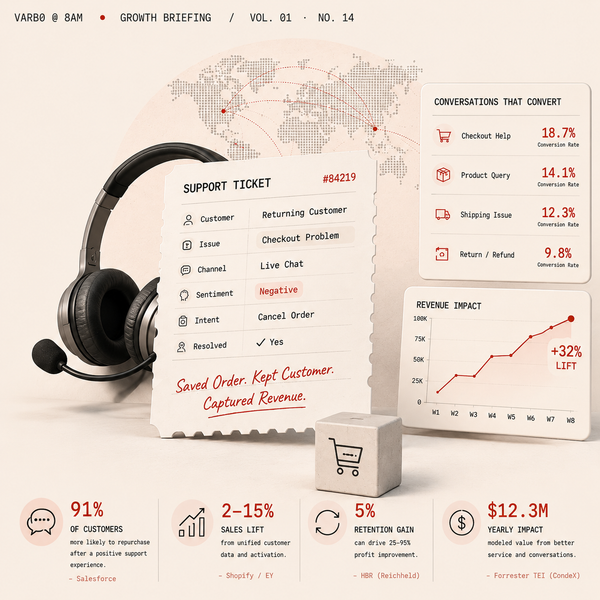
When profiles are stitched, support objections, refund signals, and churn intent become audience signals instead of isolated tickets. Marketing often pays acquisition platforms to rediscover objections that customers have already explained to support. Once a refund concern, sizing question, or delivery complaint becomes a CRM tag or a CDP attribute, marketing can stop retesting offers that will not succeed. Zendesk has repeatedly emphasized that support contains the signals that predict who stays and who leaves; surfacing those signals to activation tools reduces duplicated spend and inconsistent CX.
Case evidence is telling: when store ops and online channels share a unified profile, the organization stops running identical experiments in three places and starts allocating a single hypothesis to the channel that can best act on it. The result is not only cleaner personalization but lower CAC because lookalike seeding and suppression run off the same, current profile instead of stale daily exports.
A CRM plus automation is enough when the customer journey is simple
Startups and small D2C merchants win with CRM-first stacks because the time-to-value is quick. Instrument your commerce events, map basic segments into your CRM, and run lifecycle automations. Klaviyo's playbook is built on this fact: abandoned-cart and lifecycle flows often trigger the bulk of early retention lift for stores on a single platform. You can prove value in a quarter and fund further investment from the incremental revenue. Klaviyo’s automation guidance is the canonical playbook for this approach (Klaviyo — Ecommerce Marketing Automation Guide).
That pragmatic path buys you time. It buys the business runway while you clarify the next hidden variable: how many destinations must receive always-fresh audiences, how many channels must read the same profile, and how many markets or login surfaces multiply identity resolution complexity. If your customers live in one region, purchase only through one commerce platform, and rarely interact offsite, automation plus CRM is almost always the right first purchase.
Small stacks should sequence CRM then automation
For single-market, single-platform merchants the rational sequence is obvious. First instrument your commerce events consistently so that every abandon, purchase, subscription update, and refund has a single, documented payload. Next, prioritize flows that attach to clear revenue outcomes: abandoned cart, post-purchase cross-sell, and reactivation of high-CLV cohorts. The goal is to demonstrate measurable lift from automation before introducing systemic identity complexity. Salesforce’s overview of CRM highlights the sales and retention improvements CRM produces when the commerce data is consolidated; use that initial lift to justify more identity work later (Salesforce — What Is CRM?).
Latency becomes a feature at scale
The CRM-first model breaks at a precise operational inflection point: when audience freshness and identity breadth become business constraints. Two examples identify that moment. The first is real-time suppression of ad audiences after support refunds or chargebacks; if your ad spend must immediately stop showing an ad to a refunded customer, nightly exports are too slow. The second is on-site personalization during live sales events where a sub-minute profile update materially changes conversion. Both cases demand an always-current profile and a high-throughput fan-out to many destinations. That is the CDP problem statement.
Put another way, CRM + automation is the minimal, fastest-to-value stack for the many D2C teams who operate largely from one commerce platform. But it is not a permanent architecture for brands whose customers cross ads, subscriptions, marketplaces, and support. The moment you need sub-minute synchronization across three or more activation destinations, the CRM-only model starts to leak performance and cost.
A CDP becomes necessary when identity and latency become revenue constraints
Industry descriptions are convergent: CDPs unify behavioral and transactional data, resolve identity, and fan-out audiences to activation tools with low latency. Adobe’s CDP explainer emphasizes exactly this role: CDPs create unified profiles that power real-time personalization and cross-channel activation. A CDP buys you three durable capabilities order-level fidelity, deterministic stitching, and activation-ready audiences that a CRM export model cannot reliably replicate at scale (Adobe — What is a Customer Data Platform?).
Choosing a CDP is not an insurance policy. It is a decision you buy when fragmentation and throughput create recurring operational costs that automation and CRM exports cannot resolve. The test is practical: can your marketing, support, and ads teams share a single, current customer profile fast enough that each activation decision reflects the latest known state?
Order-level data and identity stitching are CDP core bets
The CDP’s durable advantage is the union of two technical bets. First, it stores order-level fidelity: every order, refund, subscription change and booking event is retained with the attributes you need to seed audiences and to measure outcomes. Second, it applies deterministic identity stitching where possible and controlled probabilistic stitching where needed. That combination produces activation-ready audiences because you can seed a look-alike model or suppress an ad based on a single canonical profile instead of a patchwork of nightly exports.
Those bets matter because CRM data models are optimized for relationship records and workflows, not for high-throughput event streams or deterministic multi-source stitching. When online behavior, offline bookings, and support tickets must converge into a single decision, the CDP is the pragmatic layer that reduces integration friction and preserves order-level signal fidelity.
Real-time audiences break the CRM-only model
Real-time ad suppression, instant look-alike seeding, and on-site personalization during peak events are examples where audience freshness materially reduces CAC or protects conversion. In those moments a nightly dump from a CRM is not merely inconvenient. It is a performance tax. Brands that need that freshness choose a CDP because it sustains a sub-minute or near-real-time export SLA to all destinations.
Amperity and Twilio Segment customer stories demonstrate this pattern: when identity resolution routes events into activation destinations in near real time, advertising waste falls and onsite personalization becomes a revenue lever rather than a controlled experiment. The vendor capabilities are the point; the business outcome is lower duplicated spend and faster action on customer signals.
The real cost of a 'CRM-first' decision is fragmented identity and duplicated spend
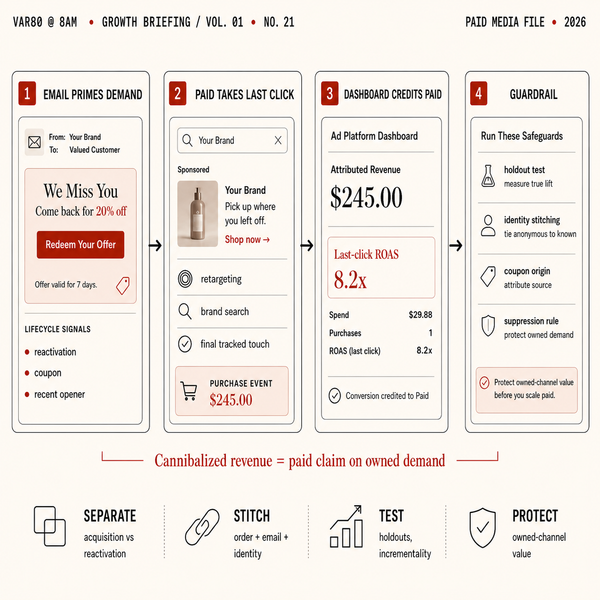
Every architecture has a hidden tax. For CRM-first buyers that tax is identity fragmentation. When support, ads, and store ops live on different records, marketing routinely pays acquisition platforms to rediscover information that support already captured. Support tickets contain three signals marketing needs but rarely receives: objection language, churn intent, and post-purchase confusion. The value of those signals is not in raw transcripts. It is in changing a segment, a flow, or an ad audience when the signal appears.
Marketing often pays to rediscover objections customers have already explained to support. That is a recurring operating expense, not a one-time data problem. Centralizing refund and support signals into a single profile reduces duplicated ad spend and avoids the learning loops that stall when each team re-solves the same problem in isolation.
Support tickets are a goldmine, not an afterthought
Support is the point of high-quality qualitative data. Zendesk’s research and operator experience show that ticket-level signals predict who will churn and why. When you convert a support disposition into a profile attribute — for example, "refund-risk: true" or "sizing-issue: true" — you enable targeted suppression of ads and tailored recovery flows in email or SMS. That conversion is an operational event, not a BI report. The cost of ignoring it is repeated acquisition for the same inactive cohort and inconsistent CX where the email team sends offers that must be reversed by the support team later.
Organizationally, the fix is governance. Define who maps support dispositions into customer attributes, how often identities reconcile, and which flows change when a support flag is set. With that guardrail, the unified profile converts support labor into a marketing asset instead of an isolated log of complaints.
How to choose: Five operational tests that decide whether you need a CDP, CRM, automation, or a hybrid

The vendor debate collapses to five operational tests you can run in a hallway with your head of retention and your engineering lead. These tests predict which investment will close the longest gap fastest.
Test 1: Identity breadth. If a customer has multiple login surfaces, marketplaces, subscriptions, or offline touchpoints that must be reconciled before activation, you need a CDP. Test 2: Activation latency. If you must suppress ads, seed look-alikes, or personalize on-site in sub-minute windows, nightly CRM exports are insufficient. Test 3: Number of destinations. If your segmentation must fan out to more than two destinations reliably and often, synchronization complexity justifies an identity layer. Test 4: Support signals. If support dispositions frequently change activation logic, centralize those signals into the profile so marketing stops rediscovering objections. Test 5: Governance readiness. If you cannot assign ownership for identity resolution, SLAs for audience refresh, and runbooks for failed exports, pause on the CDP purchase — governance, not software, drives value.
If identity spans devices and platforms, you need a CDP
The clearest signal for a CDP is multi-platform identity. When customers appear in a marketing click, an app session, a marketplace order, and a support ticket, the only reliable way to activate off that composite history is a stitched profile. Brands that chose a CDP because identity breadth was already material found that look-alike performance and suppression logic improved quickly because audiences were fresher and canonical.
If lifecycles live in email and SMS, CRM + automation suffices
Brands where commerce, support, and lifecycle are tightly coupled on a single platform should prioritize event hygiene and automation first. The operating pattern is simple: instrument clean events, demonstrate lift from flows, and then measure whether the incremental improvement from a CDP justifies its TCO. The pragmatic sequence reduces procurement risk and lets the data prove the need for identity work.
If you must push audiences to ads in real time, prioritize CDP
Audience freshness matters to CAC. Real-time suppression after refunds, immediate look-alike seeding during a live drop, and instant cross-channel suppression for high-LTV customers are all use cases where CRM exports fail. When these cases matter to CAC or conversion, a CDP delivers the required throughput and identity fidelity to keep paid spend efficient.
Each test is operational and falsifiable. Run them against your top six conversion flows and you will end the vendor debate quickly: if three of the tests return yes, prioritize identity; if none do, sequence CRM and automation and measure lift first.
Implementation failures that make CDPs a liability — and how to avoid them
CDPs are powerful when implemented carefully and toxic when implemented without governance. The failure modes are predictable and avoidable.
Failure 1: Over-instrumentation. Teams send every event imaginable to the CDP without a mapped activation path. Result: inconsistent audiences and stalled activations. Failure 2: No canonical ID policy. The CDP ingests conflicting identifiers and produces brittle audiences that require manual reconciliation. Failure 3: Missing SLAs for exports. Integrations fail quietly and downstream teams chase ghosts. Failure 4: No ownership for identity disputes. When two sources tell different customer stories, no one resolves the conflict and profiles oscillate.
Start with a minimal event model, not everything you can track
The first implementation step is to define a minimum viable event set tied to activation outcomes. Treat event taxonomy as product work, not engineering curiosity. Ask: which events change an audience or trigger a flow right now? Instrument those first. Only after those events produce measurable lift should you add secondary signals. This rule prevents the CDP from becoming an expensive, noisy repository of un-actionable events.
Define ownership and SLAs for identity and activation
Governance makes the CDP a boardable asset. Define who resolves conflicting IDs, how often audiences refresh, and who owns export failures. Name the SLA: "audiences used for paid suppression must be fresher than X minutes; any export failure triggers an automated alert to Y and a rollback to nightly CSV until repaired." Operational clarity prevents a CDP from introducing new operational debt and ensures it speeds up activation rather than slowing it down.
When to buy, when to build, and what to postpone this quarter
The practical procurement rule is conservative and simple: prove activation lift first; fund identity only when the lift math fails because of identity fragmentation or latency. Build only when you can show that homegrown stitching has a lower TCO and lower operating risk than a vendor; buy when the integration surface and identity needs exceed your team's capacity to maintain it.
Many brands try to build homegrown stitching as an optimistic cost-saver. That bet occasionally pays off for teams with long-term pipeline engineers and strict governance. More often the integration surface grows and ownerless pipes produce brittle audiences. Several brands that started homegrown later found vendor CDPs cheaper to operate once the number of destinations rose above a threshold.
Budget for identity only after you can measure activation value. The CDP budget is easiest to justify when tied to specific outcomes: reduced duplicated ad spend, measurable CAC reduction from fresh audience suppression, or X% faster recovery from refunded customers. When in doubt, hybridize: CRM + automation plus targeted identity pipes for the channels that require freshness, rather than committing upfront to an enterprise CDP.
One procurement litmus test to use this quarter: no CDP purchase without an activation ROI plan and an event-governance owner. If you cannot hand an auditor a single-page plan that ties identity budget to a CAC or retention delta in 90 days, postpone the purchase and spend the quarter improving event hygiene and flow performance.
Implementation checklist: what you must do in the first 90 days

Turn the essay into operational steps. In the first 90 days perform an "activation latency" audit that maps your top six conversion flows, the longest delays between signal and action, and the single tooling stop-gap that closes the largest gap. For example, map abandoned-cart → email flow latency; map support refund → ad suppression latency; map subscription cancellation → call-center outreach latency. Each flow must have an owner, a target SLA for audience freshness, and a measurable outcome.
Do not attempt to stitch everything immediately. Begin with the smallest identity surface that closes the longest gap. Name the operational owner for identity resolution and the SLA for each export. Create one canonical audience export that stops paid spend when a refund flag appears. Measure the reduction in wasted paid impressions and the change in CAC. If the CAC improvement matches your ROI plan, the next quarter’s identity budget is justified.
This is not theory. It is a procurement litmus test that converts the vendor discussion into measurable operational steps your CFO will accept: define the flow, measure current lag costs, choose the minimal tech to close the lag, and prove the lift before expanding scope.
Stop Asking 'Which Tool?' — Start Measuring 'Which Customer Action Are We Automating?'
The uncomfortable truth: the fight between CRM, CDP, and automation is tactical. The strategic question is which customer action you must automate this quarter. Measure that action, estimate the cost of latency, and choose the smallest tool that closes the longest gap.
Operational directive for the next 90 days: run an "activation latency" audit that maps your top six conversion flows, measures the longest delay to action, and names the single tooling stop-gap that closes the largest gap. If identity gaps span three channels, budget for a CDP this quarter. If the top flows are email-first and live on one platform, prove flow lift before investing in identity.
No CDP purchase should proceed without a one-page activation ROI plan and a named owner for event governance. That rule converts a vendor choice into a procurement test: prove activation value first; buy identity only when the business cannot close the gap by sequencing smaller steps.
Run an activation-latency audit this quarter and stop buying platforms until it produces a clear ROI plan.
Stop Buying Tools Before Fixing Data Activation
Var80 helps D2C brands connect customer data, segments, campaigns, and workflows so your CRM, CDP, and automation stack actually drives retention, AOV, and repeat revenue.
Leave a comment