


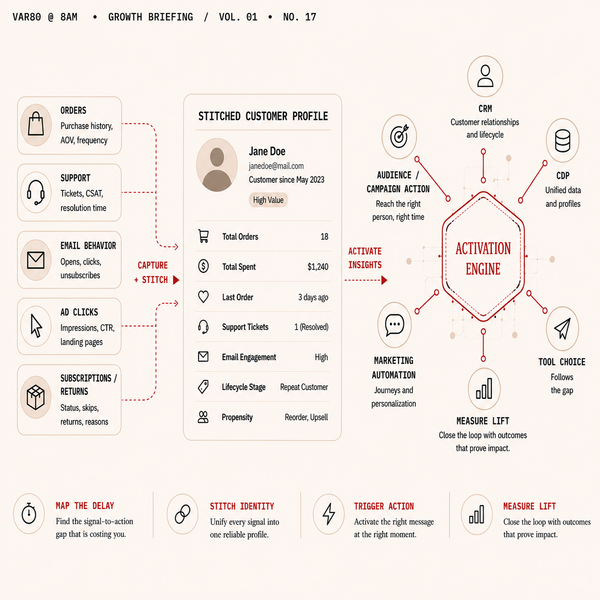
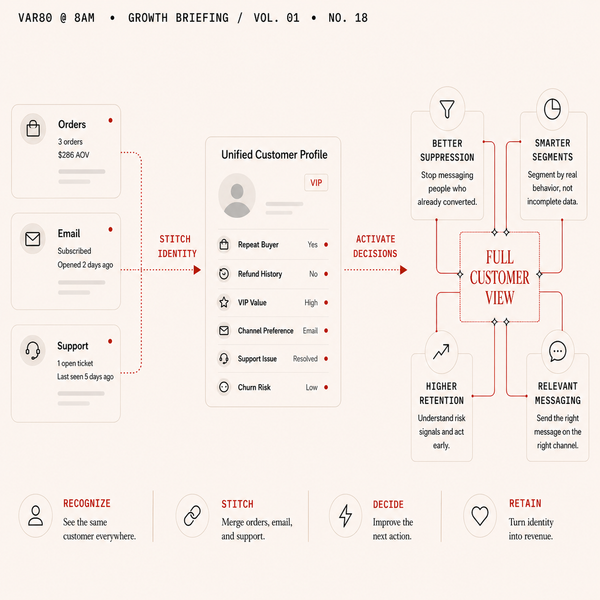
A unified customer profile matters because it changes the next action you take with each customer. When Shopify, Klaviyo, Gorgias, Zendesk, and Meta hold separate customer signals, brands send the wrong offer, suppress the wrong buyer, miss VIPs, and treat returning customers like new ones.
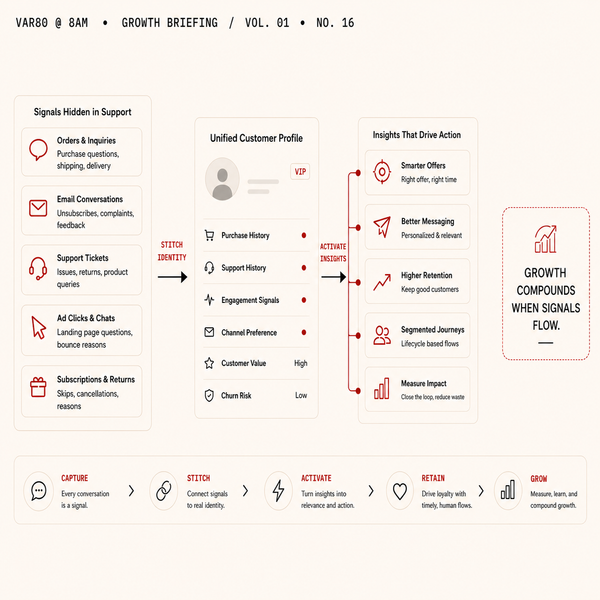
Shopify, Klaviyo, Gorgias, Zendesk, and Meta each see different pieces of the customer. The revenue problem begins when those pieces never become one profile.
TL;DR – Your CRM Cannot Grow What It Cannot See
- Partial Customer Profiles Create Revenue Waste: When commerce, email, support, and ads see different versions of the same customer, brands make the wrong suppression, offer, channel, and retention decisions.
- A Unified Profile Is a Decision Engine: Customer data becomes valuable when it changes the next action—who to suppress, who gets VIP treatment, what message to send, and when to send it.
- Integration Alone Does Not Solve Identity: Connectors move data between systems, but identity stitching determines whether those events actually belong to the same customer.
- CRM vs CDP Is the Wrong Debate: CRMs should drive customer actions, while CDPs become useful when identity resolution and audience governance must work reliably across multiple systems.
- Visibility Only Pays When It Changes Activation: Stitched profiles should become segments, suppressions, VIP flows, recommendations, and paid audiences—not simply cleaner dashboards.
- Identity Must Become an Owned Business Capability: Treat identity as a product with owners, match-rate and latency targets, merge rules, and activation contracts so customer data consistently changes revenue decisions.
1. Half-visible customers create a predictable revenue drag
The first problem with a half-visible customer is not a missing dashboard. It is a wrong action. When commerce, email, support and ads each carry a different identity for the same person, every activation that depends on identity—suppression, personalization, lookalike generation—becomes a probabilistic guess rather than a guarded decision. That guess costs money today and compounds across the customer lifetime.
Shopify frames the unified profile precisely this way: not as archival accuracy but as an operational golden record that reduces overhead and speeds activation. Shopify’s enterprise guidance describes a single customer view as a consolidated profile that captures transactions, storefront events, preferences and channel activity, and it positions that consolidation as a practical lever to lower total ownership costs and shorten activation timeframes. See Shopify’s discussion of the single customer view for the platform’s operational framing and business claims at Shopify’s Single Customer View guidance.
The revenue payoff from a stitched profile shows up most clearly in automation benchmarks. Klaviyo’s published material demonstrates that automated lifecycle flows materially outperform one‑off campaigns on revenue per recipient, turning stitched attributes into repeatable revenue. For marketers this is an operational rule: a profile that can feed flows reliably produces more revenue per recipient than a profile that only supports batch campaigns. Klaviyo’s benchmarks and guidance on flows and RPR are documented at Klaviyo Help Center and in Klaviyo’s product blog.
The economics are not subtle. A stitched profile changes retention probabilities by enabling recognition across channels, and recognition compounds. When a returning customer is treated as new on the website but as known in email, each channel erases the reinforcement the other could provide. McKinsey’s marketing and personalization research captures the same structural problem: brands that lack integrated data and technology foundations repeatedly face adoption and scaling barriers that limit personalization and retention gains. McKinsey’s work on marketing foundations and personalization is included at McKinsey on marketing foundations.
A unified profile is a decision engine, not a report
The single customer view matters only insofar as it gates different next actions. A unified profile becomes useful when it prevents a marketer from repeating a low-value decision, when it tells a merchandiser to change a price or when it allows a support agent to suppress a retention flow. If a stitched profile only exists for analysts to query, it has failed its core purpose. Shopify’s guidance makes this operational pivot explicit: the golden record is there to reduce friction and TCO so activation can happen faster and with fewer errors; the platform framing is available at Shopify’s Single Customer View guidance.
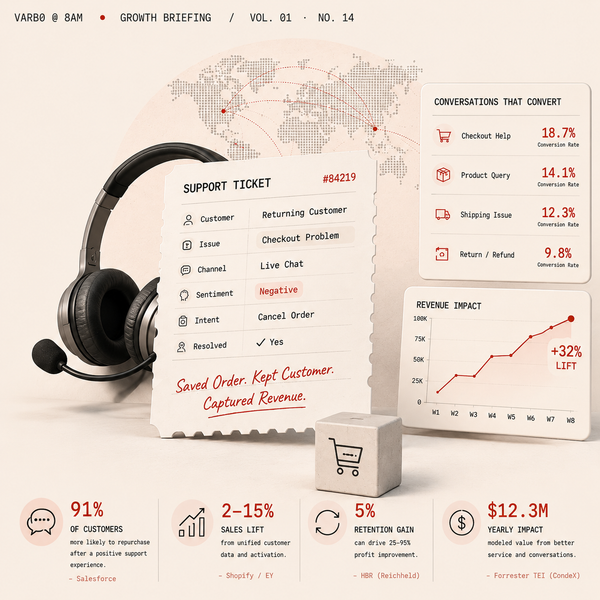
Practically, the decisioning use cases that justify the work are suppression for refunds and returns, VIP routing for high‑CLV shoppers, product recommendations that respect prior complaints, and channel suppression for customers who explicitly opt out after a poor support experience. Recognition must be surfaced where decisions are made, not only buried in a warehouse. The profile’s job is to recommend, gate, and change the next action.
Visibility drives LTV more than more campaigns
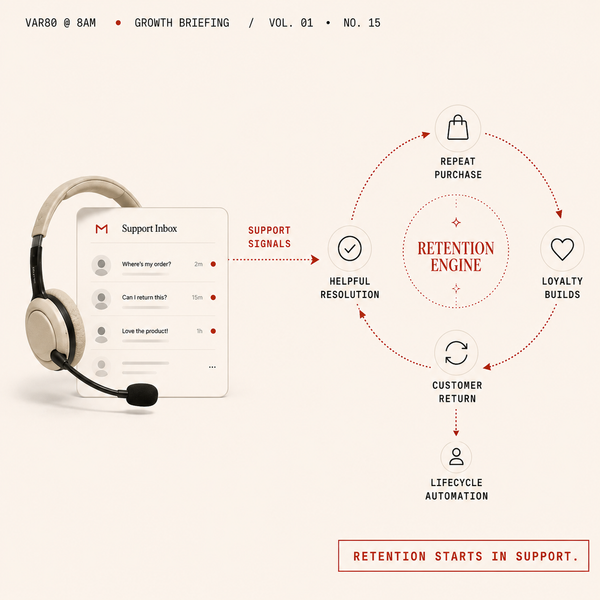
Sending more messages is not the same as recognizing a customer. Recognition changes retention probability. When flows are able to reference stitched identity—order history, support tags, and cross-channel behavior—they personalize timing and offer in ways one-off campaigns cannot. Klaviyo’s flow benchmarks show automated lifecycle programs producing outsized revenue per recipient compared with manual campaigns; use Klaviyo’s benchmark materials to understand how flow-driven recognition compounds LTV at scale at Klaviyo Help Center.
There is one clear failure case: if your stitched identity is slow or frequently wrong, flows will serve incorrect offers and suppress the wrong customers. Visibility that is stale or inaccurate is actively harmful because it creates false signals that managers trust. The practical test is simple: if a suppression rule or VIP flag is wrong one month in five, the cost of being wrong will likely exceed the incremental revenue the profile delivers when it is right.
2. Silos turn good customer signals into wasted ad spend and bad CX

The second thesis is that silos are not merely inconvenient; they are a tax on paid media and a cause of avoidable customer loss. When support agents hear refund reasons, delivery objections, or sizing complaints, and that information does not flow into marketing or ad audiences, the acquisition team keeps paying platforms to rediscover the same objections. In other words, marketing pays twice for the same insight.
Meta’s audience documentation demonstrates why clean identity matters for paid efficiency. Custom Audience match rates and upload hygiene directly influence who a campaign reaches and who must be suppressed. Meta also imposes operational constraints on how customer lists are uploaded and processed, and these constraints create latency that matters for suppression flows; for technical details see Meta’s audience guidance at Meta Custom Audiences guidance.
Zendesk’s research links support outcomes to retention risks, and the numbers are stark: the platform’s CX reporting highlights that unresolved tickets and poor agent context correlate with customer churn risk. Zendesk frames support interactions as a direct input to loyalty and churn, which argues for surfacing support signals into the activation stack rather than treating them as separate operational chores. Zendesk’s materials on retention and CX are available at Zendesk on customer retention.
Multiple platforms break identity; integrations rarely finish the job
The common technical diagnosis—install the connector, map the fields, and watch the profiles merge—is optimistic. In practice, connectors move events; they do not resolve identity logic at the quality levels required for suppression, lookalikes, or VIP routing. Event semantics drift across SDK versions, emails are captured in different fields, customer records are duplicated when orders are created by guest checkout, and offline operations carve out identity exceptions. Twilio Segment frames identity resolution as the connective tissue that must be solved before activation, and Segment’s material emphasizes that collecting events is easy but activating them reliably is the hard part. See Twilio/Segment on data activation at Twilio on data activation.
The result is a chronic mismatch: different systems point to different canonical identifiers, and even with connectors installed the match rate that matters for campaign suppression or lookalike seeding is often far lower than platform dashboards imply. The real question is not whether tools are connected but whether the match rate for the subset of events that drive decisions meets a business SLA.
When profiles are incomplete, measurement lies to you
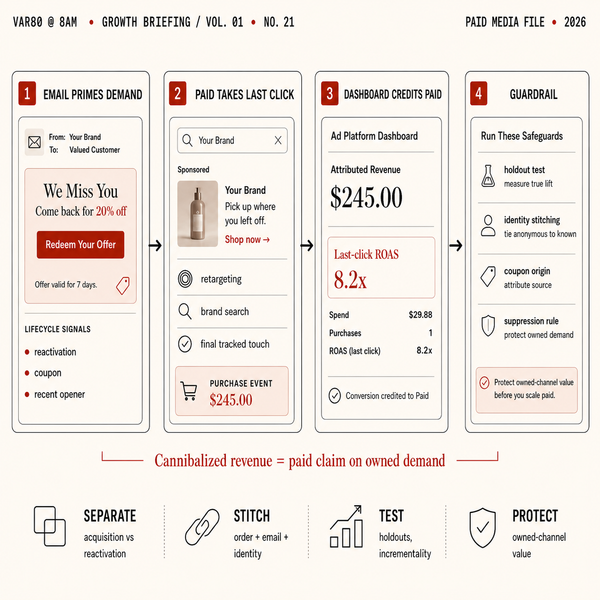
Incomplete profiles bias measurement. If purchase events from marketplace sales or phone orders are not stitched into your CRM, cohorts look artificially healthy or stale depending on which data is missing. Attribution models will over-credit the last-click channel that captured the conversion event while ignoring earlier steps recorded in a different tool. This misattribution inflates CAC estimates, masks the true effectiveness of retention flows, and drives poor budget allocation.
The practical consequence is that a brand can iterate toward worse decisions while believing its metrics confirm progress. The required discipline is to measure match rate and data freshness for every audience used in paid media and to treat those metrics as gating variables for budgeting. If a lookalike audience is seeded from a list with 50% match, the lookalike will reflect a partial customer base and likely underperform. That failure mode is not hypothetical; it is the predictable result of silos that have not been rebalanced against activation requirements.
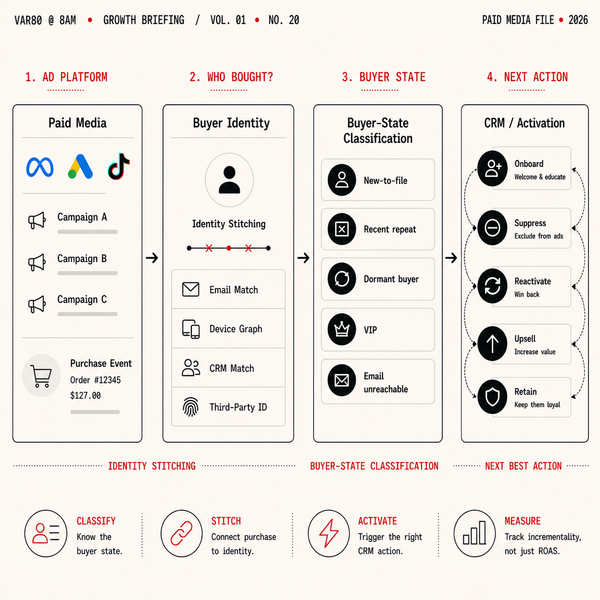
3. Identity stitching is not integration. It is the work that makes action safe
Identity resolution is not a configuration step; it is an engineering and governance effort that sets the difference between connectors and activation. Twilio/Segment describes identity resolution as the layer that connects customer events across tools before activation. The platform language is instructive: collecting data is easy; building identity graphs that reliably answer "is this the same person?" under operational constraints is the actual work. See Twilio on identity and activation at Twilio on data activation.
Vendors disagree about the practical method for stitching. Amperity argues for an identity‑first, ML‑augmented approach that discovers matches deterministic rules miss. The vendor materials claim deterministic methods miss 40% or more of true matches and that many misidentified customers represent disproportionate revenue. Those vendor claims deserve scrutiny but they point at a real engineering trade-off: precision versus reach. Amperity’s identity resolution framing is at Amperity identity resolution.
API-first wins when behavior rules matter
API-first integration patterns are preferable when teams need control over identity logic and event semantics. If your activation rules depend on behavioral nuance—cart composition, multi-touch window semantics, subscription state transitions—then custom APIs allow you to implement the exact merge and attribute logic you require. The trade-off is engineering cost and ownership. API-first gives you control and auditability but demands developer time to keep identity logic current as the business and data sources evolve.
Operationally, choose API-first when you have complex behavior rules, fast iteration on segmentation logic, and engineering capacity to own identity contracts as product code. Without those conditions, API-first becomes a maintenance liability rather than an advantage.
Middleware is the pragmatic productivity trade-off
Middleware or managed identity layers provide the fastest path from data to a usable stitched profile for small teams. These layers reduce engineering overhead and often include built-in connectors, identity graphs, and mapping interfaces. The compromise is governance risk: middleware can hide merge rules and make it harder to trace why a profile was merged or split. Teams that choose middleware must codify SLAs for match rates, pipeline latency, and ownership to prevent drift. Twilio/Segment’s documentation is useful for understanding how identity layers are positioned as a governance surface rather than a turn-key replacement for product-level contracts at Twilio on data activation.
Choose middleware when you need speed and limited engineering capacity, but plan governance milestones: a 90‑day audit of match quality, a documented merge policy, and a scheduled handoff of edge-case logic back to engineering within six months. Without that cadence, middleware solves today’s problem and creates tomorrow’s technical debt.
Native apps scale fastest — until they leak semantics
Native Shopify and Klaviyo apps provide the lowest friction for many merchants because they reduce latency and expose high-confidence events. The cost is hidden semantics: native connectors can normalize events in ways that break when you need to combine those events with non-native sources. Shopify’s and Klaviyo’s native integrations are powerful but not magical; they require deliberate mapping of order identifiers, guest checkout behavior, and subscription states if you expect the profile to be the canonical source for activation across ads and support. See Shopify’s notes on unified commerce and native integration patterns at Shopify Single Customer View.
Call this the leakage failure mode: native apps make identity cheap to start and expensive to debug later. Teams that accept the short-term velocity must also accept a mid-term governance plan that surfaces and codifies any semantic assumptions the native app encodes.
|
Pattern |
Strength |
Key Risk |
When to choose |
|
API-first |
Control, auditability |
Engineering cost |
Complex behavior rules, engineering capacity |
|
Middleware/CDP |
Speed, productivity |
Hidden merge rules, governance drift |
Small teams, short time-to-value, plan for audits |
|
Native apps |
Low friction, fast activation |
Semantic leakage with non-native sources |
Simple stacks, high trust in vendor semantics |
4. CRM versus CDP is the wrong debate when the signal loop is broken

The decisive question when teams debate CRM versus CDP is not where you store historical events. It is where activation contracts live. If you have a CDP that only pushes data into a CRM without contracts about which system makes the next decision, you have added cost without changing behavior.
Amperity and other identity-first CDP vendors frame the problem explicitly: CDPs are identity systems built to resolve and govern matches across channels and business units. CDPs are valuable when identity accuracy and cross-system governance are the bottlenecks to activation. Amperity’s public materials explain why identity-first CDPs exist and how they position themselves relative to action systems at Amperity on CDP identity.
Klaviyo and Shopify both highlight that CRMs and ESPs function as activation systems and can deliver outsized value when profiles are already stitched and flows are in place. That is a practical concession: small teams often do not need a full CDP if they can stitch identity where activation happens and if their activation needs are constrained to email and onsite personalization. Klaviyo’s guidance on when CRM activation suffices is available at Klaviyo Help Center, and Shopify’s enterprise guidance on unified profiles explains when native stacks reduce TCO at Shopify Single Customer View.
CRMs are action systems; CDPs are identity systems
Put simply, CRMs should own the activation contracts that determine the next action. CDPs should own identity resolution and audience governance when the same identity must be trusted across multiple activation systems. The wrong mental model treats them as interchangeable. If you move data into a CDP but keep activation logic decentralized and undocumented, you will have paid for a new storage tier without changing any downstream decisions.
One failure case is premature procurement. Small teams that buy a CDP before they have a single activation experiment in production often find themselves paying for profiles that do not yet change behavior. The right sequence for many teams is stitch first, prove one activation experiment, then expand identity tooling if the outcome requires cross-system governance at scale.
Small teams should stitch first and automate second
Early-stage stores often get more ROI from stitching orders, email, and support tags into a single action system and running one activation experiment than from purchasing a full CDP stack. The cheapest, fastest test is concrete: stitch orders and support tags into a VIP suppression flow and measure whether churn and paid media leakage decline in 90 days. If the experiment works and the match-rate and latency requirements exceed what a native CRM can provide, that is the signal to evaluate a CDP or middleware layer.
5. Visibility only pays when profiles become segments, suppressions, and flows
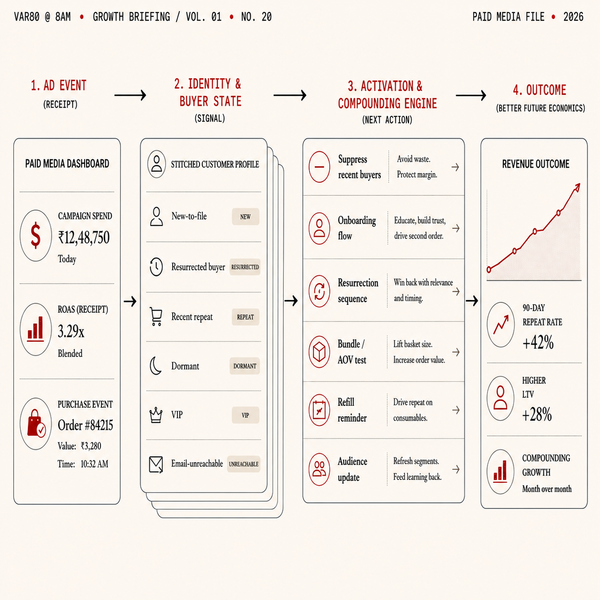
All of the previous sections lead to a single operational test. Visibility is not valuable until the stitched profile changes audience membership, suppresses low-value channels, or triggers a different workflow. Klaviyo’s published benchmark data shows lifecycle flows tend to outperform one‑off campaigns, which is the most direct proof that activation beats perfection when profiles are actionable. Reference Klaviyo material on flows and performance at Klaviyo Help Center.
Meta’s audience construction rules and lookalike guidance show how activation-ready segments improve paid efficiency. When a lookalike is seeded from an activation-ready stitched segment, ad performance improves because the seed set is representative of true customer value rather than a partial, noisy subset. Meta’s operational documentation for custom audiences and lookalike seeding is available at Meta Custom Audiences guidance.
A VIP who lapsed 30 days ago deserves different treatment
High-value customers need distinct decision paths. A VIP who lapsed 30 days ago justifies a higher-cost, urgency-based outreach than a low-value recent visitor because the expected marginal return differs. If your profile cannot reliably show who is a VIP across channels, you have no defensible reason to pay more to reacquire them. The practical step is to build segments that are defined by value and state—VIP status, days-since-last-purchase, return history, support tags—and then map different decision trees to each segment. Absent reliable stitching, these distinctions collapse back into guesswork and wasted cost.
Measure activation by decision velocity, not by data completeness
The right KPI for early experiments is how quickly a signal changes the next action. Measure the time from event (support tag, order, subscription cancel) to decision (suppress, escalate, route to VIP flow) and the business impact of that decision within a single quarter. Twilio/Segment’s materials on activation focus on latency and governance as the operational metrics that determine whether data becomes useful at decision time; see Twilio’s activation guide at Twilio on data activation.
Run a 90‑day proof: stitch transactional order events and support tags into a suppression flow for paid channels, and measure incremental ROAS lift and a reduction in refund-driven reacquisitions. If suppression reduces wasted ad spend and improves campaign margins in 90 days, the profile is paying for itself. If not, iterate on match quality and latency until the decision velocity meets the business SLA.
6. Identity has to become a product, not a backend task
The final reframe is prescriptive and operational. Stop treating identity as an engineering ticket and start treating it as a cross-functional product with SLAs, owners, and activation contracts. Identity as a product means you measure match-rate, latency, and the change in downstream decisions. It means you define who owns merge rules, who can change suppression logic, and how disputes about identity are escalated. Amperity’s approach to identity and governance is a useful reference for what an identity product looks like; see Amperity’s identity materials at Amperity identity resolution.
Operational directive: in the next ninety days define identity ownership, pick one integration pattern, and run one activation experiment that proves or disproves the stitched profile’s business value. The smallest useful experiment is concrete: stitch orders and support tags into a VIP suppression flow that feeds both email flows and paid audience suppressions. Your success criteria are simple. First, the match rate used for suppression must exceed your historical baseline by a measured delta. Second, suppression must reduce wasted ad spend or reduce avoidable re-acquisition rate within three months. Third, the decision must be codified so the next time the team rebuilds the stack the same rules apply.
The uncomfortable truth is this: technical fixes without a named owner buy tidy reports, not revenue. If you do not assign ownership, your profile will become a messy warehouse table that reassures stakeholders but does not change who you treat as a VIP, who you suppress from email, or which customers you pay to reacquire. Fix the ownership first, then the tech.
Identity is a product. If you do not own the decision, you will only ever own the data.
Your CRM Cannot Grow What It Cannot See
Var80 helps ecommerce brands stitch customer, behavior, support, and purchase data into usable profiles—so marketing can build sharper segments, better retention flows, and revenue workflows.



Leave a comment