


Most brands do not fail because they cannot buy traffic. They fail because acquisition, average order value, and purchase frequency are treated as separate problems. Profitable ecommerce growth compounds when AOV improves, repeat purchases increase, and cleaner customer data makes acquisition more efficient instead of endlessly chasing cheaper clicks.
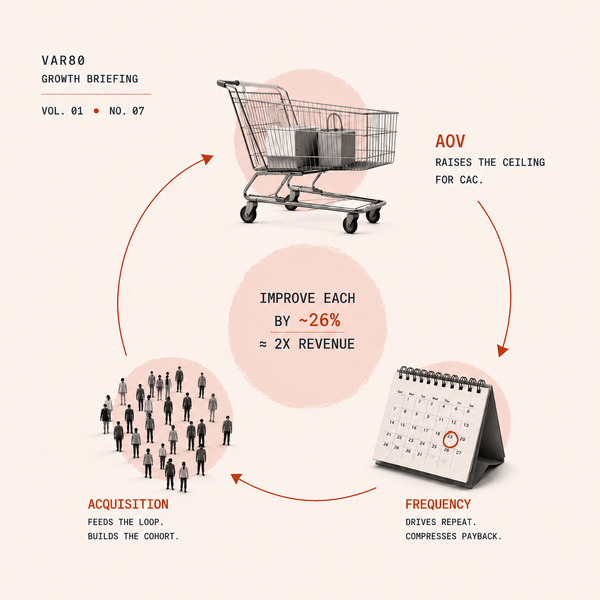
The only growth that compounds is the growth you design as a loop: raise AOV, trigger repeat purchases, and use the cleaner data that creates more efficient acquisition.
Check out how sustainable growth actually works →
TL;DR – Growth Compounds When Acquisition, AOV & Repeat Purchases Work Together
- Acquisition Alone Doesn’t Compound: Rising CAC makes paid-first growth increasingly fragile. Profitable scale comes from improving acquisition, average order value, and purchase frequency as one connected system.
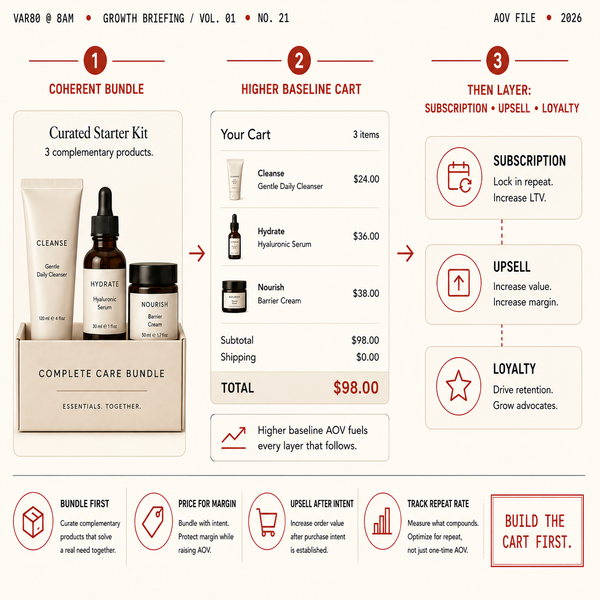
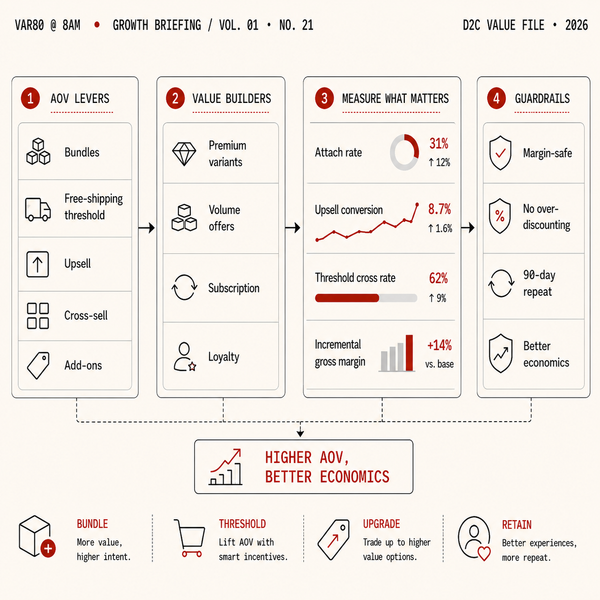
- Higher AOV Raises Your CAC Ceiling: Bundles, checkout upsells, subscriptions, and higher-margin add-ons increase the economics of every acquired customer provided the lift isn’t bought through margin-killing discounts.
- The Third Purchase Changes the Economics: The goal isn’t merely getting a customer to buy again. Repeat-purchase probability strengthens materially as customers reach their third order, turning retention into a more durable growth asset.
- Sequence Matters: Build the data infrastructure first → prove the offer and CRO → activate retention flows → then scale acquisition once you have stronger customer and conversion signals.
- Your Existing Customer Base Is an Underused Asset: Automated lifecycle flows, segmentation, replenishment, win-back, and owned channels can monetize customers you have already paid to acquire instead of continually buying them again.
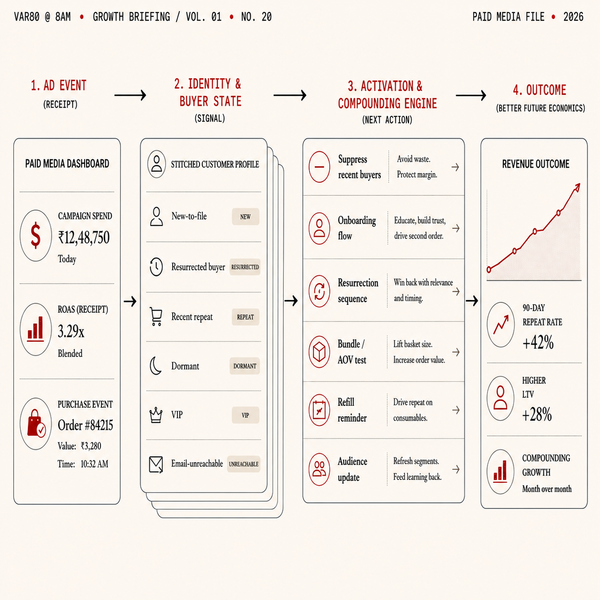
- The Real Growth Loop: Better AOV creates more acquisition headroom → stronger retention increases customer value → cleaner customer data improves targeting → better acquisition feeds stronger cohorts back into the system. That is the compounding loop.
The Broken Growth Model
Most teams separate acquisition, CRO, and retention into three silos because organizationally, those responsibilities are split across agencies, design shops, and in-house growth leads. That separation produces three predictable failures. First, rising CAC is treated as an ad problem rather than a symptom.
Teams double down on creative and channel mix until they exhaust runway. Second, owned channels email, SMS, and first-party data are left as afterthoughts. Klaviyo's 2024 benchmarks show automated flows generate nearly 41 percent of total email revenue from just 5.3 percent of sends, yet many teams run campaigns without flows. Third, operational disorganization results. If dashboards cannot answer simple funnel questions the agency prescribes creative as the cure and the brand fires the same tactics at a different landing page.
The practical consequence is cash inefficiency. You can buy a customer once and lose them because you never engineered the next purchase. You can also increase AOV with a discount bundle that looks good on a dashboard but erodes margin and trains buyers to wait. The broken model looks efficient on surface KPIs. It fails on cohort economics.
One complication is scale illusions. Big brands still grow share through acquisition in aggregate market studies, which is why acquisition cannot be abandoned. The failure is a sequencing and execution failure, not a categorical denial of paid media. The broken model ignores that the per-customer economics change with AOV and frequency, and that those changes can restore or break scale.
The Revenue Compounding Loop
Growth is not the sum of three levers. It is a loop where one lever amplifies the others. AOV increases the ceiling for allowable CAC. Purchase frequency converts that ceiling into long-term payback. Acquisition provides the raw input of new buyers that the loop turns into a valuable, owned cohort.
- Raise order value, and the acquisition budget can rise without destroying payback.
- Trigger a second and third purchase, and the early payback window compresses, which allows more aggressive customer acquisition.
- Improve acquisition efficiency, and you feed better cohorts into the loop, accelerating pixel learning.
The math is blunt and operational. If first order AOV is $75 and blended CAC is $33, then a 30 per cent lift in AOV to $97.50 gives the brand a materially higher per-customer gross to work with. That extra margin either shortens payback, funds broader customer experience investment, or funds higher
acquisition to accelerate cohort growth. The loop is multiplicative, not additive. AOV growth with no repeat buys is fragile. Frequency without an offer that captures enough margin is unscalable. Acquisition without a mature pixel and tested offers is expensive.
One complication is the discount trap. Increasing AOV with blanket discounts or forced bundles that only work with couponing does not change the structural unit economics. Those AOV lifts are demand shifting, not value creation. The loop accepts only real AOV improvements: bundling, higher margin add-ons, subscription adoption, or loyalty-driven spend that persist beyond the promotion window.
Why AOV Raises Your CAC Ceiling

Paid acquisition budgets are constrained by how much you can afford to spend to get a first order and still meet payback constraints. If your gross margin on that $74 order is thin, you cannot pay much more to find a customer. Lift that order value by 30 to 50 percent through bundling, checkout upsells, or subscription enrollment and the allowable CAC rises proportionally.
Consider the One Blade Skio migration. One Blade reported a 49 percent AOV increase and a doubling of conversion after moving to a subscription-native checkout. Charlie Pyles, CEO of One Blade, said: "At the end of the day, One Blade is dependent on subscriptions for our long-term profitability and value as a business." Platform and UX choices are often the operational difference between theoretical AOV lifts and realized economics.
The mechanical relationship is precise. If AOV increases from $74 to $110 and the contribution margin is 40 percent, the incremental gross per order grows from $29.60 to $44. That $14.40 moves the payback window and allows the business to spend more to acquire the buyer. The complication is margin
leakage. If the AOV lift is achieved with a discount that reduces margin to the point that contribution is unchanged, the CAC ceiling has not moved.
Why the Third Purchase Is the Real Retention Milestone
The second purchase matters. It proves that the product delivered value and that the buyer is more than a one-time shopper. But the inflection comes after the third purchase. The repeat purchase probabilities in Smile.io's dataset move in a clear pattern: 27 percent for a first repeat, 49 percent through the second, and 62 percent by the third. Those numbers are directional but show a structural change in behavior.
The third purchase shifts retention from incentive-driven to habit-driven. Before that point many purchases are explainable as promotions, curiosity, or trial. After the third purchase the probability of future purchases rises materially and LTV begins to look like an owned asset. Recharge subscription benchmarks reinforce this: customers on subscription average about 4.1 subscriptions and show 45 percent six-month retention. Subscriptions institutionalize repeat behavior by creating friction for churn and convenience for the buyer.
Klaviyo's benchmarks show how to reach that third purchase quickly. Nearly 48 percent of flow-driven email revenue comes from new buyers, while only 16 percent of campaign-driven email revenue comes from new buyers. Flows are not just retention tools. They accelerate the early purchases that move a cohort to the third order milestone.
One complication is incentive-driven retention. Brands that reach the third purchase via constant discounts risk creating a cohort trained to transact only because of promotions. The healthier path is structural value: faster delivery, refills, subscriptions, superior product experiences, and convenience in reorder.
The Correct Sequence: Data, Then Offer, Then Retention, Then Scale
Sequencing matters as much as the tactics. Set up infrastructure first, test the offer, automate on proven offers, then scale paid when the pixel is mature. Brands that invert the sequence spend money creating weak cohorts and then pay again to fix the owned channel.
Data Infrastructure First: without a unified data layer, every subsequent step is optimizing against noise.
Start with a live dashboard and a CDP or equivalent. The operator on the call described it plainly: "It is like driving a car without the rear view mirror." That is the real cost of operating without top/mid/bottom funnel visibility. The minimum outputs on days 1 to 15 are customer segments, a repeat rate baseline, and AOV by channel.
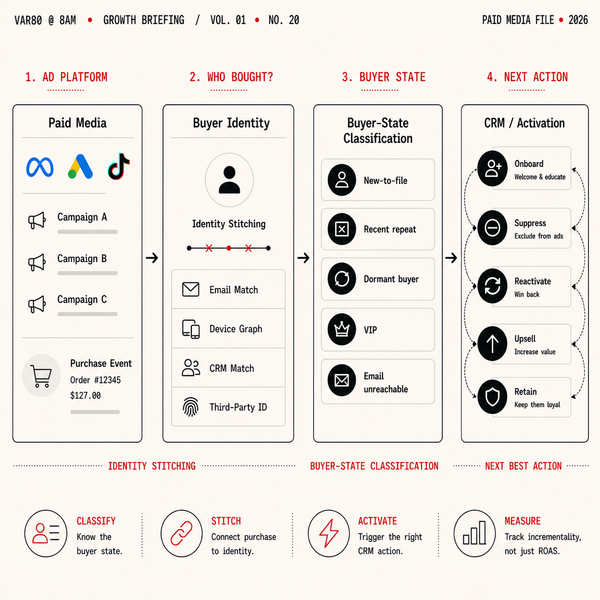
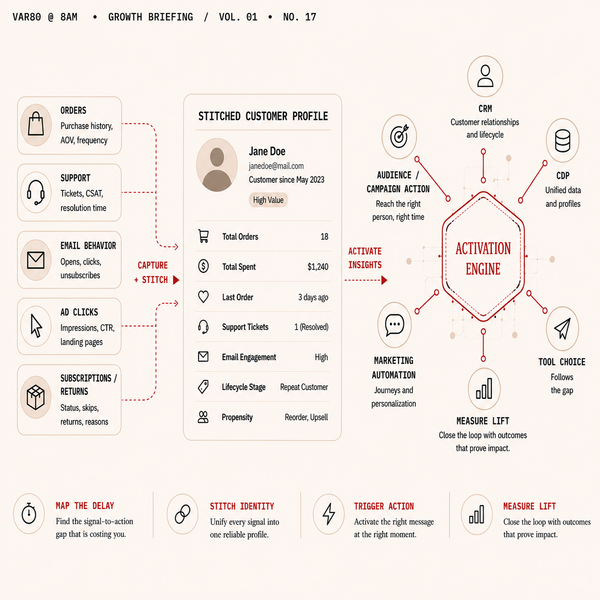
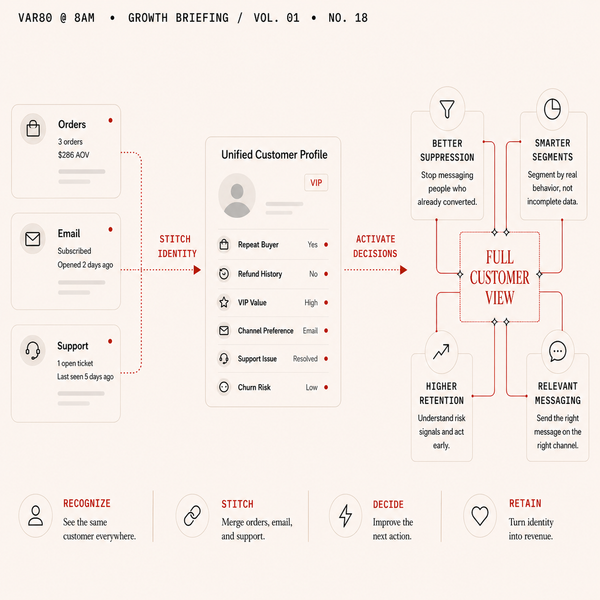
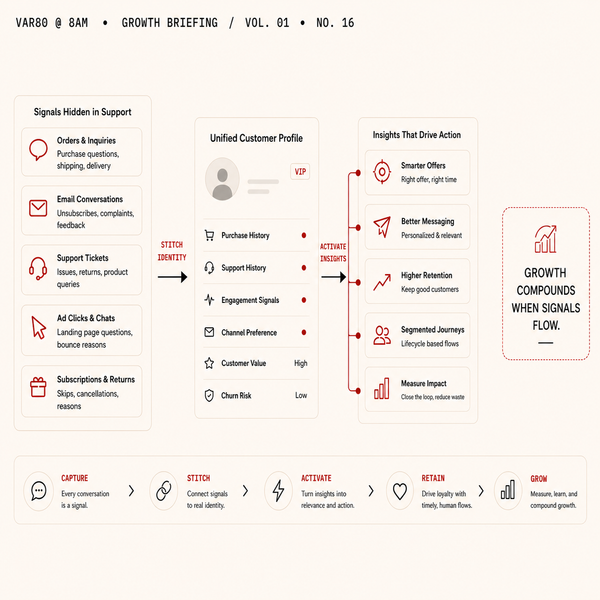
Connect the checkout, email platform, SMS provider, ad pixels, and any offline purchase records into a single reconciled dataset. Mark customers by acquisition cohort, channel, and first purchase behavior. Build a pixel conversion ledger that ties first order value to later revenue. The complication is data plumbing: many brands have Shopify orders, a mail platform, and a spreadsheet. Stitching is nontrivial but necessary.
Offer and CRO Before Retention Automation: the of er must be proven before automations are built around it.
Test the offer before automating retention. The call distinguished testing from experimentation precisely: "Testing is when I pick up a cookie box and try three creatives; experimentation is I want to put a toy along with the cookie and see whether it works — this is too much. Hold your horses." You do not want to scale automations against an offer that will change.
Test first purchase offers, bundles, and checkout upsells. Measure AOV by channel. Triple Whale shows paid-channel AOV differs significantly from overall AOV; optimize the paid landing experience to match the offer you will scale. The complication is creative versus offer confusion. Teams often ask designers to chase higher production value before they know whether the offer converts.
Retention Automation Built on Tested Offers: flows compound only when the underlying offer is stable.
Automations are powerful only when they run against predictable offers. Flows account for nearly 41 percent of email revenue despite representing only 5.3 percent of sends. Build the basic library first: welcome, abandoned cart, and post-purchase/replenishment. Start with the ones that impact early retention and new-buyer monetization. Measure revenue per recipient, new buyer share of flow revenue, and the lift to second and third purchase rates.
Acquisition Scaling Only After Pixel Maturity: 100 to 300 purchases is the threshold, not a suggestion.
Scale paid only after you have reliable signals. The clear heuristic from operator experience: 100 to 300 purchases to reach pixel maturity. Once you reach that threshold effective lookalikes and custom audiences become available and the marginal CAC tends to stabilize. Use organic channels and influencer campaigns to seed the pixel without overspending on cold paid audiences.
Postscript SMS benchmarks reinforce this path. A median SMS acquisition rate of 1.06 percent per new order and a 30-day retention rate of 93.1 percent means SMS can be a rapid onramp to owned conversions before paid scale begins. The complication is timing: treat 100 to 300 purchases as a necessary but not sufficient condition. Platforms, verticals, and seasonality shift the numbers.
What Most Brands Get Wrong
Five failure modes that repeat across the dataset:
1. The discount trap that trains buyers to wait for deals.
2. Pixel-immature scaling where teams spend heavily before the platform has signal. 3. Dashboard blindness where agencies default to creative fixes.
4. Spending on premium design before offers and funnels are proven.
5. Activating too many automations before core welcome, cart, and post-purchase flows are working.
These errors are operational and avoidable. A brand that reduces discount reliance, reaches pixel maturity, and runs three reliable flows will outperform a brand that chases ROAS vanity metrics with heavy early spending. One complication is product type. If you sell one-off items or products with genuinely low repurchase intent, retention cannot replace the need for continuous paid acquisition. The triad still applies, but the levers weigh differently.
The 90-Day Operator Plan

| 1-15 | Data audit Customer segments, repeat rate baseline, AOV by channel, basic dashboard 5 |
| 16-30 | Offer testing Bundle and checkout upsell variants, landing page split tests, first-purchase |
| 31-60 | offer winner Lifecycle flows Live welcome, abandoned cart, post-purchase/replenishment, simple winback sequence |
| 61-90 | Paid scale Pixel maturity check, seed lookalikes, retargeting sets, scaled ad tests on 90 proven offer |
This sequence protects cash because each step shortens the payback on acquisition. If you scale paid before flows are in place you pay once to acquire the buyer and again to force them back through expensive retargeting or promotions. By building the data layer first you know which audiences are worth scaling. By proving offers you reduce wasted spend. By adding flows you convert more of that paid acquisition using owned channels that cost far less.
The Prevailing Orthodoxy Earns Credit and Also Misses the Operational Reality
The Ehrenberg-Bass tradition is right on one central point. Acquisition drives category growth and long-run share. Large brands earn growth by continuously acquiring buyers and maintaining mental availability. That is a real and powerful academic anchor.
The academic claim supports cross-category share growth while the operator claim defines unit economics for profitable scale.
The partial concession is that Ehrenberg-Bass operates at category and market-share scale. For DTC and subscription brands confronting 40 percent CAC inflation, the operational reality is different. Acquisition remains necessary. It is not sufficient. When CAC rises, acquisition-first tactics without a system for AOV and frequency produce poor cohort economics. The transcript's operators were explicit: sequence matters. Build data and flows first; acquire later.
What Could Go Wrong
Execution risks are concrete and predictable. Attribution and causality problems make single-vendor case studies dangerous. The One Blade Skio case is powerful but single-vendor and subject to selection bias and concurrent marketing changes. Cash constraints can force teams to skip the incubation period and begin scaling before data and flows exist. Automation complexity can create misfires that send inappropriate messages to unsegmented lists and erode trust. Wrong sequencing activates paid scale before the owned channel is ready and doubles the acquisition cost. Finally, category limits exist for one-off purchase products where repeat behavior cannot be engineered beyond a point.
One operational failure to watch is measurement error. If blended CAC excludes agency and creative costs, the payback analysis is optimistic. Use true blended CAC that includes salaried costs and agency fees.
Strategic Implications
Founders must treat the decision to invest in data infrastructure as a valuation decision. If you cannot prove that your customer base compounds that AOV and frequency will yield a predictable LTV you are not building an asset. A 30 percent lift in AOV or moving cohorts past the third purchase are valuation multipliers that investors care about.
Marketing teams should stop optimizing for impressions. The job becomes building a sequence that compounds each new buyer. One well-run flow can produce the same incremental revenue as a broad campaign spend at far lower cost. Align offers, CRO testing, and automation logic so each paid acquisition becomes a repeating customer more cheaply.
Investors and leadership should use the 90-day plan as a diagnostic. If a brand cannot execute the plan, the brand carries infrastructure debt that will surface when the next scaling push happens. That debt is the difference between paying once to create a lifelong customer and paying repeatedly to reacquire the same buyer.
What to Watch Next
Watch these forward signals closely. Metrics that matter include blended CAC trending against AOV, the proportion of revenue from flows relative to campaigns, and the third-purchase rate by acquisition cohort. Platform trends to monitor include continued CAC inflation and the consolidation of owned channels around SMS and email. Customer behavior to watch is whether loyalty and subscription enrollment shift the composition of buyers away from discount-seeking cohorts. Competitive moves include which brands adopt subscription-native checkouts like Skio and how their cohorts perform at twelve months.
Short leading indicators are practical. If flows begin to generate 30 to 50 percent of new-buyer revenue within 60 days of activation, the system is working. If blended CAC stabilizes or falls as AOV and third-purchase rates rise, the loop is compounding.
Acquisition does not compound by itself. It compounds only when every new customer enters a system designed to increase order value, trigger the next purchase, and feed cleaner data back into the next campaign. Build the data layer first, test offers to find real AOV lift, automate for the early purchases that create habit, and scale paid when the pixel signals are reliable.
That is how you convert trapped customer records into growth that pays for itself.
Stop buying growth. Start compounding it. Map your Acquisition, AOV, and Purchase Frequency into one revenue system with Var80.
Build Your Growth Triad with Var80!

Leave a comment