


A CRM is not a revenue engine by itself. Ecommerce brands create repeat revenue when customer identity is stitched across touchpoints, profiles are activated into clear segments, and automations are tested like growth experiments. The real CRM advantage is not storing contacts; it is turning owned customer data into measurable repeat purchases.
TL;DR – Your CRM Should Be a Revenue Engine, Not a Contact Database
- Customer Data Is an Underused Growth Lever: As paid acquisition gets more expensive, increasing repeat revenue from customers you already own creates a more durable path to growth.
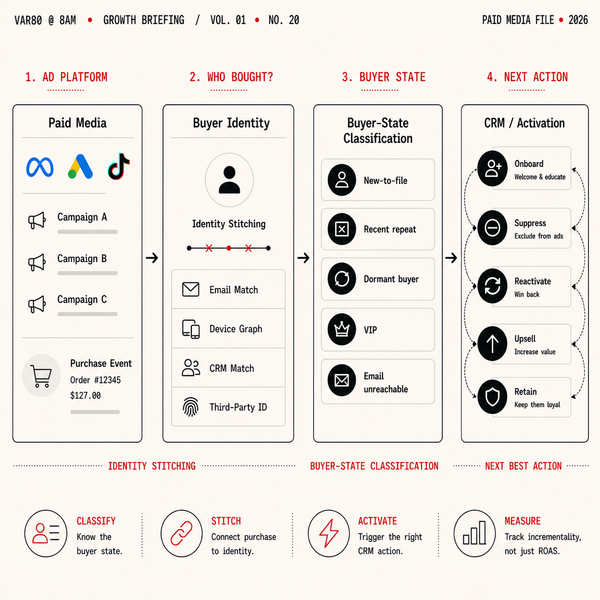
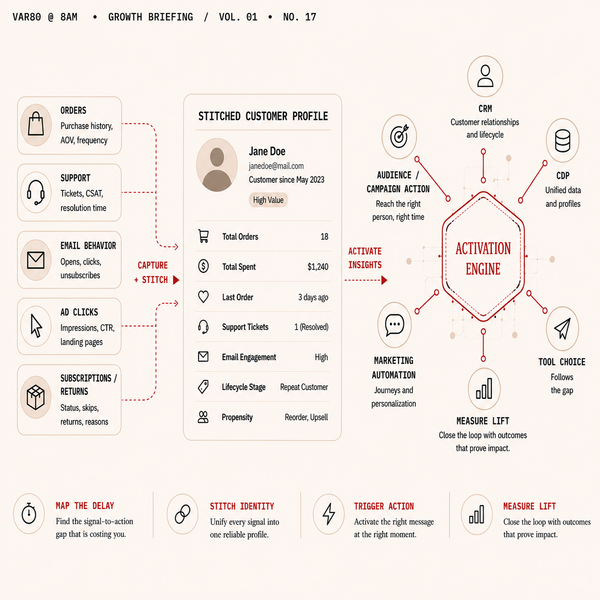
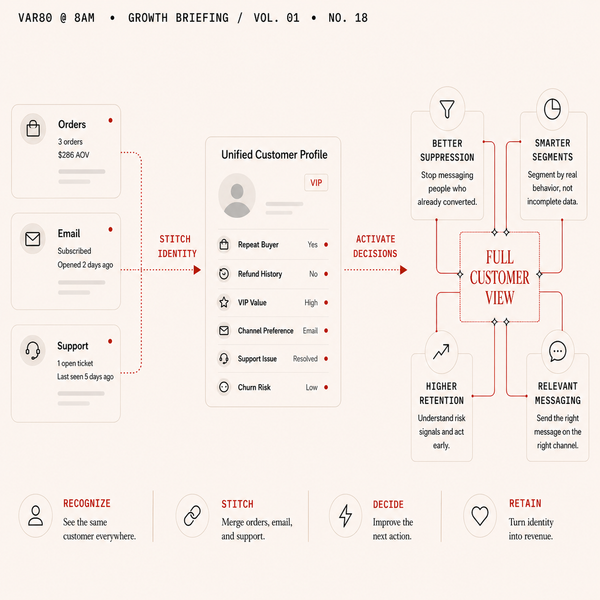
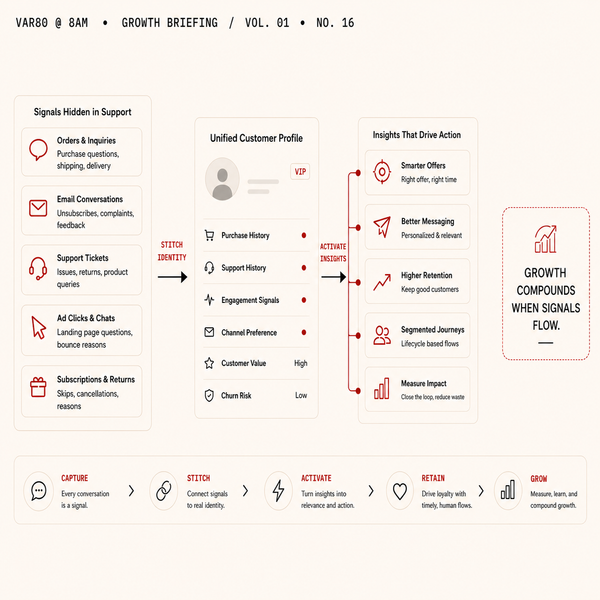
- Identity Stitching Comes Before Activation: Connect orders, email, behavior, and customer identifiers into reliable profiles before building increasingly complex CRM automations.
- Segment for Revenue, Not Audience Size: RFM, lifecycle stage, purchase behavior, and high-intent events create more actionable segments than dozens of broad demographic or vanity audiences.
- Automations Should Be Revenue Experiments: Welcome, abandoned-cart, replenishment, and win-back flows should use holdouts and cohort measurement to prove incremental revenue rather than relying on opens and clicks.
- Start Small Before Adding a CDP: For many D2C brands, CRM plus clean commerce data is enough initially; add a CDP when identity genuinely needs to span multiple platforms, devices, stores, and channels.
- Build the CRM Growth Loop in Sequence: Stitch identity → create a small set of revenue segments → activate high-impact workflows → measure incremental lift → use the results to expand the system.
Customer data is the growth lever brands underspend on when paid channels look easy
Paid channels have been the obvious lever for five years. Platforms scaled, creative tools improved, and teams optimized funnels. But costs have trended up. WordStream documented rising Google Ads CPCs in 2025, showing search and paid spend are becoming more expensive for many merchants (WordStream, 2025).
That matters because unit economics compress: higher CAC reduces the headroom for margin-driven growth. The structural response is simple. You either raise prices, accept lower return on ad spend, or extract more revenue from customers you already own. The last path is the one CRM and identity work unlocks.
Two operational facts support this pivot. First, automated lifecycle flows produce outsized revenue versus campaigns. Klaviyo's benchmark tables show flows (welcome, abandoned-cart, post-purchase) deliver much higher opens and revenue per recipient than one-off campaigns; their published examples show flows opening above 50% in many cohorts (Klaviyo benchmarks).
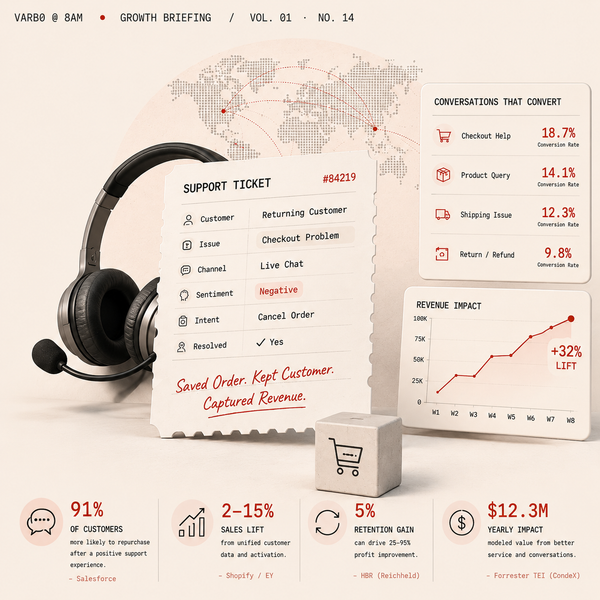
Second, stitching identity across channels lifts measurable sales. Shopify’s enterprise writing cites research showing unified customer data and commerce integration can yield single-digit to low-double-digit sales uplifts for merchants that act on the data (Shopify / EY citations).
Complication: These are directional levers, not guarantees. The classic retention statistic from *Harvard Business Review* (Reichheld) — a 5% retention gain can produce 25–95% profit improvement — is a useful economic intuition, but it needs cohort-level validation for modern commerce models. The uplift depends on margin structure, product cadence, and how well segments are activated.
Observation from practitioners: brands that pause building more acquisition channels and instead finish identity stitching routinely unlock higher LTV per retained customer with less incremental ad spend. This is the operating argument for rebalancing investment toward CRM activation and identity work.
A CRM is not a single customer view; the integration pattern is the product
Many teams conflate CRM and CDP features. That mistake leads to buying the wrong tool for the job. The correct question is not feature parity but where identity stitching, enrichment, and activation live in your stack. Twilio Segment and Amperity describe two different primitives: the identity graph and real-time identity resolution. Where you build that primitive determines which downstream work is cheap and repeatable (Segment docs; Amperity platform).
If your identity stays inside owned channels and you rarely need to merge ad-platform, in-store, and service data, a CRM-first approach can be the fastest route to ROI. If identity crosses devices, channels, and offline touchpoints, a CDP (or an identity-first layer) becomes the only practical long-term pattern.
CRM is sufficient when identity stays within owned channels
When commerce, email, and support data live in one platform, activation velocity matters more than a perfect merge. Shopify’s enterprise framing argues that commerce-native profiles reduce integration cost for many merchants; the profile lives where orders and events are created, enabling immediate automations without a separate governance layer (Shopify).
Constraints that make CRM-first sensible: small catalog complexity, single currency/market, low store traffic fragmentation, and a product that benefits from high-frequency replenishment or predictable repurchase cycles. For many mid-market DTC brands the fastest path to revenue is to stitch email + orders, build simple segments, and automate the three highest-ROI flows.
CDP becomes necessary when identity crosses channels and platforms
When loyalty programs, in-store sales, ad networks, and service logs must be deduplicated into one source of truth, deterministic or AI-augmented identity resolution prevents duplicate activation and conflicting treatments. Segment’s Unify product documents deterministic merge rules; Amperity emphasizes AI and streaming to find matches deterministic connectors miss. Both patterns produce a UCP that downstream systems can safely act on (Segment; Amperity).
Complication: A CDP-first choice carries integration and governance costs. It is only cheaper when you must reuse identity across many teams and channels. For many brands the right sequence is CRM-first with an integration pattern that allows extraction of identity into a CDP later. That sequence keeps early activation velocity while avoiding permanent technical debt.
Segmentation works when it maps to predictable revenue movement, not vanity audience counts

Segmentation is the floodgate between identity and revenue. The wrong segmentation practice is to build dozens of micro-segments without treatment plans. The right practice is to choose a small set of segments that predictably move revenue and to prioritize them by expected lift and cost of treatment.
Industry benchmarks show the bulk of repeat revenue gains come from well-worn, activation-ready segments: recency/frequency/monetary cohorts, lifecycle stages, and high-intent behavioral signals. Case studies include Glossier and Allbirds using lifecycle and behavioral segmentation to prioritize replenishment and premium cross-sells, respectively; these are operator patterns more than novelty math.
RFM remains the backbone of revenue-focused segmentation
Recency, Frequency, and Monetary value still explain future spend better than many complex unsupervised clusters for practical activation. Use simple, actionable thresholds: Recency (R) < 90 days suggests active customers; Frequency (F) 2+ purchases in 12 months suggests repeaters; Monetary (M) top 20% by spend suggests high LTV. Translate those thresholds into clear treatment logic: what channel, cadence, and offer each group receives.
Example treatment logic for a hypothetical mid-market DTC brand (illustrative): R<90 & F>=2 & M top 20% => premium cross-sell emails and exclusive early access; R 91–365 & F=1 => replenishment reminder with small discount; R>365 => win-back with holdout testing. These rules are operational and measurable across cohorts.
Behavioral microsegments beat demographics for personalization
Event-based signals provide stronger intent than demographic buckets. Product browse depth, cart events, and SKU-level view patterns create higher predictive value for conversion and immediate relevance. Glossier used behavior and lifecycle segmentation to trigger replenishment and new-product offers with measurable uplift; Allbirds prioritized high-LTV repeaters for higher-AOV cross-sell flows.
Complication: Behavioral segmentation requires event hygiene and schema discipline. Without consistent event names and reliable properties, behavioral segments drift and leak. The governance cost of event-level segmentation is the production reason to prefer a small, well-instrumented segment set.
Lifecycle mapping turns segments into prioritised activation queues
Map each revenue segment to a lifecycle stage and a treatment economics model. A lifecycle map forces you to make the trade-offs explicit: channel choice, expected revenue per recipient, cost per message, and the acceptable discount level. This mapping enables prioritization by simple ROI metrics rather than by audience size alone.
Observation. Brands that draw lifecycle maps routinely find that two to four segments explain the majority of incremental revenue from automation. The operational takeaway is to measure the marginal revenue lift by cohort, not simply audience overlap or size.
Automation is revenue only when workflows are experiments with clear success metrics
Automations like welcome sequences, cart recovery, and win-back flows are high-probability revenue generators. Klaviyo’s flow benchmarks show much higher engagement and revenue-per-recipient for these flows versus campaigns, which explains why many operators prioritize them (Klaviyo benchmarks).
But automations only become durable revenue when treated as empirical experiments. That requires hypothesis framing, holdout groups, cohort attribution windows, and a willingness to iterate on copy, cadence, and offer economics.
Treat each workflow as a hypothesis to test
Every automation should start with a one-line hypothesis: what revenue moves do we expect, for which cohort, and why. Example: "For R<90 & F=1 customers, a 24-hour abandoned-cart email with free-shipping messaging will increase 30-day incremental purchase rate by 3 percentage points versus control." Then pick a test window and size the holdout so the result is statistically meaningful for your merchant cohort.
Casper’s early win-back and cart recovery programs illustrate how targeted automations produced measurable cohort lifts when measured with proper controls. Sephora’s iterative testing of welcome and loyalty-triggered workflows optimized spend across segments in the same way.
Measure with cohorts and incremental attribution
Open and click metrics are necessary but not sufficient. Cohort-level revenue attribution and holdout groups reveal the true lift. Design attribution windows that match your purchase cadence. For replenishment-heavy categories a 30–60 day window may suffice; for considered purchases use 90 days. Always report incremental revenue per recipient and cost per incremental dollar.
Complication: Channel noise and external campaigns can create false positives. Use staggered rollouts and geography or timestamp holdouts to control for cross-channel contamination. Measure at the customer-level, not the message-level.
The practical roadmap: stitch identity, standardize 6 segments, then automate high-impact flows

Ambitious roadmaps that attempt identity, ML recommendations, and full automation at once rarely reach value. The pragmatic sequence is MVC (minimum viable control): stitch the essential identity keys, define a small segment set, and run three high-ROI automations as holdout-tested experiments. Warby Parker and a mid-market DTC example both followed incremental rollouts to align ops and marketing.
Start with a minimum viable identity and three revenue segments
Define the minimal identity keys: primary email, order ID history, phone if you use SMS, and a customer ID that the commerce platform exposes. Ingest orders and email events first; add support and POS or loyalty when available. The priority is that the identifiers are stable and available to the activation layer within minutes, not days.
Define three prioritized segments for Year 1: (1) R<90 & F>=2 & M high (loyal high-LTV), (2) lapsed high-AOV (R>365 & M high), (3) new low-AOV (first purchase, R<30 & F=1 & M low). Map each segment to one automation and one measurement plan.
Automate the highest-ROI workflows and expand by measured wins
Start with three workflows: welcome series, abandoned-cart recovery, and a lapsed win-back. Use Klaviyo or your CRM to run flows, but instrument holdouts. Use cohort revenue attribution to estimate incremental LTV from each workflow. Pay special attention to revenue per recipient tables by AOV and cohort when modeling expected ROI (Klaviyo RPR tables).
Use the following practical quarter-by-quarter table as a working roadmap.
|
Quarter |
Focus |
Output |
Success Metric |
|
Q1 |
Minimum viable identity + RFM segments |
Stitched profiles for email+orders; three segments defined |
Segment accuracy & hygiene; pipelines deliver events within minutes |
|
Q2 |
Launch welcome and abandoned-cart flows as holdouts |
Flows live with 10% holdouts per cohort |
Incremental revenue per recipient and purchase rate vs control |
|
Q3 |
Iterate flows, add win-back and lifecycle mapping |
Refined cadences and offer economics |
Lift in 90-day cohort retention and LTV |
|
Q4 |
Scale segments, add off-platform identity (ads/POS) |
CDP consultation or integration; cross-channel segments usable in ads |
Improved repeat revenue share and lower blended CAC |
Hypothetical modelling guidance for a mid-market DTC brand: with AOV $85 and baseline repeat rate 25%, a 3–5 percentage point lift in repeat rate from combined automations can materially improve 12-month revenue. Use the brand’s cohort curves to turn percent improvements into dollar LTV uplift before expanding scope.
Complication: Teams often mistake feature rollouts for business outcomes. Ship the simplest thing that produces measurable lift and use those wins to fund identity and governance investment. This incrementalism reduces risk and builds internal buy-in for a CDP if one becomes necessary.
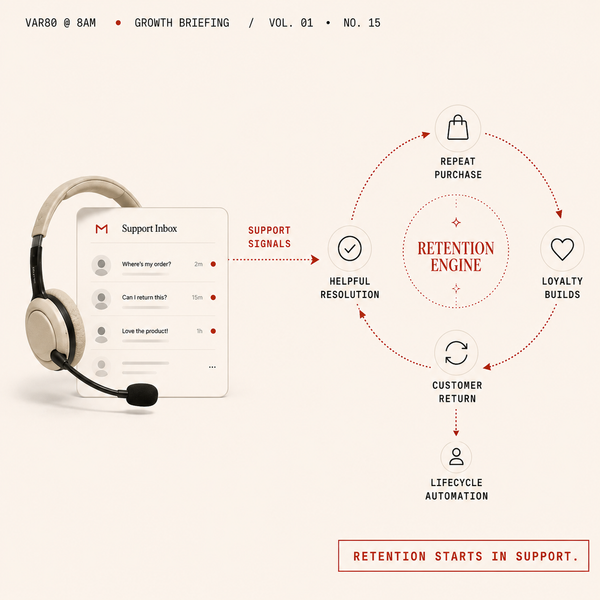
Reframe CRM investment as a revenue loop: identity enables segments, segments become experiments, experiments compound into predictable growth
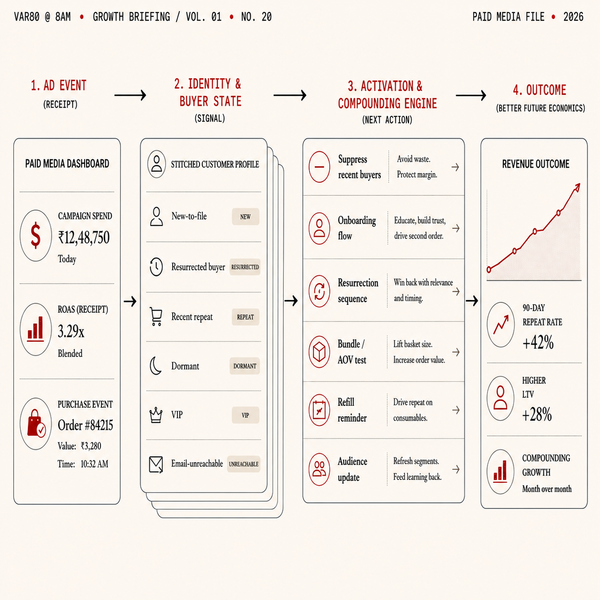
Stop thinking about tools. Start thinking in loops: how identity feeds segments, how segments feed workflows, and how workflows must be measured for incremental revenue. Vendors are converging on real-time, identity-resolved profiles because the business problem is not storage; it is latency between event and action. Klaviyo’s recent product moves, Twilio Segment’s Unify documentation, and Amperity’s real-time profile announcements all point to the same operational truth (Klaviyo; Segment; Amperity).
One concrete Q1 action: pick one identity key (email), define three segments (R<90 & F>=2 & M-high; lapsed high-AOV; new low-AOV), and run two holdout-tested automations (abandoned-cart and welcome). Use incremental revenue per recipient to decide the next investment. That sequence converts identity work into cash flow and decision leverage.
Named operator notes from vendor leadership underline the urgency. Andrew Bialecki of Klaviyo observed that unified profiles are central as AI becomes an interface for customer interactions; Tony Owens of Amperity emphasized that unified, actionable customer data is what closes the gap between AI ambition and execution. These are not marketing lines; they are tactical signals about where activation velocity will come from in the next two years (Andrew Bialecki, Klaviyo; Tony Owens, Amperity).
Brand example (hypothetical): a $10M–$50M DTC brand that stitches email+orders and runs three holdout-tested automations can often reach measurable revenue impact inside two quarters, using the flow benchmarks and revenue-per-recipient tables vendors publish for planning (Klaviyo RPR).
Still using CRM like a database? That is the leak.
Most ecommerce teams already have the data they need. What they lack is the system: stitched profiles, RFM segments, lifecycle triggers, and experiments tied to revenue. Var80 helps brands build that operating layer across retention, AOV, and customer intelligence.

Leave a comment