


TL;DR – Your Support Team Already Knows Why Customers Come Back
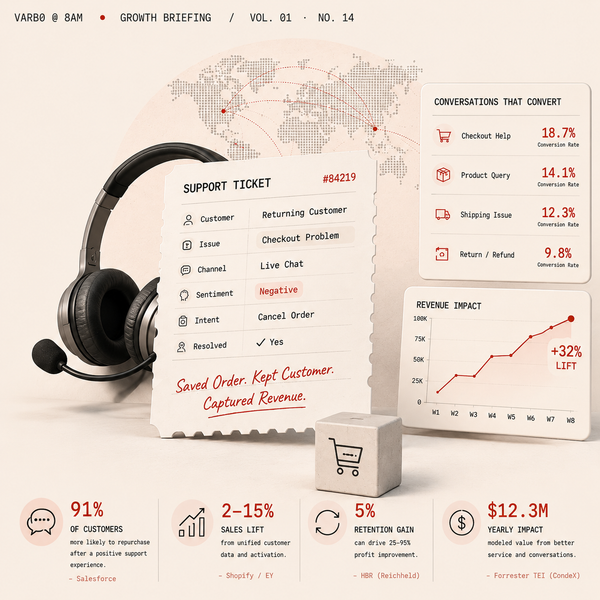
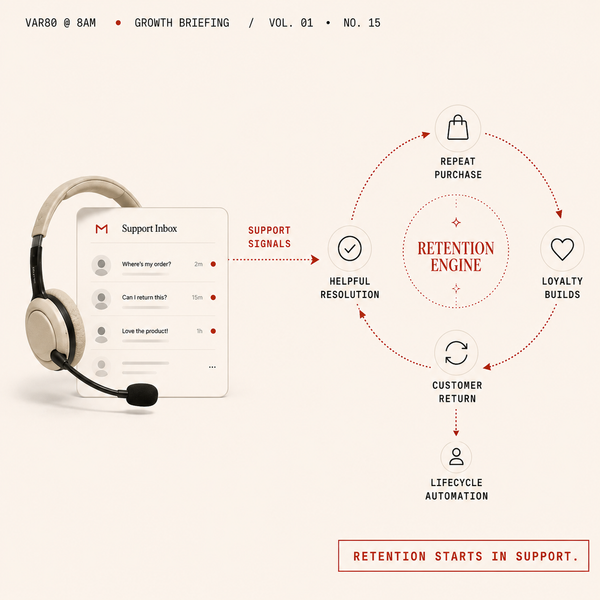
- Support Is a Retention Signal, Not Just a Cost Center: Ticket conversations reveal the friction, intent, and post-purchase experiences that influence whether customers buy again.
- Small Interventions Can Produce Measurable Repeat-Purchase Lift: Faster resolutions, proactive check-ins, human follow-ups, and carefully targeted concessions can change repurchase behaviour without large marketing investments.
- Measure Repurchase Lift, Not Just CSAT: Track 30/90/180-day repurchase rates, ticket-attributed CLV, and time-to-repurchase to understand whether support actually changed customer behaviour.
- Support Conversations Should Become CRM Signals: Capture intent, outcome, and friction score from tickets and use them to trigger education, replenishment, reactivation, and churn-prevention journeys.
- Post-Purchase Operations Are a Retention Lever: Returns, repairs, replacements, dispute resolution, and proactive care can preserve customer relationships and create repeat-purchase opportunities.
- Stitch Identity Before You Automate: Connect support signals to reliable customer profiles, prove their impact through manual tests and holdouts, and only then scale the winning retention actions through automation.
Support is not a cost center it is the primary behavioral signal that predicts who will buy again
Most leadership teams measure support by headcount, cost per ticket, or CSAT and then wonder why retention forecasts look fuzzy. Those metrics describe internal efficiency. They do not measure outcomes. The signal that actually predicts repeat purchase is whether a customer had a high-effort post-purchase touch that produced ownership, resolution, or a renewed intent to buy.
This is not theory. Zappos made the empirical claim decades ago that service-first operations create repeat buyers and advocates. Modern examples are quieter and more measurable. Chewy's financial reporting frames Autoship as the recurring engine that underlies durable revenue, and that is an operations argument: retain the relationship and repurchases follow; see Chewy's fiscal reporting for how Autoship concentrates sales into recurring revenue streams (Chewy investor release).
Operationally, a support interaction turns product ambiguity into a renewed purchase decision. A returned item that is handled with ownership can become a repurchase six weeks later. A delivery failure resolved proactively can convert a frustrated first-time buyer into a subscriber. When operators examine ticket cohorts by acquisition source and outcome, the correlation between resolved ticket and repurchase is visible; when they do not, that signal is lost amid aggregate CSAT and volume metrics.
One failure case is obvious: if support acts like a black box that only returns CSAT scores, the business will keep optimizing handle times and outsource empathy. That optimization reduces cost but also removes the single mechanism that prevents early churn. A better approach routes ticket outcomes into cohort repurchase metrics and uses those cohort results to prioritize operational fixes and product changes.
Embed one practical test: pick a high-volume ticket intent, measure 30- and 90-day repurchase rates for customers whose tickets were resolved versus unresolved, and use that delta to compute ticket-attributed CLV lift. If the lift is material, the ticket is a retention priority; if it is not, the ticket still matters for other KPIs but should not consume retention budget.
Short, proactive interventions in support increase repeat purchases more reliably than large brand investments
Marketing teams spend on hero creative and content because those things are visible. Operators get repeat purchases with a five-sentence follow-up that answers the customer's question and invites repurchase. The difference is measurement and timing. Small, cheap interventions executed at the right time produce measurable lift in the next-order probability that often outperforms the equivalent acquisition spend.
There are public experiments that prove the point. A randomized post-delivery check-in run by Signals for Quaker Marine found a 16 percent lift in three-week repurchase for the treatment group, and a 51 percent lift among customers who actively replied to the message (Quaker Marine case study). That outcome is not a marketing trick. It is a low-cost operational message that created conversation, resolved friction, and produced a measurable behavioral change.
Why do small interventions work? Because most churn in the first 0 to 90 days is habitual and avoidable. Customers who experience friction during this window do not come back because they assume the friction will repeat. Fast ownership and a confidence-restoring intervention change that expectation. The behavioral logic is straightforward: reduce uncertainty, demonstrate ownership, and remove the micro-frictions that break habitual repurchase.
Fast dispute resolution reduces churn in the 0–90 day window
Speed matters more than perfection in early disputes. If an agent takes ownership within the first 24 hours, the customer updates their mental model of the brand from "risky" to "reliable." That change in belief increases the probability of a repeat purchase independent of the solution's financial generosity. You can test timing with a simple holdout experiment: randomize early dispute cases into a priority resolved-within-24-hours stream versus normal flow, and measure 30- and 90-day repurchase. If timing alone increases repurchase, prioritize operational routing and single-owner handoffs rather than incremental marketing spend.
Proactive outreach converts unhappy first-time buyers into loyal repeat customers
An automated outreach sequence followed by a human check-in captures the scale of automation and the trust of human response. Automated messages detect likely friction, collect context, and route high-friction cases to humans. The human follow-up then repairs the relationship. To measure incremental lift, run an A/B test where the automation alone is one arm and automation-plus-human is the other. Track incremental repeat-rate lift using cohort holdouts to isolate the human effect.
A well-timed small concession often outperforms large content investments for retention
The economic argument is simple. The marginal cost of a discount, replacement shipment, or free repair often runs far below the customer acquisition cost required to reacquire a lost buyer. When a small concession preserves the relationship and raises repurchase probability, it should be treated as a retention investment. Use ticket-level LTV-attribution to compare the expected present value of concession-driven retention against the CAC of reacquisition. That comparison will often reallocate budget from content or brand experiments into support plays.
One counter-example: if the category is ultra-low margin or the customer lifetime is short, concessions can create moral hazard and accelerate returns. The guardrail is measurement: concession scripts should be A/B tested with repurchase and subsequent return behavior as outcomes, not just immediate CSAT wins.
If you want repeat purchases, stop measuring tickets and start measuring lift
Support metrics are full of vanity. Ticket volume and average handle time are useful for workforce planning, but they do not prove that support drove the business forward. The KPIs that matter are cohort-level post-ticket repeat rate, ticket-attributed CLV lift, and the time from resolution to repurchase. Those are outcome metrics that answer the question the finance team actually cares about: did this interaction increase revenue over the customer lifetime?
CSAT is a process metric. It tells you how a customer felt in the moment. Repeat-purchase lift is an outcome metric. It tells you whether the customer's future behavior changed. A support leader who wants a seat at the revenue table must link actions to outcomes by instrumenting cohorts.
Measure repeat-purchase lift, not just CSAT
To attribute incremental orders to resolved tickets, establish a holdout methodology. Randomize a fraction of eligible tickets into a 'control' that receives baseline resolution and an 'experiment' that receives prioritized outreach or a specific concession. Measure the difference in 30/90/180-day repurchase rates. Convert that difference into incremental CLV. If you cannot randomize, use matched cohorts by acquisition source, SKU, and tenure; the latter is noisier but still superior to aggregate KPIs.
Tickets-by-cohort predicts future churn better than aggregate ticket volume
Segment tickets by acquisition channel, product SKU, and customer tenure. When you do that, patterns emerge: tickets from certain SKUs often correlate with lower repurchase because they indicate product fit issues; tickets from newly acquired cohorts predict habitual churn; tickets from high-LTV channels predict outsized lifetime gains when resolved well. That insight changes prioritization: a single SKU that produces many post-purchase tickets may warrant product fixes rather than marginal CSAT improvements.
A product/ops dashboard should show ticket origin, resolution action, and 30/90/180 day repurchase curves

Product leaders need three panels. The first panel shows ticket origin and intent by cohort, so leaders can see what types of tickets cluster by SKU, channel, and tenure. The second panel shows the resolution action taken, because the action is the policy lever you can change. The third panel shows 30/90/180-day repurchase curves for customers matched to those ticket cohorts. This three-panel view turns support signals into prioritizable product and ops tasks.
|
Panel |
Purpose |
Key metric |
|
Origin & Intent |
Identify where tickets start and what they are about |
Tickets by SKU / channel / tenure |
|
Resolution Action |
Show which operational levers were used |
Action types (refund, replacement, education, upsell) |
|
Repurchase Curves |
Link action to behavior over time |
30/90/180-day repurchase rates |
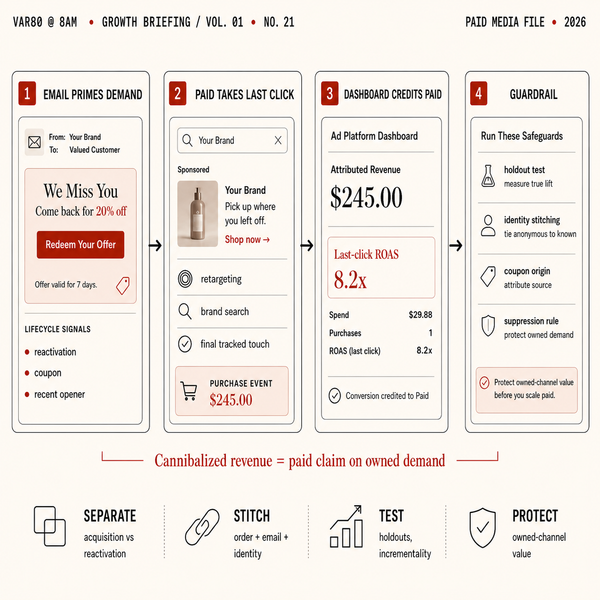
The failure mode here is measurement contamination. If you attribute every repurchase to marketing last-touch, the dashboard will hide ticket-lift. Build attribution rules that credit post-ticket repurchase to the ticket when the repurchase occurs within a reasonable window and no intervening acquisition touch explains the lift. In guarded cases use randomized holdouts to prove causality.
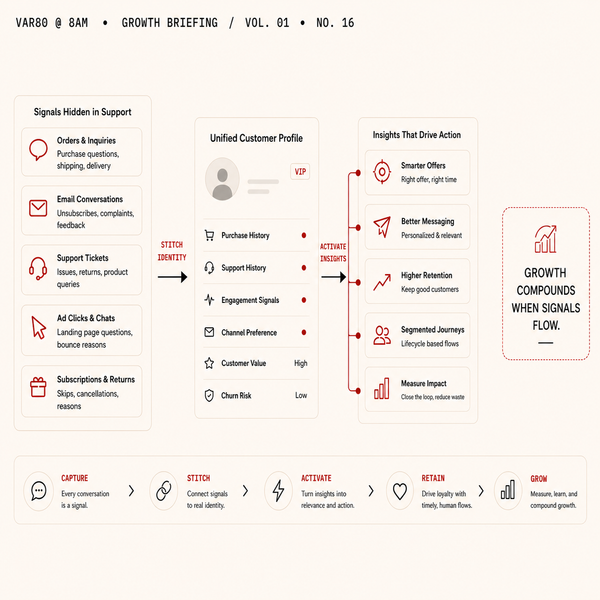
Support conversations are untapped CRM data — and that ignorance costs personalization and repeat revenue
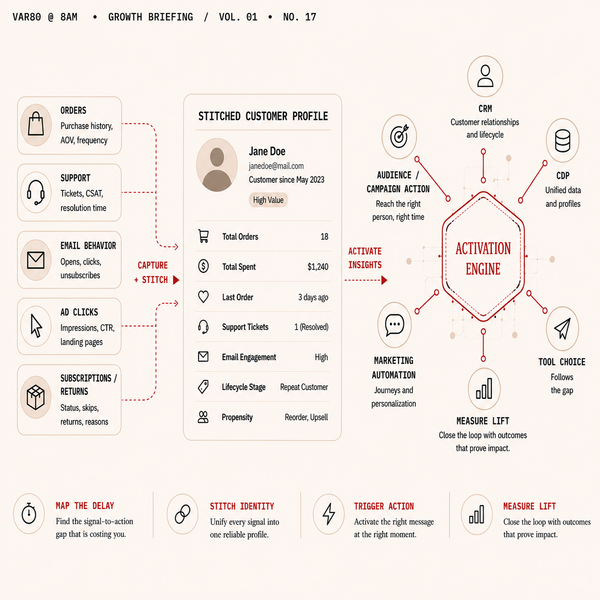
Support teams have a conversational record that captures intent, friction, and product usage signals at the moment the customer experiences the product. Most teams leave that record in Zendesk or another helpdesk and never move it into CRM, which turns a high-fidelity behavioral input into a locked silo. That inaction is expensive: it forfeits the ability to run personalized post-purchase flows that would otherwise increase repurchase probability.
When operators stitch ticket intent into CRM segments, they can trigger product guidance, replenishment reminders, or targeted reactivation journeys. Warby Parker uses repair and fit tags to trigger education flows; that operational move transforms a repair ticket into a subsequent repurchase opportunity (Warby Parker Impact Report). Sephora blends conversational intent from advisors and support with purchase history to personalize replenishment reminders and loyalty outreach (Sephora reporting).
intent, outcome, and friction score must be the minimum viable taxonomy for ticket signals
You do not need perfect intent classification or sophisticated ML to start. A pragmatic taxonomy of three fields—intent, outcome, and friction score—captures the actionable signal without overwhelming agents with tags. Intent catches the customer's purpose, outcome records how the case was closed, and friction score records severity. That triad is cheap to tag and materially changes CRM activations: customers with a high friction score are routed into higher-touch reactivation flows; customers with a product-education intent receive targeted usage guides.
The second failure case is over-automation. Teams that export every ML-derived tag without human validation create noisy segments. The sequence that works is: reliable identity resolution, pragmatic signal extraction, manual activations, and then automation.
Sync tags to activation channels with consent-aware rules
Not every ticket-derived segment deserves an email. Channel economics and privacy require different thresholds for activation. Use email for education and replenishment, SMS for timely operational push (delivery updates, urgent fixes), and ad audiences for longer-horizon reactivation. Respect consent. Map ticket-derived segments to channels only when the customer has permission or when the message is operational rather than promotional. Otherwise you create trust erosion that kills long-term CLV.
One instructive limitation: not every tag should trigger a paid ad. The economics of ad activation often do not justify expensive custom audiences unless the ticket signal predicts high-LTV behavior. Apply the same CLV-first triage used elsewhere in the article to decide which segments merit paid activation.
The post-purchase experience is where retention experiments beat acquisition experiments
Brands overinvest in top-of-funnel experiments because victories are visible and attribution is well understood. In practice, small operational experiments in returns, repairs, and proactive care change lifetime behavior more reliably. The post-purchase window is compressed and repeatable. Fixes there compound across future orders.
Warby Parker’s repair and trade-in flows are an operational example: by treating repairs as a service offering rather than a loss, the brand creates repeatable touchpoints that extend lifetime value (Warby Parker Impact Report). Patagonia’s Worn Wear program converts repair and resale into ongoing brand engagement and trust-building that changes customer lifetime behavior (Patagonia Worn Wear).
Make returns and repairs an acquisition and retention channel, not a loss center
Returns are often treated as negative vanity. That view misses the acquisition and retention upside. A generous and predictable returns policy removes buyer hesitation at checkout and creates an opportunity to re-engage customers through repair, replacement, or trade-in offers. To treat returns as a channel, design operational experiments that vary the return policy or fulfillment speed for a randomized cohort and compare lifetime revenue outcomes, not just return rate. If the relaxed policy increases repeat purchases sufficiently, the apparent near-term loss becomes a long-term investment.
Use loyalty triggers from support interactions to seed higher-touch journeys
Not every high-effort resolution should be rewarded with a generic thank-you. High-effort support wins are signals that the customer has emotional capital with the brand. Use that signal to seed a time-bound VIP reactivation path: a human follow-up within a week, a product education sequence, and a narrowly scoped discount that tests reactivation lift. Measure the lift and keep the path time-limited to avoid habituating customers to concessions.
A cautionary exception: in ultra-commodity categories with thin margins, expensive VIP treatments scale poorly. There the correct investment is operational precision—speed, clear instructions, and cheap replacements—rather than expensive gifts.
Support can be a revenue engine — but only with ethical guardrails and measured incentives
Support teams are a natural place to discover purchase intent. That proximity tempts brands to monetize every conversational moment. When support doubles as a sales channel without guardrails, CLV calculations and customer trust suffer. The right model ties assisted selling to long-term retention metrics rather than one-off ticket revenue.
Sephora shows a responsible path: advisors and support inform product recommendations, but the brand measures downstream repurchase to validate uplift and preserves advisor integrity through training and loyalty alignment (Sephora reporting). This approach turns support advice into measurable revenue while keeping trust intact.
Align incentives to lifetime value, not per-ticket conversion
Compensation and KPIs for support agents should reward measured repurchase lift and long-term outcomes rather than short-term conversions. If agents earn bonuses for per-ticket conversions, they will push promotions that harm long-term trust. Instead, tie a portion of compensation to cohort repurchase outcomes or to the quality of handoffs that reduce future tickets. That alignment changes behavior: agents will recommend solutions that preserve the relationship rather than maximize a single-ticket sale.
Design assisted-selling scripts with transparent opt-ins and easy exits
Preserve trust by making assisted selling a clear choice. Scripts should include simple opt-ins and easy ways to decline. Test transparency as a variable; sometimes being explicit about a recommendation increases conversion without harming trust because customers appreciate honesty. Use randomized tests where transparency itself is the experiment, and measure downstream repurchase and complaint rates.
One failure mode to watch is upsell overreach: an aggressive upsell program may increase short-term revenue but produce higher long-term returns and returns rates, especially where product fit is difficult. Measure downstream behavior before scaling.
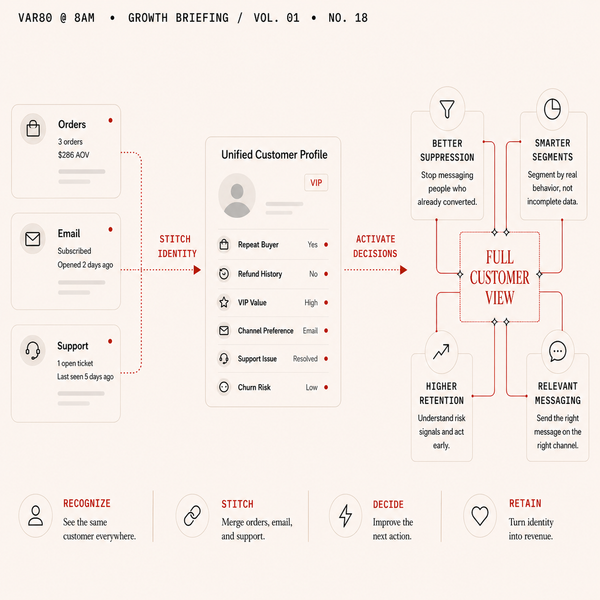
Most teams fail because they automate before they can identify: stitch identity first, then automate

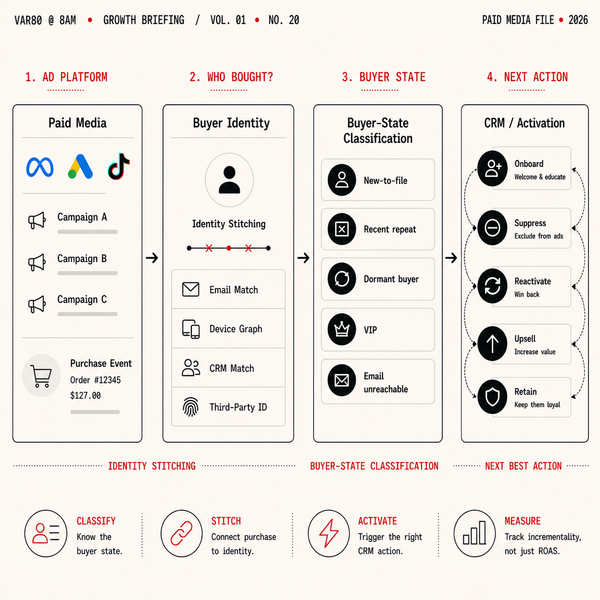
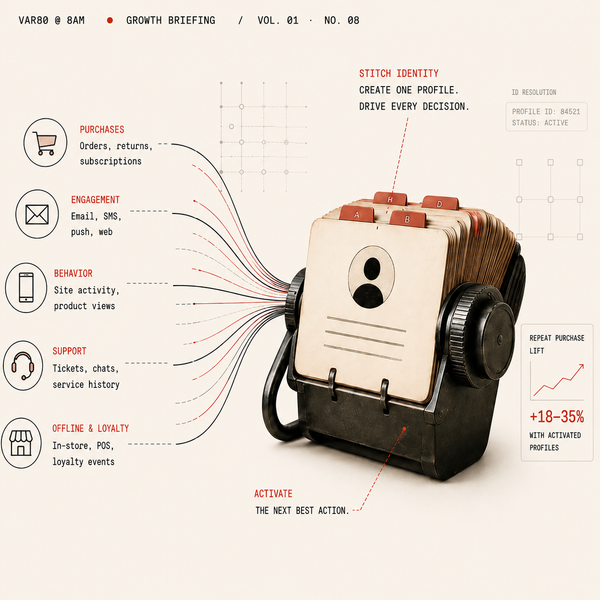
Automation without reliable identity is noise. Teams buy ML taggers and automated journeys, then complain that segments do not hold. The correct sequence is identity resolution, signal extraction, manual activations, and only then scale with automation. Identity is infrastructure. It is the thing that makes your ticket signals actionable across email, SMS, and ad platforms.
One DTC operator exported stitched VIP segments into an ESP and immediately saw better reactivation rates because the segments finally matched real customers across devices and channels. The cost of skipping identity is wasted channel spend and brittle automations that drop customers into irrelevant flows.
Start with identity resolution, not with ML tags
Invest first in a reliable customer identifier across touchpoints. Use email, phone, and order history to stitch profiles before you build complex ML-driven categorization. A stable identity layer reduces false positives and produces usable segments for manual activation. If your identity is unstable, automated workflows will fire incorrectly and train your systems to be noisy rather than helpful.
Run human-in-the-loop activations until lift is proven
Before automating, run manual activations that validate the signal. Human activation both proves lift and trains automations. Use manual workflows for the first several hundred activations per signal and measure repurchase lift. Only then generalize the rule into an automation. This sequence reduces false positives, preserves channel spend, and ensures you automate things that actually move revenue.
One operational exception: if you have a very high volume and low-LTV product, the economics of manual activation may not justify the lift. In that case build higher-precision identity rules and very targeted, cheap automations rather than broad human workflows.
Reframe retention: treat support as your primary product signal and act this quarter
The uncomfortable truth is that the data you need to improve retention is not in marketing dashboards — it is in your ticketing system. If you act this quarter, you will capture low-cost lift from the customers you already have rather than chasing expensive reacquisition.
For a concrete, quarter-bound directive, do these three things this quarter. First, map three high-frequency ticket intents to CRM segments with pragmatic tags for intent, outcome, and friction score. Second, run two randomized holdout experiments: one that tests a prioritized 24-hour dispute resolution stream against baseline, and one that tests a post-delivery conversational check-in against control. Measure 30- and 90-day repurchase lift and compute ticket-attributed CLV. Third, feed results into product and ops prioritization for the next planning cycle so experiments change roadmaps, not just dashboards.
This allocation of experimentation budget beats a top-of-funnel acquisition sprint when your churn is concentrated in the early post-purchase window. The support team already has the data and the relationships to execute. The remaining barrier is organizational will.
The operational challenge is simple and immediate: who owns retention if not the teams who touch customers daily? Make retention an operations KPI, not a marketing vanity metric, and the business will follow.
By acting on ticket signals now you convert a siloed cost center into a measurable retention engine. That is the practical path from service to durable revenue.
Your Support Team Already Knows Why Customers Come Back
Var80 helps ecommerce brands turn support conversations into retention segments, churn alerts, repeat-purchase triggers, and CRM workflows.
Leave a comment