

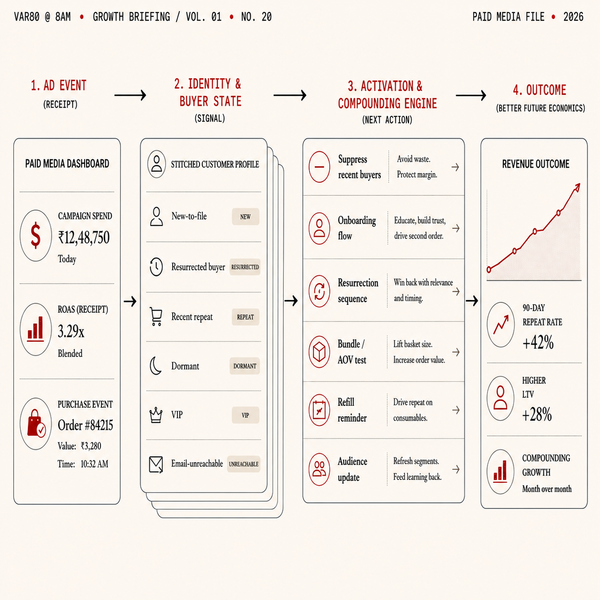
ROAS can show revenue, but it cannot show buyer quality. A paid conversion may be a new customer, a dormant buyer, or an existing customer who would have purchased anyway. Ecommerce teams need buyer-quality reporting to understand whether paid media is creating durable growth or only claiming easy conversions.
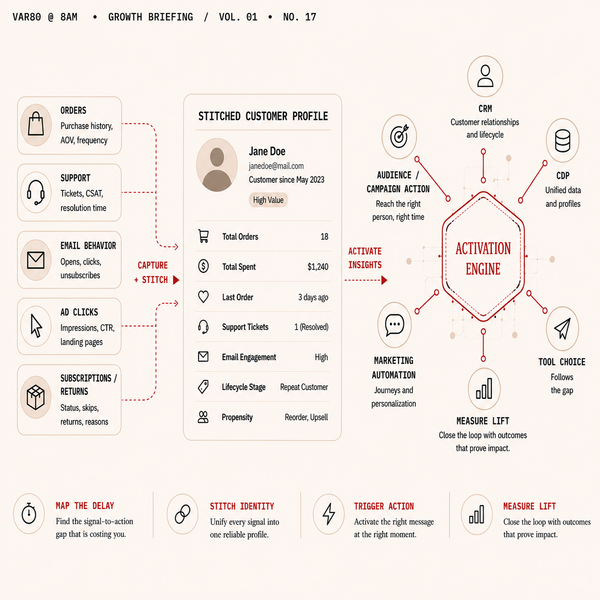
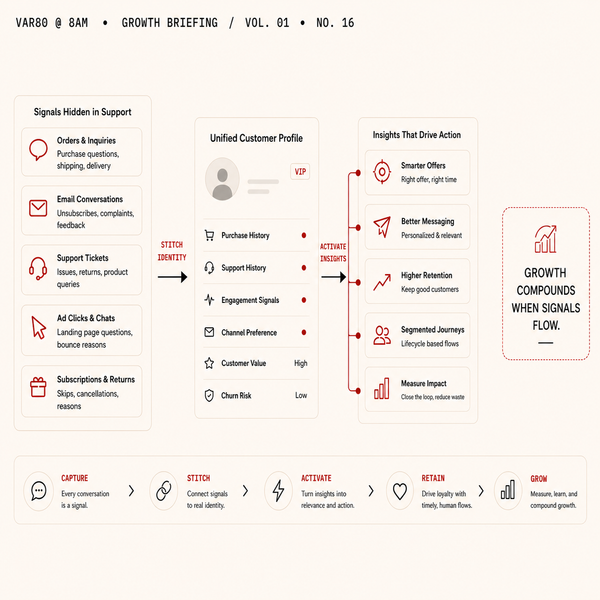
Shopify, Klaviyo, Gorgias, Zendesk, and Meta each see different pieces of the customer; the revenue problem begins when those pieces never become one profile.
TL;DR – ROAS Tells You Revenue. Your CRM Tells You Who Actually Bought.
- ROAS Is a Ledger, Not a Diagnostic: The same 3x ROAS can come from valuable new buyers, resurrected VIPs, or low-value repeat purchasers, so revenue alone does not reveal buyer quality.
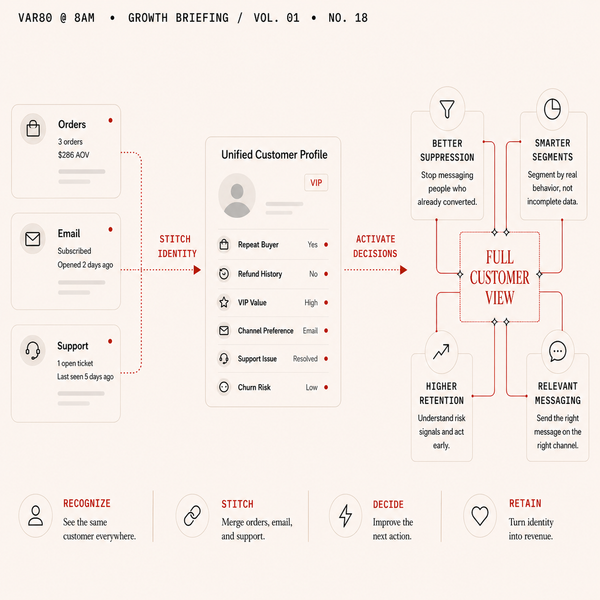
- Identity Is the Missing Variable: Stitching Shopify, ads, email, support, and CRM data into one customer profile reveals whether a conversion came from a new, returning, or resurrected buyer.
- Buyer Type Changes CAC and Incrementality: A higher-cost new buyer with strong lifetime value can be more valuable than a cheap reactivation that looks better in short-term ROAS reporting.
- Incrementality Tests Need Buyer Segmentation: Holdouts should be balanced by purchase recency, frequency, and value so measured lift reflects real buyer creation rather than easy reactivation.
- Ads Must Feed the CRM: Ad events, orders, support signals, and customer history should flow into the CRM quickly enough to change audiences, lifecycle flows, bids, and creative decisions.
- Measure Buyer Creation, Not Just Channel Revenue: Report new, returning, and resurrected buyers by channel alongside CAC and LTV so budgets reward campaigns that create durable customers, not merely cheap conversions.
ROAS Is a Ledger, Not a Diagnostic, and That Difference Hides Buyer Quality
ROAS is a simple arithmetic statement: revenue attributed divided by ad spend. That simplicity is its charm and its danger. A ledger records money; it does not record causality. The same 3x ROAS can represent two entirely different businesses. One campaign that returns three dollars on the dollar because it reactivates churned VIPs will produce long-term return in repeat purchases and higher LTV. Another campaign hitting 3x because it converts low-frequency one-time buyers produces no repeat behavior and accelerates churn-normalization. Reporting both as equivalent is a mistake.
Platform attribution choices make the ledger noisier. When Meta and other platforms change view-through windows or move toward modeled attribution, the counts inside that ledger shift. Industry analysis documented the operational consequences when Meta removed long view-through windows in early 2026 and warned advertisers that a large share of previously attributed conversions fall out of the insight stream, producing 30–40% fewer platform‑reported conversions for some advertisers after the change (Dataslayer.ai). That is not an economic change in demand. It is a bookkeeping change that alters ROAS without telling you whether the buyer who remained came with high LTV or not.
Cannibalization Makes Good ROAS Look Like Growth
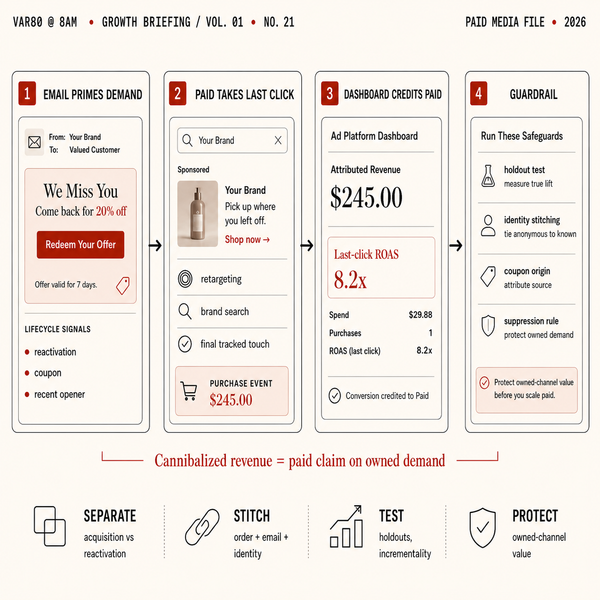
Campaigns that systematically reallocate customers from emails, owned channels, or organic search into paid channels still register revenue inside the ad ledger. A brand that spends to reactivate customers who would otherwise have purchased via email or the store increases paid-channel revenue while reducing owned-channel revenue; total business revenue may be unchanged. This is the classic cannibalization effect made invisible by channel-level ROAS. Platforms report conversions to the channel that gets the credit, but they do not resolve whether the purchase would have happened anyway. Meta’s native lift product exists because the ledger misleads; Conversion Lift is Meta’s randomized holdout tool meant to estimate causal impact rather than ledgered attribution (Meta Conversion Lift). But platform-native lift measures impact inside the platform’s ecosystem and is useful only if advertisers understand its scope and constraints.
Because cannibalization looks like growth inside a ledger, the wrong budget and creative choices follow. You may scale a message that pulls forward near-term purchases from your own lifecycle programs rather than create new, durable buyers who will return at higher frequency and margin.
Buyer-Quality Explains Why Two 3x ROAS Campaigns Aren't Equal
Buyer‑quality is a shorthand for the composition of purchasers by their expected lifetime value. Two campaigns with identical immediate ROAS can produce divergent portfolio outcomes because they acquire different buyer types. One ad set that reaches lookalikes of high-frequency buyers will typically raise long-run LTV and reduce future CAC. Another ad set that cherry-picks bargain hunters will maximize short-term conversions without generating repeat behavior. That difference matters for media optimization because the right objective is not always conversion; sometimes it is customer creation with predictable repeat revenue.
Reporting that ignores buyer-quality trains bidding algorithms toward the cheapest conversion, not the most valuable one. This failure mode makes short attribution windows and click-focused optimizations especially dangerous because they reward reactivations and impulse purchases that do not scale into durable revenue.
The Hidden Variable Is Identity: Knowing Who Bought Reframes Incrementality, CAC, and Attribution

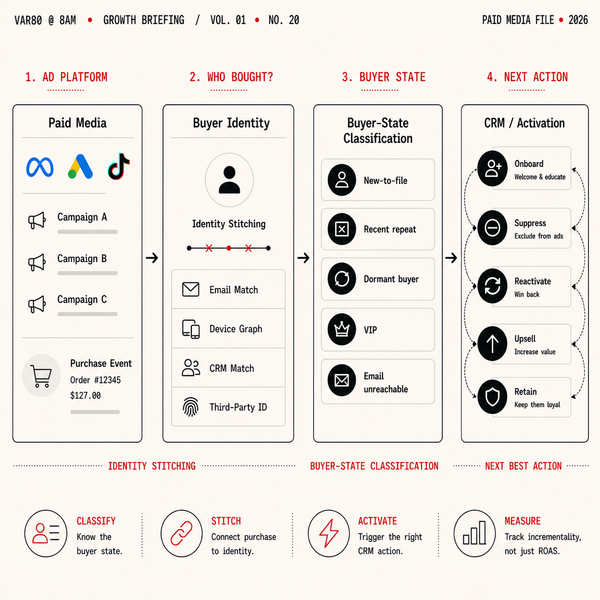
Identity is the missing causal connector. Platforms and tools each observe fragments of the buyer: Meta sees ad clicks and aggregated conversion events; Shopify sees orders and buyer handles; Klaviyo sees email opens and flow conversions; Zendesk and Gorgias see support interactions and complaint signals. None of these systems alone can declare whether an ad actually created a new buyer. Stitching those fragments into a unified profile changes how every metric reads.
Identity stitching converts a raw merchant purchase stream into the buyer-types marketers need to measure incrementality and CAC correctly. Twilio Segment’s identity documentation describes this role precisely: identity resolution merges identifiers across devices and systems into a single profile so events can be tied to the same buyer before activation (Twilio Segment). Without that merge, you cannot say whether the conversion Meta credited was the same customer who appears in Shopify’s order list and Klaviyo’s lifecycle flow.
A Unified Profile Turns Channel Revenue into Actionable Signal
A unified profile transforms channel revenue from a spreadsheet row into actionable marketing segments. When profiles include prior purchase dates, average order value, refund history, subscription status, and support tags, marketers can convert a raw conversion into a buyer‑type: new, returning, or resurrected. That conversion is what makes incrementality tests valid. Vendors that build on identity resolution report that stitching often uncovers vast fragmentation. Amperity’s diagnostics, for example, reported that a substantial share of high-value customers were split across multiple records and that reassembling profiles materially changed LTV calculations and audience sizes (Amperity). If stitching changes your top-customer count, it changes the denominator in any CAC or LTV calculation.
Shopify frames unified customer profiles as the canonical record for orders, POS, and marketing signals, arguing that a single view allows brands to personalize and report by buyer-type rather than by channel alone (Shopify). That single view is not an optional analytics convenience. It is the causal glue that turns attributed conversions into buyer-creation evidence.
New vs Returning: The Split That Makes or Breaks Incrementality
Incrementality hinges on the distinction between new and returning buyers. A holdout that contains a disproportionate share of returning buyers will bias lift upward when the treatment reactivates lapsed customers. Incrementality experiments therefore must stratify by prior purchase behavior so control and test groups mirror the buyer mix the campaign aims to change. Independent incrementality guides warn that platform-native experiments measure platform-limited effects and that stratification is essential to avoid confounding (Haus). Without identity-backed stratification, an advertiser can rerun the same lift test and find a significant reduction in measured lift simply by isolating the prior-purchase cohort.
When identity is present in the CRM, CAC can be calculated per buyer-type and compared to LTV per buyer-type. That comparison reorients budget decisions: paying more to acquire a high-LTV new buyer can be the rational choice even if the short-term ROAS looks worse than cheap reactivations.
Incrementality Without Customer-Type Segmentation Is a False Positive
Randomized holdouts and modeled attribution are not magic. They are tools that require disciplined design. The typical failure starts with a holdout that is not a statistical mirror of the treated audience. If your test group contains more dormant VIPs than the control, the measured lift will reflect reactivation efficiency rather than the ad’s ability to create new demand.
Holdouts Must Mirror the Buyer Mix They Aim to Change
Practically, stratified holdouts mean exposing and withholding audiences that are matched on prior purchase frequency, recency, and monetary value. Meta’s Conversion Lift product explains the intent-to-treat logic and provides practical rules around minimum spend and timing for statistical power; these constraints matter because underpowered or poorly stratified tests give noisy or biased lift estimates (Meta Conversion Lift). Independent auditors and measurement houses emphasize triangulation: combine randomized tests with identity-backed attribution and compositional checks to ensure the lift is not a sampling artifact (Haus).
Operationally this is not hard technology. It is a workflow: push recent purchase history into the test-selection process, assign holdouts within strata, and measure outcomes with the CRM as the source of truth. That workflow only works if the CRM contains stitched identity and buyer-type labels.
Short Windows Reward Low-Quality Revenue
Short attribution windows inflate apparent performance by capturing near-term reactivations and cannibalized purchases while missing the longer lifecycle outcomes that reveal true incrementality. Industry analysis after Meta’s attribution-window changes highlighted how reported conversions compress when longer view windows are removed, producing abrupt shifts in platform ROAS numbers that do not reflect underlying buyer behavior (Dataslayer.ai). If your optimization objective is short-window ROAS, you will naturally favor campaigns that produce fast, low-quality revenue. If your objective is buyer creation, you must extend outcome windows or weight outcomes by predicted LTV so that optimization rewards the right behavior.
Reactivation Campaigns Look Like Acquisition Until Your CRM Closes the Loop
Paid reactivation and acquisition appear identical in an ad dashboard until the CRM tells a different story. A conversion recorded in Meta that surfaces simultaneously in Klaviyo as a resubscription and in the CRM as a returning buyer is materially distinct from a conversion that appears in Shopify as a first-time order. Without that closure inside CRM and without buyer-type tags, reactivation campaigns masquerade as efficient acquisition.
Vendors in the subscription and email space show why this closure matters. Klaviyo’s benchmarks demonstrate that automated flows drive a large share of email revenue despite representing a small fraction of sends, showing how lifecycle-enabled, CRM-aware activations capture high-value behavior that raw campaign-based metrics miss (Klaviyo). For reactivation specifically, subscription platforms and merchants have found that resurrected subscribers have different LTV and churn profiles than genuinely new subscribers; measuring the immediate order alone misstates the economic return.
A VIP Who Lapsed 30 Days Ago Deserves Different Treatment Than a Recent Low-Value Visitor
Not all lapsed buyers are equal. A VIP who lapsed recently has a higher expected repeat probability and justifies more expensive creative, higher frequency, and tighter offers than a low-value shopper who has never purchased. Segmenting reactivation audiences into tiers based on prior frequency, monetary value, and churn signals allows marketers to design treatment ladders: preferential messaging for VIP lapsers, discount-limited offers for habitual purchasers, and low-cost retargeting for low-value churners. These are operational distinctions that only an identity-backed CRM can support.
Measure Reactivation by Incremental LTV, Not By Immediate Revenue
Reactivation success must be judged by the incremental value that survives beyond the first recovered purchase. That requires measurement windows that extend months and a commitment to tracking repeat behavior in the CRM. If the CRM can annotate purchases with buyer-type at the moment of order, you can compute incremental LTV for resurrected cohorts and compare that to acquisition cohorts. Without those cohort trails, reactivation appears efficient in the ledger while it erodes long-term margin.
If Ads Aren't Feeding CRM, You're Paying Twice. Integration Is the Optimization Signal

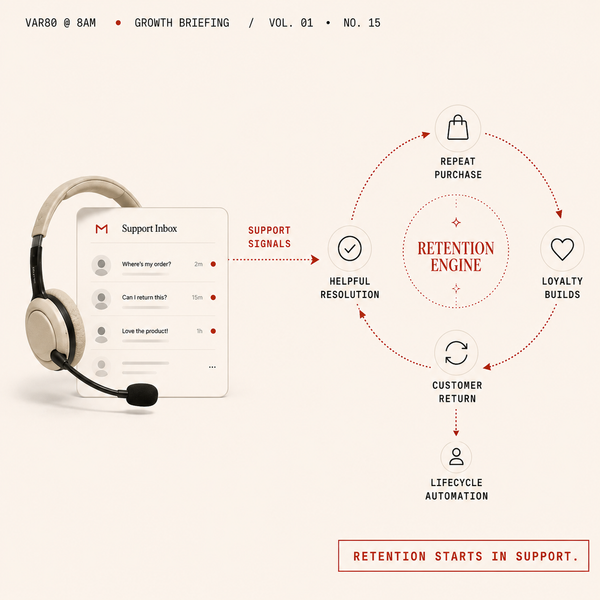
When ads generate events that do not surface in the CRM, marketing pays to relearn customer objections and behavior that support and order systems already know. The practical solution is not a perfect identity graph delivered in six months. It is low-latency activation: ship ad events, order events, and support tags into the CRM fast enough that they immediately change a segment, a lifecycle flow, or a paid audience.
Shopify merchants commonly route orders and support events into Klaviyo to trigger differentiated lifecycle journeys; that pattern converts support-derived signals into activation that meaningfully alters audience composition and downstream spend (Shopify). Zendesk documentation and integrations show how helpdesk systems can surface order-level data into CRM or analytics stacks so support signals do not remain siloed (Zendesk). Practical implementations often favor a hybrid: accept imperfect stitching but prioritize the connectors that create segments in near real time.
Low-Latency Activation Beats Perfect Stitching
There is an engineering trade-off between perfect identity graphs and activation speed. For many retention and reactivation flows, a near-real-time connector that attaches recent purchase and support tags to profiles provides outsized value compared with waiting for an exhaustive identity reconciliation. Conversions recovered via server-to-server pipelines such as Meta’s Conversions API demonstrate that first‑party event flows improve match rates and measurable conversions without waiting for a complete identity overhaul (Meta Conversions API). Vendors and implementation guides claim meaningful improvements in measured purchase events after adding server events, which supports the operational point: faster activation yields faster optimization.
Make the CRM the Source of Truth for Buyer-Type Reports
Once ad and commerce events flow into the CRM, the CRM should become the canonical place to answer "who bought." Build buyer-type reports inside the CRM that list new, returning, and resurrected buyers by channel. Make those reports the signals that feed bidding and creative briefs. When the CRM drives activation, you stop optimizing for ledgered vanity and begin optimizing for durable buyer creation.
Customer Intelligence Is the Signal Layer That Turns Media Into Growth
Customer intelligence is the layer that translates stitched profiles into activation signals. A customer intelligence engine that predicts LTV and assigns buyer-type at event time enables bidding that optimizes for predicted lifetime value instead of only conversion probability. Amperity’s messaging about identity and downstream LTV changes underlines this: reassembled profiles materially altered their view of high-value customers and changed where marketing should be spent (Amperity).
Use Unified LTV Signals to Reweight Bids, Not Vanity Metrics
Bid models that favor predicted buyer value change portfolio outcomes. Rather than bidding only on conversion likelihood, feed predicted LTV into your bidding logic so the system prefers fewer conversions that are worth more. Implementing this requires a path to export LTV signals from a customer intelligence layer into ad platforms, or at minimum into audience tags that ad platforms use. Several vendors and implementation guides now document patterns for exporting first-party signals to ad platforms; combine that with server-side conversion flows to close the loop and the result is measurably different allocation behavior than ROAS-first optimization.
Reports Should Answer Questions, Not Just Surface Columns
Analytics should be built to answer the question "who bought" directly. Reports that still focus on columns of channel revenue and ROAS will perpetuate the ledger problem. Instead, design reports that show the mix of new, resurrected, and returning buyers by channel, the CAC per buyer-type, and the realized LTV over a multi-month window. When reports answer the operator question, they force different choices about creative, offer, and budget allocation.
Most Teams Ask the Wrong Question. They Optimize Channels Instead of Buyer Creation
Teams routinely optimize channels because dashboards make channels visible and buyer creation invisible. That failure mode is not a data problem. It is a questions problem. The events are usually available, but they are trapped in separate systems. When analytics asks "which channel earned the revenue" instead of "which channel created the buyer and what type was the buyer," optimization becomes an exercise in defending channels rather than building the business.
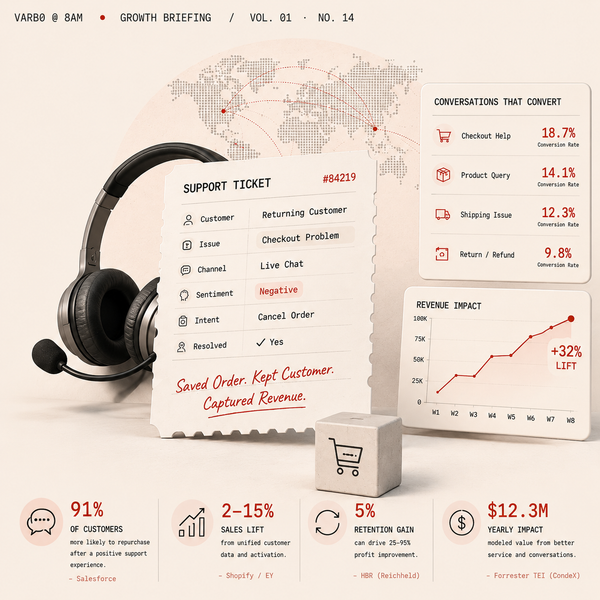
Support systems often contain the most direct evidence of buyer intent and friction. Marketing pays ad platforms to rediscover objections customers have already explained to support. Turning support signals into lifecycle triggers and paid audiences closes that loop and makes the signals actionable. Vendors document integrations and patterns to enable that flow; Zendesk and Gorgias integrations into commerce stacks are examples of this operational pattern (Zendesk).
Stop Reporting Channel ROAS — Report Buyer Creation Mixes
Dashboards should surface buyer-creation mixes by channel: the share of new, resurrected, and returning buyers each channel creates. That change does not require new data; it requires identity stitching and a decision to treat the CRM as the canonical report source. When teams switch their reporting lens, media allocation changes. Channels that produce cheap, low-LTV buyers shrink. Channels that bring valuable new buyers expand.
The failure mode is not data, it's the questions you ask of it.
Most analytics teams have the raw events they need. The real gap is the framing: asking whether revenue was produced instead of whether a valuable buyer was created. Fix the question and the answers follow. The operational mandate is straightforward: build low-latency ad→CRM connectors, tag buyer-type at event time, and re-run stratified incrementality tests using CRM-labeled cohorts.
The Strategic Reframe: Stop Measuring Revenue by Channel, Measure Buyer Creation by Type, and Make Your CRM the Answer Key
The uncomfortable truth is this: better measurement is an engineering and workflow problem, not merely a dashboard request. ROAS will continue to be useful as a ledger. It will never substitute for identity-backed measurement that proves whether ads actually created buyers who matter.
This quarter, ship one tangible operational change: implement an ad‑to‑CRM connector that surfaces buyer‑type at the moment of order. Use a pragmatic mix of server events (for improved match quality) and identity stitching tools to annotate purchases as new, returning, or resurrected. Then build a buyer‑type report in the CRM and re-run a stratified incrementality test that uses these labels to define strata. That single change will expose whether current ad spend is creating durable buyers or simply moving owned revenue into paid channels.
Do not treat this as a long-term data science project. You do not need a perfect identity graph to start; you need a low-latency signal that changes segments and feeds bids. Platform documentation shows practical steps: Meta’s Conversions API improves event match by accepting hashed first‑party identifiers and hybrid pixel+CAPI setups (Meta Conversions API). Twilio Segment and similar tools document deterministic identity stitching patterns you can adopt to avoid mis merged profiles (Twilio Segment). Klaviyo’s benchmarks prove that lifecycle flows outperform one-off sends and that CRM activity is where revenue permanence appears (Klaviyo). Amperity’s diagnostics show how common profile fragmentation is and how repairing it changes the counts of high-value buyers (Amperity).
Change one thing this quarter: make the CRM the answer key. Ship the connector. Tag buyer-type. Re-run incrementality with stratified holdouts. The ledger will still exist, and it will be easier to stop mistaking accounting for causation.
The dashboard is not the system. The CRM is the proof.
Your Ad Account Shows Conversions. Var80 Shows Buyers.
Var80 connects ad performance with customer, order, CRM, and repeat-purchase data so e-commerce brands can see which campaigns bring valuable buyers, not just cheap conversions.


Leave a comment